

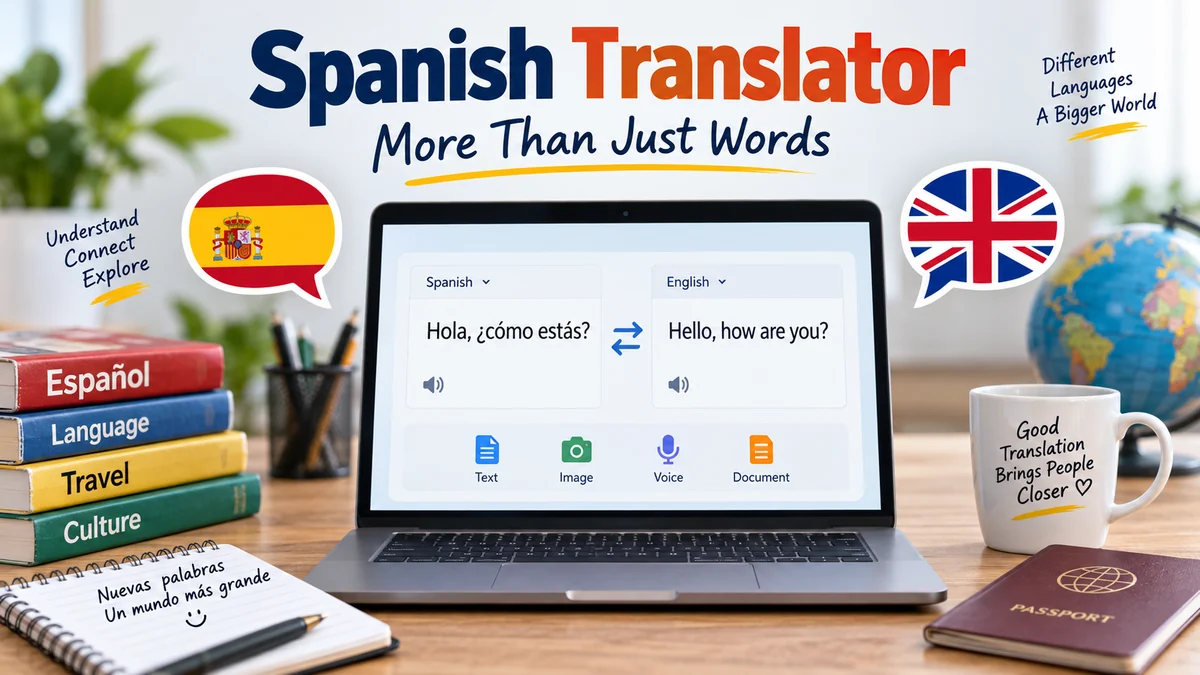
A spanish translator can turn a word into English in seconds, but accurate translation involves much more than swapping vocabulary. Spanish changes with context, grammar, region, tone, and even the relationship between speakers, so the first translation you see is not always the one you should use.
A spanish translator converts Spanish words, phrases, sentences, documents, speech, or images into another language and can also translate into Spanish. Modern tools such as Google Translate, DeepL, SpanishDictionary.com, Cambridge Dictionary, and Collins combine machine translation, dictionaries, pronunciation, examples, and language data to help users understand meaning more accurately.
Spanish matters far beyond Spain. Instituto Cervantes reported that the worldwide Spanish-speaking community exceeded 630 million potential speakers in 2025, including more than 500 million people with native proficiency. That scale explains why Spanish translation is useful for travel, education, work, websites, healthcare communication, media, and everyday conversations.
What Does a Spanish Translator Actually Do?
The term translator can mean either a person who translates written language or a digital translation tool.
A human Spanish translator reads the source text, determines what the writer actually means, and recreates that meaning naturally in the target language. That process may involve grammar, terminology, cultural references, register, regional vocabulary, and subject knowledge.
An online Spanish translation tool performs a similar task automatically. Depending on the service, you may be able to translate:
- Individual words
- Phrases and full sentences
- Long passages
- Emails
- Website text
- Documents
- Images containing text
- Spoken Spanish
- Conversations
- Signs and menus
Google Translate, for example, currently provides text, image, document, and website translation interfaces, while SpanishDictionary.com combines translation with dictionary entries, conjugations, vocabulary, grammar, pronunciation, and regional usage.
Spanish translator vs. interpreter
These terms are often mixed up.
A translator traditionally works with written language. An interpreter handles spoken or signed communication in real time or shortly after a person speaks.
Modern apps blur the distinction because many can translate both typed text and speech. Still, when discussing professional language services, translation and interpreting remain different skills.
English to Spanish Translator: Why Context Changes the Answer
One reason English-to-Spanish translation can be difficult is that a single English word may have several Spanish equivalents.
Take the word “right.”
Depending on the sentence, it might relate to:
- derecho — a right or entitlement
- correcto — correct
- derecha — the right-hand side
Typing one isolated word into a translator removes the context needed to choose between those meanings.
The same problem appears with common verbs.
“Get” might refer to obtaining something, becoming something, arriving somewhere, understanding something, or receiving something. Spanish normally expresses those meanings with different verbs.
Translate complete phrases when possible
Instead of translating:
bank
translate:
I need to go to the bank to withdraw money.
The full sentence tells the translator that bank means a financial institution rather than the bank of a river.
This simple habit significantly improves machine translation results.
Watch formal and informal “you”
English normally uses you regardless of formality.
Spanish distinguishes between forms such as:
- tú
- usted
- vos
- vosotros
- ustedes
The appropriate choice depends on location, relationship, number of people, and level of formality.
A translation can therefore be grammatically correct while still sounding socially inappropriate.
Spanish to English Translator: Getting the Meaning, Not Just the Words
Spanish-to-English translation brings a different set of problems.
Spanish frequently leaves out subject pronouns because verb endings already indicate who is performing the action.
For example:
Estoy cansado.
A literal word-by-word approach may appear incomplete because Spanish does not need yo. Natural English requires:
I am tired.
Good translation reconstructs the intended English sentence rather than mechanically copying Spanish grammar.
Gender affects Spanish grammar
Spanish nouns, adjectives, articles, and some pronouns contain grammatical gender distinctions that English often does not express in the same way.
Even the Spanish noun for a professional translator can appear as traductor or traductora, depending on the person being described. Collins records these masculine and feminine forms in its English-Spanish dictionary.
Automatic translators may therefore need additional context to determine the intended gender or produce appropriate alternatives.
Google Translate, for example, can display gender-specific alternatives for some translations when its system detects that more than one interpretation is possible.
How to Use a Spanish Translator More Accurately
For everyday translation, the best process is surprisingly simple.
1. Enter enough context
Translate a complete sentence instead of an isolated word whenever meaning is ambiguous.
Instead of:
charge
use:
The hotel charged my credit card twice.
More context gives the translation system information about the grammatical role and intended meaning.
2. Check the translation in reverse
After translating English into Spanish, copy the Spanish output and translate it back into English.
This is called back-translation.
It does not prove that a translation is correct, but it can reveal obvious problems, missing details, or sentences whose meaning has shifted.
3. Check important words in a dictionary
Machine translation is useful for producing a complete sentence. A bilingual dictionary is often better for investigating one important word.
SpanishDictionary.com provides translations alongside examples, pronunciation, conjugation, phrases, and regional information. Cambridge also links translated words to dictionary entries, while Collins combines its translation interface with dictionary material and common Spanish expressions.
4. Look at several example sentences
Never assume the first dictionary definition fits your sentence.
Real examples reveal:
- Which prepositions are normally used
- Whether a word is formal or informal
- Which verbs commonly appear with it
- Whether it refers to a person or object
- Whether it sounds natural in the intended context
5. Verify regional vocabulary
Spanish is not identical everywhere.
A perfectly understandable word in Spain may be uncommon in Mexico. A common expression in Argentina may sound unusual in Colombia.
SpanishDictionary.com specifically highlights regional translations, including differences among Spanish-speaking countries.
For content aimed at a particular audience, tell your translator which variety you need.
Google Translate vs. DeepL vs. SpanishDictionary.com
There is no single translation tool that is ideal for every situation.
| Tool | Particularly useful for | Useful features |
|---|---|---|
| Google Translate | General everyday translation | Text, images, documents, websites and language detection |
| DeepL | Contextual text and document translation | Text, files, language varieties and writing-oriented translation |
| SpanishDictionary.com | Spanish learners and vocabulary checking | Translation, dictionary, conjugation, pronunciation, grammar and regional usage |
| Cambridge Dictionary | Short translations and vocabulary research | Translator connected to dictionary entries |
| Collins | Vocabulary, examples and quick translation | Dictionary definitions, examples and common phrases |
Google Translate supports several forms of input, including documents such as DOCX, PDF, PPTX, and XLSX through its web interface.
DeepL supports Spanish as both a source and target language and distinguishes European Spanish and Latin American Spanish as target varieties in supported configurations. Its Latin American option aims for a broadly neutral regional style rather than one specific national dialect.
SpanishDictionary.com takes a more language-learning-focused approach by combining translation with conjugation, pronunciation, vocabulary, grammar, examples, and regional translations.
Quick takeaway: Use a machine translator for speed, a dictionary for uncertain vocabulary, examples for context, and a qualified human translator when mistakes could have serious consequences.
Why Spanish Translation Is Not Always Word for Word
Literal translation is one of the most common mistakes language learners make.
Consider:
Tengo 20 años.
Word by word, this resembles:
I have 20 years.
Natural English says:
I am 20 years old.
The Spanish sentence is correct because Spanish expresses age using tener (“to have”), while English normally uses to be.
Idioms create an even bigger challenge.
Idioms need meaning-based translation
Expressions frequently make little sense when translated literally.
A translator has to determine the communicative meaning first and then find an equivalent expression in the target language.
This is why context-aware translation is more useful than simply replacing each Spanish word with an English dictionary equivalent.
Word order can change
English and Spanish follow many similar sentence patterns, but adjective placement, pronouns, questions, emphasis, and object structures can differ.
For example, Spanish often places descriptive adjectives after nouns:
una casa blanca
Natural English reverses the order:
a white house
Translation software therefore has to understand syntax as well as vocabulary.
Spanish Pronunciation, Accents, and Special Characters
Written Spanish uses several characters that affect meaning and pronunciation:
á, é, í, ó, ú, ü, ñ
It also uses opening punctuation marks:
¿ ?
¡ !
Accent marks should not be treated as decoration.
Compare:
si — if
sí — yes
Or:
el — the
él — he
Removing written accents can change meaning or make otherwise polished Spanish look incorrect.
What does ñ mean?
The letter ñ is a separate letter in Spanish, not simply an n with optional decoration.
For example:
año means year.
Changing the spelling can produce a completely different word.
A good spanish translator should preserve Spanish diacritics automatically, but users copying text between systems should still check that the characters remain intact.
Regional Spanish: Spain, Mexico, Argentina, and Beyond
One of the biggest weaknesses of simplistic translation is the assumption that there is only one form of Spanish.
Spanish is spoken across a large international community. Instituto Cervantes estimated more than 519 million native-proficiency speakers worldwide in its 2025 demographic figures, with large populations in Mexico, Colombia, Spain, Argentina, Peru, the United States, and many other territories.
Vocabulary therefore varies considerably.
A familiar example is the word for car:
- coche is common in Spain
- carro is common in many Latin American contexts
- auto or automóvil may also be used
Computer terminology, clothing, food, transportation, education, slang, and everyday verbs can all vary by country.
Which Spanish variety should you translate into?
Use the variety your audience expects.
For a traveler visiting Madrid, European Spanish may make sense.
For material intended for Mexico, Mexican terminology is often preferable.
For content serving readers across Latin America, neutral international Spanish can reduce highly local vocabulary.
There is no universal “best” variety. Audience determines the right choice.
Can a Spanish Translator Handle Voice and Images?
Yes. Many modern translation apps can work with more than typed text.
Voice translation
Speech translation can help during:
- Travel
- Informal conversations
- Language practice
- Restaurant visits
- Asking directions
- Basic customer interactions
Accuracy may decline when speakers talk quickly, use slang, speak over background noise, or have strong regional accents.
Camera and image translation
Image translation can be especially useful for:
- Street signs
- Menus
- Labels
- Posters
- Instructions
- Printed notices
Some Spanish-English translator apps combine text, speech, and image recognition in the same interface.
Treat camera translation as an aid rather than unquestionable truth. Poor lighting, decorative fonts, handwriting, abbreviations, or damaged text can cause recognition errors before translation even begins.
When Should You Use a Human Spanish Translator?
Automatic translation is excellent for many low-risk tasks.
It is usually reasonable for understanding:
- Casual messages
- Social posts
- Travel information
- Basic emails
- Product descriptions
- Simple instructions
- Vocabulary
- General website content you only need to understand
Human review becomes much more valuable when exact wording matters.
Examples include:
- Legal documents
- Immigration records
- Medical information
- Contracts
- Academic records
- Financial documents
- Published marketing campaigns
- Technical instructions
- Sensitive business communications
Official organizations may impose their own translation and certification requirements, so users dealing with legal, immigration, court, educational, or government documents should always check the receiving authority’s current rules rather than assuming that an online translation will be accepted.
Machine translation and human translation can work together
The choice does not always have to be one or the other.
A practical workflow is:
- Use machine translation to understand the source.
- Identify ambiguous terminology.
- Check important words in dictionaries and examples.
- Have a proficient speaker or professional translator review high-impact content.
- Perform a final check against the original before publishing or submitting anything.
This keeps the speed advantage of translation technology while adding human judgment where it matters.
Common Spanish Translator Mistakes
Even sophisticated tools can produce sentences that look convincing while missing the intended meaning.
Translating isolated words
Single words frequently have multiple meanings.
Fix: Provide the full sentence.
Ignoring regional differences
Vocabulary may be correct but inappropriate for the target country.
Fix: Specify Spain, Mexico, Argentina, Latin America, or another intended audience when regional language matters.
Trusting idioms literally
Idiomatic language rarely survives direct word replacement.
Fix: Translate the underlying meaning.
Ignoring formality
Choosing tú where usted is expected can change tone.
Fix: Decide who is speaking to whom before translating.
Forgetting gender and agreement
Spanish adjectives and articles often need to agree with nouns.
Fix: Review the complete sentence rather than checking vocabulary individually.
Ignoring accents
Missing accent marks can create errors or change meaning.
Fix: Preserve Spanish spelling, including ñ and accented vowels.
Using machine translation for official documents without checking requirements
A translation that communicates the general meaning may still fail an institution’s formal rules.
Fix: Check the requirements of the organization receiving the document.
Can You Learn Spanish With a Translator?
Yes, provided you use translation as a learning aid rather than an answer machine.
A productive routine is to write your own Spanish sentence first, then compare it with a translation tool.
Ask:
- Did I choose the correct verb?
- Did I use the right tense?
- Does the adjective agree with the noun?
- Would a native speaker phrase this differently?
- Is there a regional alternative?
- Why did the translator use ser instead of estar?
- Why does the verb use the subjunctive?
SpanishDictionary.com is particularly useful for this style of learning because translation sits alongside conjugation, pronunciation, grammar, vocabulary, examples, and learning material.
There is also a large audience learning the language: Instituto Cervantes estimated about 24.6 million Spanish learners worldwide in 2025.
A translator can therefore become more than a shortcut. Used carefully, it becomes a tool for noticing patterns.
How to Check Whether a Spanish Translation Is Correct
Before relying on important translated text, perform a simple quality check.
- Read the source again. Identify the exact intended meaning.
- Check names and numbers. Dates, addresses, measurements, currencies, and names should remain accurate.
- Inspect key vocabulary. Verify ambiguous terms in a reputable dictionary.
- Check verb tense. Make sure past, present, future, commands, and hypothetical meanings remain intact.
- Review pronouns and formality. Confirm tú, usted, vos, vosotros, or ustedes fits the audience.
- Check regional vocabulary. Make sure the wording fits the intended country.
- Read the translation naturally. A grammatically possible sentence may still sound awkward.
- Back-translate uncertain passages. Look for meaning that disappeared or changed.
- Get human review for high-risk material. Do not rely solely on automated output when accuracy has legal, medical, financial, or professional consequences.
For one casual sentence, this process may take seconds. For a document, it can prevent much larger mistakes.
What Makes a Good Spanish Translator?
The best translator is not necessarily the one that produces the fastest answer.
A useful spanish translator should preserve the meaning, tone, grammar, context, and intended audience of the original.
For everyday translation, modern tools can handle an impressive amount of work. Google Translate provides broad multimodal translation, DeepL offers contextual text and file translation with Spanish variety options, while SpanishDictionary.com, Cambridge, and Collins add dictionary and learning context that can help users investigate uncertain wording.
The key is knowing when to trust automation and when to verify it.
Use full sentences rather than isolated words. Check regional vocabulary. Preserve accents. Compare dictionary examples when something looks unusual. For important material, add human review.
That approach turns a spanish translator from a simple word converter into a much more reliable way to understand and communicate across languages.
