

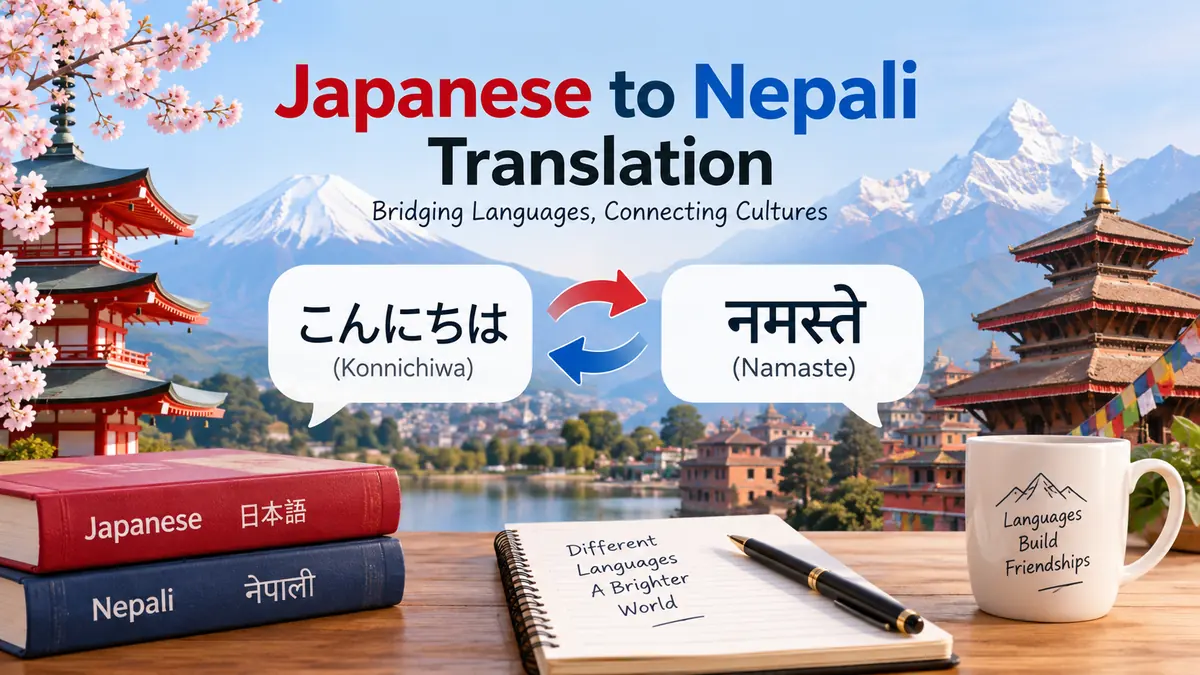
Japanese and Nepali can express the same idea in surprisingly different ways. A sentence that looks simple in Japanese may need reordered words, added pronouns, or a different level of politeness to sound natural in Nepali.
japanese to nepali translation means converting Japanese words, sentences, conversations, or documents into natural Nepali while preserving their meaning, context, tone, and level of formality. Accurate translation involves more than replacing individual words because Japanese and Nepali use different writing systems, grammar patterns, honorifics, vocabulary, and cultural conventions.
That distinction matters. A machine-generated sentence can be grammatically understandable yet still sound unnatural to a native Nepali speaker.
This guide explains how the translation process works, why certain Japanese expressions are difficult to translate, how Japanese and Nepali grammar compare, and how to check translations for everyday communication, study, travel, work, and documents.
How japanese to nepali translation Works
At its simplest, translation takes information expressed in Japanese and communicates the same information in Nepali.
The actual process is more complicated because languages encode meaning differently.
Consider:
Japanese: ありがとうございます。
Romanization: Arigatō gozaimasu.
Nepali: धन्यवाद।
Meaning: Thank you.
This example transfers easily. Longer sentences often require restructuring.
A good translation process normally involves five steps:
- Read the complete Japanese sentence.
- Identify its intended meaning and context.
- Determine omitted subjects or objects where necessary.
- Reconstruct the sentence according to Nepali grammar.
- Review the result for natural wording, tone, and accuracy.
Translating word by word often fails because grammatical relationships do not always correspond directly.
Why context matters
Japanese frequently leaves information unstated when listeners can infer it from the conversation.
For example:
行きます。
Ikimasu.
Depending on context, this could communicate:
- I will go.
- I am going.
- He or she will go.
- We will go.
A translator therefore needs context before deciding on the most appropriate Nepali subject.
This is one of the main reasons a single Japanese expression can produce several valid Nepali translations.
Japanese and Nepali Writing Systems Are Very Different
One of the first challenges in Japanese to Nepali language conversion is script.
Japanese normally combines three writing systems:
- Hiragana
- Katakana
- Kanji
Latin letters, or rōmaji, are also used in some contexts.
Nepali is primarily written using Devanagari.
| Language | Main writing system | Example |
|---|---|---|
| Japanese | Kanji, Hiragana, Katakana | 日本語 |
| Nepali | Devanagari | नेपाली |
| Japanese romanization | Latin alphabet | Nihongo |
| Nepali romanization | Latin alphabet | Nepali |
Hiragana
Hiragana represents native grammatical elements and many Japanese words.
Examples include:
こんにちは — Konnichiwa — Hello
ありがとう — Arigatō — Thank you
Katakana
Katakana is commonly associated with foreign loanwords, names, technical terms, and emphasis.
For example:
ホテル — hoteru — hotel
The appropriate Nepali rendering might be होटल, depending on context.
Kanji
Kanji characters often carry lexical meaning, and their pronunciation can change according to the word in which they appear.
For example:
日本 means Japan and is normally read Nihon or Nippon.
Kanji creates an extra challenge for translation software because identifying a character is not enough. The system must understand the word and sentence containing it.
Devanagari in Nepali
Nepali uses Devanagari, the same broad script family used for Hindi, although Nepali is a separate language with its own vocabulary, grammar, pronunciation, and usage.
For example:
म जापान जान्छु।
This means roughly:
I go/will go to Japan.
A Japanese equivalent could be:
私は日本に行きます。
Watashi wa Nihon ni ikimasu.
Notice that translation requires both script conversion and grammatical interpretation.
Quick Takeaway: Transliteration changes how something is written or pronounced. Translation changes its meaning into another language. They are related processes, but they are not the same thing.
Japanese to Nepali Grammar: What Changes During Translation?
Japanese and Nepali actually share some useful structural similarities.
Both frequently follow a subject-object-verb (SOV) pattern. This can make certain sentences easier to translate than language pairs with radically different basic word order.
Consider:
Japanese: 私は水を飲みます。
Romanized: Watashi wa mizu o nomimasu.
Nepali: म पानी पिउँछु।
English: I drink water.
The verb appears toward the end in both Japanese and Nepali.
That does not make their grammar interchangeable, however.
Japanese particles need interpretation
Japanese uses particles to show the grammatical role of words.
Common examples include:
- は (wa) — topic marker
- が (ga) — subject/focus marker
- を (o) — object marker
- に (ni) — direction, destination, time, or indirect object
- で (de) — location of an action or means
- の (no) — possession or relationship
Nepali expresses these relationships through its own postpositions and grammatical structures.
For example:
学校に行きます。
Gakkō ni ikimasu.
Natural Nepali:
विद्यालय जान्छु।
The Japanese particle に should not simply be assigned one Nepali word in every sentence. Its translation depends on its grammatical function.
Subjects are frequently omitted
Japanese is strongly context-dependent.
Instead of repeatedly saying 私 (watashi) for “I,” a speaker can omit the pronoun once the subject is understood.
Nepali can also omit information in suitable contexts, but a translator must decide whether retaining that omission remains clear.
For example:
食べました。
Tabemashita.
This literally provides the idea of “ate” in polite past form without explicitly stating who ate.
Possible Nepali translations depend on context:
मैले खाएँ। — I ate.
उसले खायो। — He/she ate.
Automatically assuming a subject can change the meaning.
Tense and aspect require attention
Japanese verbs distinguish forms that communicate past events, ongoing situations, negation, politeness, requests, and other meanings.
Examples:
食べます — eat/will eat
食べました — ate
食べません — do not/will not eat
食べています — is eating / has been eating, depending on context
The translator needs to select a Nepali construction that represents the intended time and aspect rather than mechanically copying the Japanese form.
Japanese Politeness and Honorifics Need Special Care
One of the biggest challenges in japanese to nepali translation is preserving social tone.
Japanese contains extensive systems of politeness and honorific language, commonly discussed through the concept of keigo.
Japanese speech may vary according to:
- age
- social position
- workplace hierarchy
- familiarity
- customer-service situations
- respect toward the listener
- respect toward the person being discussed
Nepali also distinguishes levels of respect.
Pronoun choice provides an obvious example. Depending on relationship and context, Nepali may use forms such as तँ, तिमी, or तपाईं, which communicate substantially different degrees of familiarity or respect.
A translation that preserves literal meaning but chooses the wrong level of respect can sound rude or socially inappropriate.
Formal Japanese should not become casual Nepali
Suppose a Japanese business message uses highly polite language.
The Nepali version should normally maintain professional respect rather than reducing the sentence to its shortest dictionary meaning.
This matters particularly for:
- business emails
- workplace instructions
- official correspondence
- customer communication
- university communication
- interviews
- government documents
What actually works: translate the relationship between speakers, not merely the dictionary definitions of their words.
Common Japanese to Nepali Words and Phrases
Basic phrases are useful for understanding how meanings move between the two languages.
| Japanese | Romanization | Nepali | English meaning |
|---|---|---|---|
| こんにちは | Konnichiwa | नमस्ते | Hello |
| ありがとう | Arigatō | धन्यवाद | Thank you |
| ありがとうございます | Arigatō gozaimasu | धन्यवाद | Thank you (polite) |
| はい | Hai | हो / हजुर | Yes |
| いいえ | Iie | होइन | No |
| おはようございます | Ohayō gozaimasu | शुभ प्रभात | Good morning |
| おやすみなさい | Oyasuminasai | शुभ रात्री | Good night |
| すみません | Sumimasen | माफ गर्नुहोस् | Excuse me / Sorry |
| ごめんなさい | Gomennasai | माफ गर्नुहोस् | I’m sorry |
| 水 | Mizu | पानी | Water |
| 食べ物 | Tabemono | खाना | Food |
| 学校 | Gakkō | विद्यालय | School |
| 友達 | Tomodachi | साथी | Friend |
| 家族 | Kazoku | परिवार | Family |
| 日本 | Nihon | जापान | Japan |
| ネパール | Nepāru | नेपाल | Nepal |
These are useful equivalents rather than universal substitutions.
Take すみません (sumimasen). Depending on the situation, it can function as “excuse me,” “sorry,” or even a polite way of attracting someone’s attention.
The best Nepali wording therefore changes with context.
japanese to nepali translation for Complete Sentences
Sentence translation reveals why context is more important than isolated vocabulary.
Example 1: Introducing yourself
Japanese: 私の名前はラメシュです。
Romanization: Watashi no namae wa Rameshu desu.
Nepali: मेरो नाम रमेश हो।
English: My name is Ramesh.
The Japanese grammatical structure does not need to be reproduced literally. The Nepali sentence follows the natural Nepali way of introducing a name.
Example 2: Going to Japan
Japanese: 私は日本に行きます。
Romanization: Watashi wa Nihon ni ikimasu.
Nepali: म जापान जान्छु।
English: I am going to Japan / I will go to Japan.
Context determines the most precise English interpretation, while Nepali can express the intended statement naturally.
Example 3: Asking for help
Japanese: 手伝ってください。
Romanization: Tetsudatte kudasai.
Nepali: कृपया मद्दत गर्नुहोस्।
English: Please help me.
Here ください (kudasai) contributes to the polite request. The Nepali translation should preserve that politeness.
Example 4: Asking where a station is
Japanese: 駅はどこですか。
Romanization: Eki wa doko desu ka.
Nepali: स्टेशन कहाँ छ?
English: Where is the station?
A traveler needs the communicative meaning, not a word-for-word reconstruction.
How to Translate Japanese to Nepali Accurately
Online translation has made basic language conversion much faster, but getting a reliable result still requires a good workflow.
1. Start with the original Japanese text
Whenever possible, use the actual Japanese characters rather than an uncertain romanized transcription.
For example, a Kanji expression can provide information that may disappear when converted to rōmaji.
2. Translate complete sentences
Avoid breaking a sentence into individual words unless you are studying vocabulary.
Translation systems perform better when they can analyze surrounding context.
Instead of separately translating:
私 / は / 学生 / です
translate:
私は学生です。
The complete sentence tells the system how the pieces relate to one another.
3. Check the subject
Ask:
Who is performing the action?
Japanese may not tell you explicitly.
Look at surrounding sentences before adding म, तपाईं, उहाँ, or another Nepali pronoun.
4. Check formality
Determine who is speaking to whom.
A conversation between close friends should not necessarily sound like government correspondence. Likewise, respectful Japanese should not be converted into overly casual Nepali.
5. Read the Nepali as an independent sentence
Forget the Japanese wording temporarily.
Ask whether a native Nepali speaker would naturally construct the sentence that way.
This catches many literal-translation problems.
6. Back-check important passages
For an important message, compare the Nepali result against the Japanese source sentence by sentence.
Back translation can reveal missing information, but it should be treated as a checking technique rather than proof of accuracy. Two machine translations can reproduce the same underlying error.
7. Use human review when mistakes have consequences
Machine translation is useful for understanding everyday material. It should not automatically be treated as an authoritative translation for high-stakes documents.
Professional review is sensible for:
- contracts
- immigration documents
- certificates
- legal records
- medical information
- employment agreements
- academic transcripts
- safety instructions
The cost of mistranslating one term can be much greater than the convenience gained from instant translation.
Online Japanese to Nepali Translators and Machine Translation
Modern translation systems generally use machine-learning approaches that analyze sentences as contextual units rather than translating every word independently.
Services such as Google Translate and Lingvanex provide multilingual translation capabilities. Lingvanex’s current document tools also support formats including DOC, DOCX, PDF, CSV, PPTX, XLSX, XLS, RTF, and TXT, although capabilities and limits vary by format and service.
Machine translation is particularly convenient for:
- individual words
- short messages
- straightforward sentences
- basic travel communication
- getting the gist of webpages
- informal conversations
- first-pass document translation
It becomes less dependable when language contains ambiguity, implied subjects, specialized terminology, cultural references, humor, or sophisticated honorifics.
Can a Japanese to Nepali translator be 100% accurate?
No translation system should be assumed to deliver 100% accuracy in every context.
Consider the Japanese word:
先生 (sensei)
It may refer to a teacher, instructor, doctor, or another respected professional depending on the setting.
The correct Nepali term depends on whom the speaker is describing.
Machine translation can identify likely meanings, but contextual judgment remains essential.
Quick Takeaway: Use automatic translation for speed and comprehension. Use contextual checking or a qualified human translator when exact wording matters.
Translating Japanese Documents into Nepali
Document translation introduces challenges beyond ordinary text.
A document can contain:
- headings
- tables
- captions
- dates
- names
- addresses
- technical terminology
- footnotes
- signatures
- numbers
- formatting
- text embedded in images
Some document translators can process formats such as PDF, DOCX, PPTX, TXT, and spreadsheets while attempting to retain the original layout. Lingvanex, for example, currently distinguishes digitally created/searchable PDFs from image-only scanned PDFs in its document translation workflow.
Scanned PDFs require another step
A scanned Japanese document may contain no machine-readable text at all.
In that situation, the workflow becomes:
- Extract Japanese characters using optical character recognition (OCR).
- Check the recognized Japanese text for errors.
- Translate it into Nepali.
- Review names, dates, numbers, and terminology.
- Reconstruct the required document formatting.
OCR mistakes can become translation mistakes.
A poorly recognized Kanji character, for example, can change the source word before translation even begins.
Names should be handled carefully
Personal and place names often require transliteration, not semantic translation.
A Japanese person’s name generally should not be replaced with a Nepali word that happens to resemble the Kanji’s literal meaning.
Official documents are especially sensitive because the spelling may need to correspond with a passport, residence card, certificate, or another identity document.
Transliteration vs. Translation
This distinction causes a great deal of confusion.
Translation transfers meaning.
Transliteration represents the pronunciation of a word using another writing system.
For example:
東京
Translation as a place name:
Tokyo
A Nepali-script rendering is:
टोकियो
The goal is to represent the name rather than translate the individual Kanji meanings.
Similarly:
カトマンズ (Katomanzu) refers to Kathmandu.
In Nepali:
काठमाडौं
A translator needs to recognize established place names instead of mechanically converting their Japanese pronunciation.
Japanese Pronunciation and Romanization
Rōmaji can be useful when a reader cannot yet read Japanese scripts.
Examples:
日本語 — Nihongo — Japanese language
ありがとう — Arigatō — Thank you
おはよう — Ohayō — Good morning
However, romanization is not a replacement for Japanese text when accuracy matters.
Long vowels, doubled consonants, particles, and names can become ambiguous when users type informal Roman letters.
For language learning, a useful progression is:
Japanese script → pronunciation → Nepali meaning
rather than relying permanently on:
Romanized Japanese → Nepali
This helps learners connect the original Japanese word with its actual written form.
Why Literal Japanese to Nepali Translation Often Sounds Wrong
Literal translation is tempting because it feels precise. In practice, precision comes from preserving meaning rather than preserving word order.
Idioms
Japanese idioms may make little sense when translated component by component.
The translator needs to identify the intended idea and find an appropriate Nepali expression or explain the meaning plainly.
Cultural expressions
Some Japanese expressions have no neat one-word Nepali equivalent.
いただきます (itadakimasu) is a classic example. It is commonly said before eating, but reducing it to a literal dictionary translation loses its cultural function.
Depending on the purpose of the translation, the best solution may be an explanatory Nepali phrase rather than a forced equivalent.
Context-dependent words
Japanese vocabulary can be highly context-sensitive.
大丈夫 (daijōbu) can communicate ideas such as:
- I’m okay.
- It’s okay.
- No, thank you.
- No problem.
- Are you okay?
The surrounding conversation determines the meaning.
A translation tool that selects the wrong interpretation may produce a perfectly grammatical Nepali sentence that communicates the wrong message.
Common Mistakes to Avoid
Several problems appear repeatedly when translating between Japanese and Nepali.
Translating isolated words: A dictionary meaning may not match the sentence meaning.
Ignoring omitted pronouns: Adding the wrong person can completely alter a statement.
Treating particles as fixed words: は, が, に, で, and を perform grammatical functions that change with context.
Ignoring politeness: Japanese honorific language carries social information that should be reflected appropriately in Nepali.
Confusing transliteration with translation: Names and places often need phonetic representation rather than semantic conversion.
Trusting OCR without checking it: Scanned documents can introduce errors before translation begins.
Assuming fluent-looking output is correct: A sentence can sound natural while containing a mistranslated name, date, number, negative, or technical term.
For important material, always compare these high-risk elements directly with the Japanese source.
Japanese to Nepali Translation for Language Learners
Translation can be a powerful learning tool when it is used to analyze language rather than simply obtain an answer.
Suppose you encounter:
今日は忙しいです。
Kyō wa isogashii desu.
आज व्यस्त छु।
“Today I am busy.”
Break it down:
今日 (kyō) = today
は (wa) = topic marker
忙しい (isogashii) = busy
です (desu) = polite copular/politeness element
This shows something important: the natural Nepali sentence does not need a visible one-to-one equivalent for every Japanese element.
A better study method
For each new sentence, record:
| Japanese | Reading | Nepali meaning | Grammar note |
|---|---|---|---|
| 日本語 | Nihongo | जापानी भाषा | noun |
| 食べる | Taberu | खानु | verb |
| 大きい | Ōkii | ठूलो | adjective |
| 先生 | Sensei | शिक्षक/गुरु | context-dependent noun |
Then study the word inside a complete sentence.
This method builds vocabulary while also teaching sentence structure.
Japanese to Nepali Translation for Travel and Daily Life
For travelers, perfect literary translation is rarely the priority. Clear communication is.
Useful topics include transportation, accommodation, food, shopping, emergencies, and directions.
For example:
トイレはどこですか。
Toire wa doko desu ka.
शौचालय कहाँ छ?
Where is the toilet?
これはいくらですか。
Kore wa ikura desu ka.
यो कति हो?
How much is this?
助けてください。
Tasukete kudasai.
कृपया मद्दत गर्नुहोस्।
Please help me.
For travel phrases, saving both the Japanese text and pronunciation is useful. If speaking becomes difficult, the Japanese text can be shown directly to another person.
How to Check Whether a Translation Is Good
You do not need to be a professional linguist to perform a basic quality check.
Ask five questions:
- Meaning: Does the Nepali sentence communicate the same information?
- Grammar: Is the Nepali grammatically sound?
- Naturalness: Would a Nepali speaker actually phrase it this way?
- Tone: Is the level of politeness appropriate?
- Details: Are names, numbers, dates, places, and technical terms correct?
For longer documents, consistency becomes a sixth requirement.
If 会社 (kaisha) is translated using one term for “company” on page one and an unrelated term later, the document can become confusing even when individual sentences are understandable.
A terminology list is useful for technical, academic, and professional translations.
Is Direct Japanese to Nepali Better Than Translating Through English?
Direct translation is generally preferable when a reliable Japanese-to-Nepali system or translator is available.
Using English as an intermediate language creates two opportunities for meaning to drift:
Japanese → English → Nepali
For example, an ambiguous Japanese expression might be interpreted one way during the English step. The Nepali translator then receives that interpretation rather than the original Japanese ambiguity.
However, English can still be useful as a checking language when the reader understands it well.
For difficult material, compare:
Original Japanese → Nepali
with:
Original Japanese → English explanation
If the meanings disagree, inspect the Japanese source again instead of assuming either automatic result is correct.
What Makes Japanese to Nepali Translation Accurate?
Accuracy comes from combining linguistic meaning with context.
The strongest translation preserves:
- factual meaning
- speaker intention
- grammatical relationships
- politeness
- names and terminology
- cultural context
- natural Nepali expression
The weakest approach simply replaces Japanese words with Nepali dictionary entries.
For everyday messages, modern translation tools can provide a useful starting point. For learning, compare the Japanese script, pronunciation, grammar, and Nepali meaning rather than memorizing machine output blindly. For official, legal, medical, academic, or other high-stakes material, have the final translation reviewed by someone competent in both languages.
Ultimately, effective japanese to nepali translation is not about making every Japanese word visible in Nepali. It is about making the original message understandable to a Nepali reader without changing what the Japanese speaker or writer intended.
