

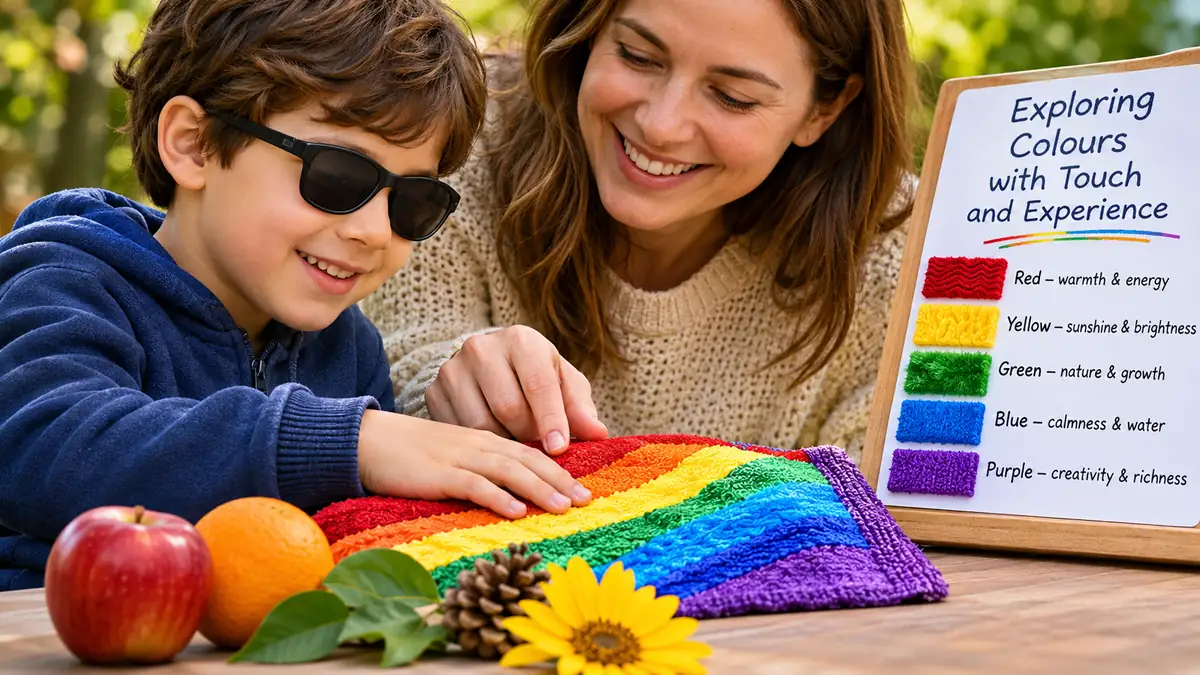
Your son may not be able to see colours, but that doesn’t mean colours have to remain meaningless to him. They are part of everyday language, nature, stories, clothing, food, and the way people describe the world.
If you’re wondering how to explain colours to a blind child, begin with experiences he already understands. Warmth, texture, sound, smell, emotion, and familiar objects can help him build meaningful associations with colour words. The goal isn’t to make him experience vision through another sense, but to help him understand what colours represent and how people use them.
My son can’t see. how do i explain colours to him?There is no single perfect explanation. What matters most is your son’s age, interests, visual experience, and the questions he asks.
Understanding How a Blind Child Experiences Colours
Before teaching colours, it helps to understand how your son experiences the world.
Blindness exists on a spectrum. Some children have no light perception, while others can detect brightness, shapes, movement, or certain colours. A child who lost sight after previously seeing may also have visual memories that help him understand colour descriptions.
A child who has been totally blind since birth does not have the same visual reference points as a sighted child. Describing red as looking like a strawberry may not explain its visual appearance if he has never seen a strawberry.
However, he can still learn that strawberries are commonly red, leaves are often green, and the sky is usually described as blue.
This is an important distinction: understanding what a colour means is not necessarily the same as experiencing how that colour looks.
My son can’t see. how do i explain colours to him?
Yes. A person born blind can develop substantial knowledge about colours, including their names, relationships, common associations, and social meanings.
For example, your son may learn that:
- Red is commonly associated with fire, stop signs, and warnings.
- Blue is associated with clear skies, water, and calmness.
- Green is associated with grass, leaves, and growing plants.
- Yellow is associated with sunshine, bananas, and caution signs.
These associations provide useful information, even when the visual experience itself remains inaccessible.
Research on conceptual knowledge in people who are congenitally blind also shows that visual experience is not required to learn many relationships between colours and objects.
How to Explain Colours Through Touch, Temperature, and Sound
One of the most accessible approaches is to connect colour words with familiar sensory experiences.
These connections are metaphors, not literal equivalents. A warm object is not necessarily red, and something blue does not inherently feel cold.
Flames rising from an orange hot camp fire
Red — Warmth and energy
Let your son safely feel warmth from sunlight or a warm mug. Explain that red is often used to represent heat, excitement, urgency, and strong feelings.
Blue — Calmness and coolness
Let him touch cool water or listen to gentle waves. Explain that blue is commonly associated with the sky, water, and peaceful surroundings.
Close-Up of Green Grass with Dew Drops in Macro
Green — Nature and growth
Explore soft grass, fresh leaves, and plants together. Describe green as a colour commonly found in living plants and associated with growth.
Yellow — Sunshine and brightness
Feel the gentle warmth of morning sunshine together. Explain that yellow is often used to represent brightness, cheerfulness, and sunlight.
These examples make colour vocabulary more memorable because they connect unfamiliar visual concepts to experiences your child can explore independently.
Use More Than One Sensory Association
Avoid teaching every colour through only one sensation.
For example, if red always means hot, your son may assume that every red object is warm.
Instead, explain that a red apple may feel cool, a red sweater may feel soft, and a red traffic light communicates a rule.
All three can be red even though they have different textures, temperatures, and purposes.
This teaches a deeper lesson: colour is a visual property that cannot reliably be determined through touch, sound, smell, or temperature alone.
Explaining Individual Colours to Your Son
You can use short, conversational explanations that match your child’s age and curiosity.
| Colour | Simple explanation |
|---|---|
| Red | A colour often used for fire, ripe strawberries, love, and warning signs |
| Orange | A colour commonly found in oranges, carrots, and autumn leaves |
| Yellow | The colour of many sunflowers, lemons, and school buses |
| Green | A colour often found in grass, leaves, and growing plants |
| Blue | A colour commonly associated with clear skies and large bodies of water |
| Purple | A colour associated with some flowers, grapes, and royal traditions |
| Pink | A colour often found in certain flowers and associated with affection |
| Brown | A common colour of soil, tree bark, and chocolate |
| Black | The colour associated with the absence of visible light |
| White | A colour associated with snow, clouds, and objects that reflect visible light broadly |
Remember that objects can have different colours. Apples can be red, green, or yellow, and flowers can appear in many shades.
How Do You Explain Black and White to Someone Who Cannot See?
Black and white can be especially difficult to describe because they relate closely to light.
You might explain:
“Black is what sighted people call the appearance of a surface that reflects very little visible light. White is what they call the appearance of a surface that reflects many wavelengths of visible light.”
For a younger child, simplify the explanation:
“Black and white are two very different ways things can look. People use black to describe things like charcoal and white to describe things like snow.”
Avoid telling a child who has never seen that black is simply what he sees. Complete blindness does not necessarily mean experiencing a continuous black visual field.
Fun Activities to Teach Colours to a Blind Child
Learning becomes easier when colour vocabulary is part of enjoyable everyday activities.
1. Explore Fruits and Vegetables
Collect familiar foods such as apples, bananas, carrots, cucumbers, and oranges.
Let your son identify each food through its shape, texture, smell, and, when appropriate, taste.
Then explain its common colour.
For example:
“This banana has a yellow peel. When bananas are unripe, their peels are often green. As they ripen, they usually become yellow.”
This introduces the idea that colour can communicate information about an object’s condition.
2. Create a Colour-and-Texture Collection
Toucher carrés – Hop’Toys | Achetez sur Everykid.com
Find the Match Fabric Sensory Squares Pack of 20
12
Create a collection of objects with different textures and assign colour labels to them.
You might use smooth fabric for blue, fuzzy fabric for green, or textured paper for yellow.
Explain clearly that these are memory aids, not the actual feeling of each colour.
If your son reads Braille, add Braille labels. Otherwise, use tactile symbols or recorded audio labels.
Over time, he can build a personal colour vocabulary through repeated exploration.
3. Use Music and Sound
Music can provide another way to explore colour associations.
For example, you might associate:
- Red with energetic drumming.
- Blue with slow, gentle music.
- Yellow with cheerful melodies.
- Green with birdsong and rustling leaves.
Ask your son what feelings the sounds create.
His associations may differ from yours, and that is perfectly reasonable. There is no universal sound that represents a particular colour.
4. Describe Colours During Daily Routines
Colour education doesn’t require a formal lesson.
When helping your child get dressed, you could say:
“Your shirt is blue today, and your trousers are grey.”
When preparing dinner:
“We’re having green broccoli and orange carrots.”
When walking outside:
“The leaves on this tree are mostly green, but some are turning yellow and brown.”
These small conversations help colour words become familiar and useful.
5. Make a Personal Colour Story
Invite your son to create a story using colour words.
For example:
“A little bird lived in a green forest. Every morning, the yellow sun warmed the trees. One day, the bird discovered a bright red flower.”
Ask him what the bird might hear, smell, or touch.
The purpose isn’t to test whether he remembers the correct colour. It’s to help him connect descriptive language with an imaginative, multisensory world.
Teaching the Science of Colour in Simple Language
As your son grows older, he may become curious about what colours actually are.
You can introduce the science without requiring him to see.
What Makes Something Red, Blue, or Green?
Light is a form of electromagnetic radiation. The part human eyes can detect is called the visible spectrum.
Different wavelengths of visible light are associated with different colour experiences.
For example:
- Violet light generally has shorter wavelengths, around 380–450 nanometres.
- Blue light occupies roughly 450–495 nanometres.
- Green light occupies roughly 495–570 nanometres.
- Yellow light occupies roughly 570–590 nanometres.
- Orange light occupies roughly 590–620 nanometres.
- Red light occupies roughly 620–750 nanometres.
These ranges are approximate, and perceived colour depends on more than wavelength alone.
When light reaches the eyes, specialised cells called cones respond to different parts of the visible spectrum. The brain interprets signals from these cells to produce colour perception.
You could explain:
“Colours are different ways our eyes and brains interpret light. Just as your ears can distinguish different sounds, sighted people’s eyes can distinguish different kinds of light.”
The analogy helps explain the idea of sensory differences without suggesting that sound and colour are identical.
Can Sound Help Explain the Colour Spectrum?
Sound and light both involve waves, but they are physically different.
Sound usually travels through a material such as air, while light is electromagnetic radiation.
A musical note has a frequency, and light also has a frequency. However, light frequencies are enormously higher than audible sound frequencies.
You can use music to introduce the idea that different frequencies produce different sensory experiences, while explaining that colours themselves are not musical notes.
How to Explain Rainbows to a Blind Child
A rainbow is a wonderful opportunity to combine science, storytelling, and sensory learning.
Explain that sunlight contains light of many wavelengths. When sunlight enters and leaves water droplets, it bends, reflects internally, and separates into different colours.
The familiar rainbow sequence is red, orange, yellow, green, blue, indigo, and violet.
A simple explanation might be:
“A rainbow is a curved band of colours that people can sometimes see in the sky when sunlight interacts with tiny drops of water. The colours appear next to each other in a particular order.”
Make a Tactile Rainbow
Use a curved piece of cardboard and divide it into seven raised bands.
Give each band a different texture and label it with Braille or tactile symbols.
Guide your son’s hands along the bands while naming the colours in sequence.
This helps him understand the rainbow’s shape, arrangement, and order. Explain that the textures are representations rather than physical properties of the colours.
You can also describe how a rainbow forms an arc across the sky and why it often appears when the sun shines while rain is falling.
How Colour Knowledge Helps Blind Children in Everyday Life
Learning colour names isn’t simply about understanding sighted people’s descriptions.
It can help your son participate in conversations, understand stories, make personal choices, and recognise information communicated through colour.
Clothing and Personal Style
Your son may enjoy choosing clothes based on their texture, comfort, design, or colour descriptions.
Tell him which colours are available and explain how people commonly combine them.
For instance:
“This shirt is dark blue, and these trousers are light grey. Some people like wearing these colours together.”
Let him develop his own preferences.
A blind child can have favourite colours based on their associations, memories, meanings, or personal experiences.
Safety Signs and Public Information
Colours often carry practical meanings.
Red frequently indicates stopping or danger. Yellow may indicate caution, while green often communicates permission or safety.
However, these meanings depend on context and local conventions.
Teach your son the meaning of colour-coded information, but never rely on colour alone for safety. Accessible pedestrian signals, tactile markings, orientation and mobility skills, and appropriate assistance are more dependable.
Stories, Art, and Imagination
Books frequently describe colourful landscapes, clothing, animals, and buildings.
Instead of skipping these descriptions, explain them naturally.
For example, if a story describes a golden sunset, you might explain that golden refers to a warm yellow-orange appearance often associated with the setting sun.
You can also invite your son to make art using clay, textured materials, raised outlines, and labelled colours.
Artistic expression doesn’t require sight.
Common Mistakes Parents Should Avoid
Even thoughtful explanations can become confusing if they unintentionally present metaphors as facts.
Saying That a Colour Is a Feeling
Describing blue as peaceful or red as angry can be useful for storytelling.
But colours do not have fixed emotions.
Red can represent love, danger, celebration, or happiness depending on culture and context. Blue may represent calmness in one situation and sadness in another.
Explain that these are associations people make, not properties of the colours themselves.
Assuming Your Child Cannot Understand Visual Concepts
A child who cannot see may still understand complex ideas about appearance, colour, distance, and visual relationships through language and reasoning.
A 2021 study published in Proceedings of the National Academy of Sciences found that adults born blind and sighted adults shared sophisticated knowledge about how colours relate to objects. PubMed Central (PMC)+1
This suggests that conversation can teach more than memorised colour labels.
Avoiding Visual Words Entirely
You don’t need to remove words such as “look,” “see,” “bright,” or “colourful” from ordinary conversation.
Many blind people use these words naturally.
For example, saying “Let’s see what happens next” is an ordinary expression that doesn’t require literal vision.
Follow your child’s preferences, but don’t assume visual vocabulary is automatically inappropriate.
Turning Every Conversation Into a Lesson
Colour learning should not become a constant test.
If your son is enjoying a story, playing a game, or exploring outdoors, you don’t need to interrupt repeatedly to ask him to name colours.
Offer explanations when they’re useful and allow curiosity to guide the conversation.
Supporting Your Son’s Learning as He Grows
The best approach changes with age, language development, and visual abilities.
| Developmental stage | Helpful approach |
|---|---|
| Early childhood | Familiar objects, simple descriptions, sensory play, and repetition |
| Primary school years | Colour vocabulary, tactile diagrams, object comparisons, and stories |
| Older children | Light, wavelengths, colour mixing, symbolism, and scientific explanations |
| Teenagers | Personal style, art, cultural meanings, accessibility technology, and independent choices |
These are flexible suggestions rather than fixed developmental milestones.
Work With a Teacher of Students With Visual Impairments
A Teacher of Students with Visual Impairments (TVI) can help adapt lessons to your son’s needs.
Depending on his abilities, instruction might involve tactile graphics, Braille, auditory descriptions, large-print materials, or accessible technology.
Perkins School for the Blind provides resources on concept development for children with visual impairments, emphasising meaningful instruction and accessible experiences. Perkins School for the Blind+1
If your son has usable vision, an appropriate eye-care professional and educational team can help determine which visual materials, contrasts, and lighting conditions support his learning.
Can Technology Identify Colours for Blind People?
Yes. Some accessible smartphone applications and electronic devices can use cameras to identify and announce colours.
These tools may help with clothing, household objects, and everyday exploration.
However, colour identification can be inaccurate because of lighting, shadows, camera quality, and reflective surfaces.
Technology should support your son’s independence rather than replace direct learning or reliable safety information.
What Research Tells Us About Colour Understanding Without Sight
Scientific research provides encouraging evidence that people can develop sophisticated colour knowledge without direct visual experience.
A 2018 study published in Visual Cognition compared how congenitally blind, later-blind, and sighted adults understood relationships between colour terms. The researchers found broadly similar patterns in how participants organised colours. DOI+1
Research published in 2021 also showed that people born blind can reason about why certain objects tend to have particular colours and how consistently those colours occur.
For instance, people can understand that two bananas are more likely to share a colour than two randomly selected cars, even without seeing either object. PubMed Central (PMC)+1
A qualitative study published in 2025 found that blind participants could develop colour preferences and associations involving objects, emotions, and cultural meanings. The study was small, so its findings should not be treated as universal, but they illustrate the diversity of nonvisual colour understanding. PubMed
Together, these findings support a valuable principle: colour knowledge can develop through language, experience, relationships, and reasoning, even when visual perception is unavailable.
What to Say When Your Son Asks What a Colour Looks Like
Sometimes your son may ask a question that has no complete nonvisual equivalent.
“What does blue actually look like?”
Rather than inventing an exact sensory comparison, you can acknowledge the limitation while giving him meaningful information.
You might say:
“Blue is a particular way light looks to people who can see it. I can’t give you exactly that visual experience through words, just as describing a sound isn’t the same as hearing it. But I can tell you where blue appears, what people associate with it, and how it differs from other colours.”
This answer is truthful without discouraging curiosity.
If he asks whether he’ll ever know exactly what a colour looks like, the answer depends on his individual vision and medical circumstances. You don’t need to make promises or assumptions.
You can focus instead on the many ways he can understand, describe, and enjoy the world.
Final Thoughts: Helping Your Son Understand Colours
If you’ve been asking yourself, “my son can’t see. how do i explain colours to him?”, remember that teaching colours doesn’t require recreating sight.
Begin with everyday objects, meaningful conversations, tactile experiences, and simple scientific explanations. Use warmth, sounds, textures, and emotions as helpful comparisons while making clear that these sensations are not literally colours.
Most importantly, let your son decide which explanations are interesting and useful to him.
He doesn’t need to experience the world exactly as a sighted person does to develop rich knowledge about it. With accessible learning opportunities and open conversation, colours can become a meaningful part of his language, imagination, and understanding of the world.
