

A large, fast-moving spider racing across your floor can be startling, especially when you don’t know whether it’s dangerous. Often, the unexpected visitor is a wolf spider—a skilled hunter that spends much of its life on the ground rather than waiting in a web.
Despite their intimidating appearance, wolf spiders are generally not aggressive toward humans. They also play a useful ecological role by feeding on insects and other small invertebrates.
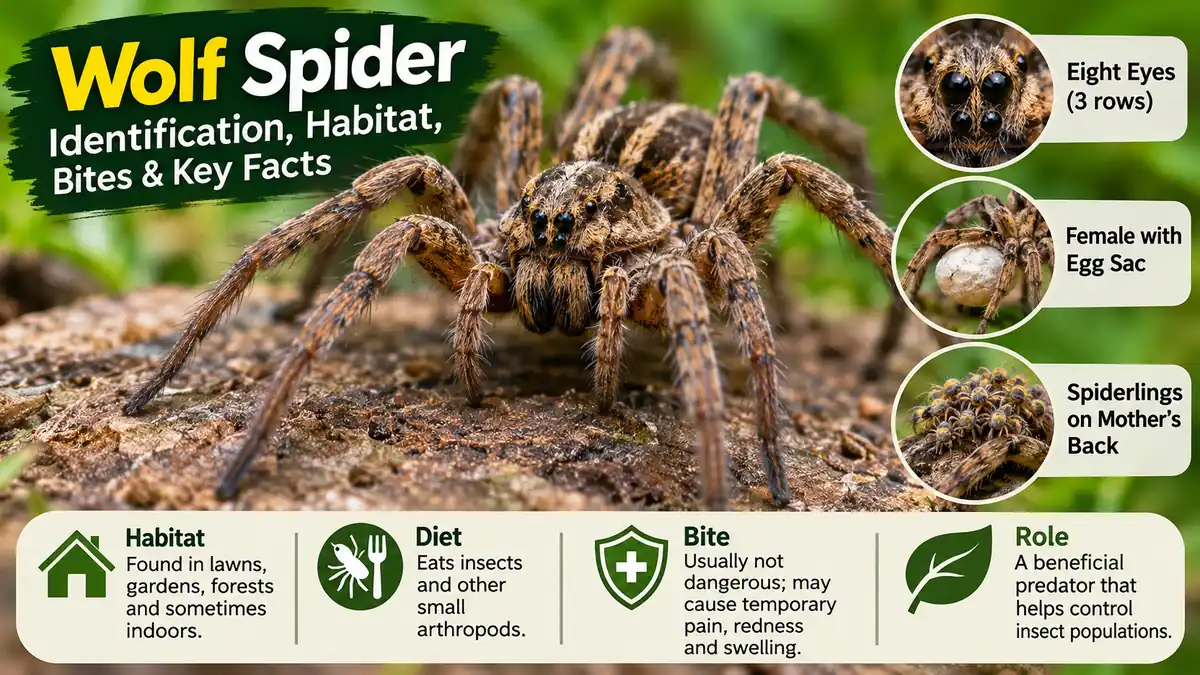
A wolf spider is a hunting spider belonging to the family Lycosidae. It typically has a brown or gray, camouflaged body, eight eyes arranged in three rows, and strong legs adapted for running. Wolf spiders capture prey without using a typical prey-catching web. Their bites are usually not medically significant, although they can cause temporary pain, redness, and swelling.
Understanding how these spiders look, behave, and reproduce makes it easier to identify them accurately and respond appropriately when one appears indoors.
What Is a Wolf Spider?
Wolf spiders belong to the family Lycosidae, a diverse group of spiders found across much of the world.
The family name comes from the Greek word lykos, meaning wolf. Early observers associated these spiders with active hunting, although wolf spiders do not hunt in coordinated packs like wolves.
Unlike orb-weaving spiders, which construct circular webs to capture flying insects, wolf spiders generally pursue prey or ambush it from concealed positions.
They are members of the order Araneae, which includes all true spiders, and the class Arachnida, which also includes scorpions, ticks, and mites.
Scientific Classification
| Classification | Name |
|---|---|
| Kingdom | Animalia |
| Phylum | Arthropoda |
| Class | Arachnida |
| Order | Araneae |
| Family | Lycosidae |
| Common name | Wolf spider |
The family includes numerous genera, including Hogna, Pardosa, Rabidosa, Schizocosa, and Lycosa.
Species vary considerably in size, coloration, habitat, and hunting behavior. As a result, not every wolf spider looks exactly like the large, brown spiders commonly pictured in identification guides.
How to Identify a wolf spider
Wolf spiders are recognizable through a combination of body shape, coloration, eye arrangement, and movement.
However, several unrelated spiders share similar characteristics, so color or size alone is not sufficient for reliable identification.
Body Size and Appearance
Most wolf spiders have compact, relatively robust bodies covered in fine hairs.
Their coloration usually includes combinations of:
- Brown
- Gray
- Tan
- Black
- Cream or pale yellow markings
These earthy colors help them blend into soil, rocks, fallen leaves, and vegetation.
Body length varies widely among species. Many are approximately 5–20 millimeters long, excluding the legs, while some larger species exceed 30 millimeters.
The legs can make the spider appear substantially larger than its body measurements suggest.
Some species display longitudinal stripes across the cephalothorax, the fused head-and-thorax region. Others have mottled markings or contrasting patterns on the abdomen.
The Distinctive Eight-Eye Arrangement
One of the most useful identification features is the arrangement of the spider’s eight eyes.
Wolf spiders generally have three eye rows:
- Four small eyes in a lower row.
- Two noticeably large eyes in the middle row.
- Two medium-sized eyes positioned farther back on the head.
The prominent middle eyes provide a recognizable facial appearance when viewed closely.
Their eyes also reflect light, producing visible eyeshine when illuminated at night.
Naturalists sometimes use a flashlight or headlamp to locate wolf spiders in grassy areas after dark.
However, eye arrangement is best examined using a clear photograph rather than attempting to handle an unfamiliar spider.
How Fast Can Wolf Spiders Move?
Wolf spiders can move rapidly over short distances, particularly when pursuing prey or escaping a perceived threat.
Their speed varies according to species, body size, temperature, and terrain. There is no single scientifically established running speed that applies to every wolf spider.
Their sudden movements are one reason people sometimes mistake them for more dangerous spiders.
Speed alone, however, does not indicate that a spider is aggressive or venomous enough to pose a serious threat.
wolf spider vs. Other Common Spiders
Wolf spiders are frequently confused with grass spiders, fishing spiders, huntsman spiders, and brown recluse spiders.
Recognizing the differences can help prevent unnecessary alarm.
| Feature | Wolf spider | Grass spider | Brown recluse |
|---|---|---|---|
| Family | Lycosidae | Agelenidae | Sicariidae |
| Typical appearance | Robust, often hairy | Slender, frequently striped | More uniformly tan or brown |
| Eyes | Eight in three rows | Eight in two rows | Six in three pairs |
| Hunting method | Active pursuit or ambush | Funnel-web hunting | Mostly nocturnal wandering |
| Typical web | No prey-catching web | Funnel-shaped sheet web | Irregular retreat web |
| Medical concern | Usually minor local effects | Generally minor | Can cause medically significant injury |
Wolf Spider vs. Grass Spider
Grass spiders, including members of the genus Agelenopsis, are common in lawns and gardens.
They often have elongated bodies, striped markings, and prominent spinnerets extending from the rear of the abdomen.
Their funnel-shaped webs are frequently visible in grass, shrubs, and near foundations.
Wolf spiders, by comparison, usually do not construct these broad funnel webs to capture prey.
The presence of a distinctive funnel web can therefore be a useful clue, although some wolf spiders also build silk-lined retreats or burrows.
Wolf Spider vs. Brown Recluse
The brown recluse, Loxosceles reclusa, is often confused with harmless brown spiders.
A brown recluse generally has six eyes arranged in three pairs, whereas a wolf spider has eight eyes arranged in three rows.
Brown recluse spiders also tend to have less conspicuous body hair and comparatively uniform coloration.
The violin-shaped marking sometimes associated with brown recluse identification is not reliable by itself.
A suspected brown recluse should be identified using multiple anatomical characteristics and geographic distribution rather than color alone.
Wolf Spider vs. Huntsman Spider
Huntsman spiders belong to the family Sparassidae.
They commonly have flattened bodies and legs extending sideways in a crab-like posture.
Wolf spiders usually have a more compact body shape and a different eye arrangement.
Both groups may move quickly, but their anatomy and preferred habitats can differ substantially.
Where Do Wolf Spiders Live?
Wolf spiders inhabit a remarkable variety of environments, from forests and grasslands to deserts, agricultural fields, wetlands, and suburban gardens.
They are found on every continent except Antarctica.
Their preferred habitat depends on the species, but most spend considerable time near ground level, where they can hunt and find shelter.
Common Outdoor Habitats
Wolf spiders frequently shelter in:
- Leaf litter and fallen vegetation
- Beneath stones, logs, and boards
- Grass and garden beds
- Mulch and compost areas
- Cracks in soil
- Woodpiles and sheltered foundations
Some species, including members of the genus Geolycosa, excavate burrows in the ground.
These burrows may have silk-lined walls that provide structural support and a protected retreat.
Other species wander through vegetation without maintaining a permanent burrow.
Wolf spiders can also occupy shorelines and moist habitats. Their distribution is influenced by temperature, moisture, vegetation, and prey availability. apps.extension.umn.edu+1
Why Are Wolf Spiders Found in Houses?
A wolf spider inside a home is usually a wandering individual rather than evidence of an established infestation.
Common entry points include gaps beneath doors, damaged window screens, foundation cracks, and openings around utility pipes.
Spiders may enter buildings while searching for prey, shelter, or suitable environmental conditions.
They are often encountered in:
- Basements
- Garages
- Laundry rooms
- Storage areas
- Ground-floor bathrooms
- Spaces near exterior doors
Seasonal changes can influence indoor sightings. In some regions, wolf spiders become more noticeable during autumn as temperatures decline.
However, the timing varies by species and local climate.
Finding one indoors does not necessarily mean that additional spiders are breeding inside the building.
What Do Wolf Spiders Eat?
Wolf spiders are carnivorous predators that primarily feed on insects and other small arthropods.
Their diet depends on the spider’s size, habitat, and available prey.
Common food sources include crickets, grasshoppers, beetles, flies, ants, cockroaches, and smaller spiders.
Larger individuals may occasionally capture other small animals, including tiny vertebrates, although insects and related invertebrates make up the typical diet.
How Wolf Spiders Hunt
Wolf spiders rely heavily on movement detection and vision to locate prey.
Their hunting process generally involves several stages:
- Detecting movement nearby.
- Approaching or waiting for the prey.
- Making a rapid attack.
- Grasping the prey with their legs and mouthparts.
- Injecting venom through their fangs.
- Consuming the prey after digestive enzymes begin breaking down its tissues.
Some species actively patrol their surroundings, while others wait near burrow entrances and ambush passing insects.
The Smithsonian Institution describes wolf spiders as solitary hunters that use their well-developed eyesight to locate prey, frequently at night. Smithsonian Institution+1
Do Wolf Spiders Make Webs?
Wolf spiders produce silk, but they generally do not build prey-catching webs like orb weavers or funnel weavers.
Instead, they use silk for purposes such as:
- Constructing egg sacs
- Lining burrows
- Creating protective retreats
- Producing draglines
- Supporting reproductive behavior
This distinction matters because the absence of a visible web does not mean a spider cannot produce silk.
A wolf spider found running across the floor is behaving normally for an active hunting species.
Are Wolf Spiders Dangerous to Humans?
Wolf spiders are venomous, but their venom is primarily adapted to immobilizing small prey.
For most healthy people, a confirmed wolf spider bite causes limited local symptoms rather than serious poisoning.
Wolf spiders generally prefer escaping over confronting a person.
Bites are most likely when a spider is trapped against the skin, squeezed, or handled.
What Does a Wolf Spider Bite Look Like?
A wolf spider bite may produce:
- Immediate localized pain
- Redness around the bite
- Mild swelling
- Tenderness
- Temporary itching or irritation
Symptoms often improve within a day, although recovery varies between individuals.
Penn State Extension reports that typical wolf spider bite reactions involve pain, redness, and sometimes localized swelling, without documented serious medical consequences in the species it discusses. Penn State Extension
However, a skin lesion cannot reliably be identified as a wolf spider bite based on appearance alone.
Many suspected spider bites turn out to have other causes, including skin infections or reactions to different arthropods.
What Should You Do After a Wolf Spider Bite?
For a suspected uncomplicated bite, basic first aid is usually appropriate.
- Wash the affected area gently with soap and water.
- Apply a cool compress wrapped in cloth for 10–15 minutes.
- Elevate the affected limb if swelling occurs.
- Avoid scratching or squeezing the area.
- Monitor for worsening symptoms.
An over-the-counter pain reliever may help when appropriate for the individual. Follow product instructions or seek advice from a pharmacist or clinician.
Seek urgent medical attention if the person develops breathing difficulties, swelling of the face or throat, faintness, or other signs of a severe allergic reaction.
Medical assessment is also appropriate if pain becomes severe, redness spreads, fever develops, or the wound appears infected.
If the spider was not positively identified, do not assume that the bite came from a wolf spider.
Can a Wolf Spider Bite Kill You?
A confirmed wolf spider bite is not generally considered life-threatening.
There is no established pattern of fatal human envenomation from wolf spiders comparable to the risks associated with certain medically significant spider groups.
Nevertheless, individual allergic reactions, secondary infections, and mistaken spider identification can create situations requiring medical care.
The safest approach is to evaluate the person’s symptoms rather than relying exclusively on the suspected species.
Are Wolf Spiders Dangerous to Dogs and Cats?
Wolf spiders are not generally regarded as a major envenomation threat to household pets.
A pet that disturbs or attempts to eat one may experience localized irritation if bitten.
However, symptoms such as repeated vomiting, marked swelling, weakness, breathing difficulties, or unusual behavior require veterinary advice.
Because other spiders may resemble wolf spiders, accurate identification is particularly important when an animal becomes ill after a suspected encounter.
Wolf Spider Reproduction and Life Cycle
One of the most distinctive features of wolf spiders is their maternal care.
Unlike many spider species that leave their eggs in stationary silk sacs, female wolf spiders carry their egg sacs attached to the spinnerets at the rear of the abdomen.
After hatching, the spiderlings climb onto their mother’s back and remain there temporarily.
This behavior is an important identification clue and one of the most recognizable characteristics of the family Lycosidae.
Mating and Courtship
Male wolf spiders locate potential mates using chemical and environmental cues.
Courtship may involve leg movements, vibrations, body postures, and signals transmitted through the ground or vegetation.
These displays help females recognize suitable mates.
In certain species, males produce complex vibrational signals using their legs, pedipalps, or other body structures.
Courtship behavior differs significantly between genera and species.
Egg Sac Formation
Following successful mating, a female produces eggs enclosed within a silk sac.
The sac is commonly rounded and may appear white, cream, gray, or tan.
The number of eggs varies according to species, female size, nutrition, and environmental conditions.
The female attaches the sac to her spinnerets and carries it as she moves.
This allows her to continue hunting while protecting the developing eggs.
Why Do Baby Wolf Spiders Ride on Their Mother’s Back?
When the spiderlings emerge, they climb onto the mother’s abdomen and remain clustered there until they are ready to disperse.
This behavior provides temporary protection during a vulnerable developmental stage.
The young may remain on her back for days or weeks, depending on the species and environmental conditions.
Unlike mammals, wolf spiders do not nurse their offspring. The spiderlings eventually leave and begin hunting independently.
The Missouri Department of Conservation identifies this combination of egg-sac carrying and spiderlings riding on the mother’s back as a distinctive characteristic of wolf spiders. Missouri Department of Conservation
How Long Do Wolf Spiders Live?
Wolf spider lifespan varies considerably.
Some species complete their life cycle in approximately one year, while others survive for multiple years.
Female spiders of certain larger species may live longer than males.
Temperature, prey availability, seasonal conditions, and predation all influence survival.
Growth occurs through molting, during which the spider sheds its external skeleton to accommodate its increasing body size.
Young spiders pass through several molts before reaching adulthood.
Common Types of Wolf Spiders
The family Lycosidae includes many species with different sizes, markings, and ecological adaptations.
Several North American examples are especially familiar.
Carolina Wolf Spider (Hogna carolinensis)
The Carolina wolf spider is among the larger wolf spiders found in North America.
It has a robust, hairy body and typically displays brown, gray, or dark markings.
This species often shelters in ground burrows and hunts insects at night.
Its size can make it appear threatening, but it is not normally aggressive toward people.
Rabid Wolf Spider (Rabidosa rabida)
Despite its alarming common name, the rabid wolf spider does not carry rabies.
The name refers to its rapid movements rather than any infectious disease.
This species often has a brown body with contrasting longitudinal stripes.
It occurs in grassy and vegetated habitats and may occasionally wander into buildings.
Thin-Legged Wolf Spiders (Pardosa)
Members of the genus Pardosa are generally smaller and more slender than many large Hogna species.
They are often active during daylight and can be found moving across soil, grass, rocks, and other open surfaces.
Some species occur in relatively cool environments, including high-latitude and mountainous habitats.
Brush-Legged Wolf Spiders (Schizocosa)
The genus Schizocosa is particularly interesting because of its courtship behavior.
In several species, males use visual displays and substrate-borne vibrations to communicate with females.
These spiders have been studied extensively in research on animal communication, mate choice, and sexual selection.
Tiger Wolf Spiders (Tigrosa)
Some Tigrosa species have bold body markings and relatively large bodies.
For example, Tigrosa aspersa has distinctive markings that help distinguish it from other wolf spiders.
The genus illustrates how identification often requires examining more than the spider’s overall brown coloration.
How to Get Rid of Wolf Spiders in Your House
Wolf spiders are beneficial outdoors, so removing individual spiders without killing them is often a practical option.
When they repeatedly enter a building, reducing entry points and suitable hiding places is generally more useful than relying only on insecticide applications.
Safely Remove a Wolf Spider
A simple container-and-card method can relocate a spider without direct handling.
- Place a transparent container over the spider.
- Carefully slide a stiff card beneath the opening.
- Keep the container and card together.
- Carry the spider outside.
- Release it in a sheltered location away from frequently used entrances.
Avoid touching the spider directly, especially if its identification is uncertain.
If a female is carrying spiderlings, gentle handling is particularly important because sudden disturbance may cause the young to scatter.
Prevent Wolf Spiders From Entering
Practical prevention focuses on exclusion and reducing attractive shelter.
| Prevention method | Why it helps |
|---|---|
| Seal cracks and gaps | Limits entry through foundations and walls |
| Install door sweeps | Blocks openings beneath exterior doors |
| Repair window screens | Reduces entry through windows |
| Remove indoor clutter | Eliminates sheltered hiding places |
| Move firewood away from walls | Reduces nearby spider habitat |
| Manage indoor insects | Reduces available prey |
| Adjust exterior lighting | May reduce insects gathering near entrances |
Utah State University Extension recommends measures such as sealing openings, reducing clutter, maintaining screens, and limiting insect prey around buildings. USU
Do Natural Repellents Work?
Peppermint oil, vinegar, citrus, and other household substances are sometimes promoted as spider repellents.
However, reliable evidence that these materials consistently prevent wolf spiders from entering homes is limited.
Essential oils may also irritate people or create risks for pets when used improperly.
Physical exclusion and habitat management offer a more dependable starting point.
Should You Use Pesticides?
Routine pesticide treatment is usually unnecessary for an occasional wolf spider sighting.
Broad insecticide applications may also affect beneficial insects and other non-target organisms.
If spiders are repeatedly entering a building in large numbers, investigate structural gaps, moisture problems, and nearby insect activity.
A qualified pest-management professional can help assess persistent problems and recommend targeted control measures where necessary.
Are Wolf Spiders Good for Gardens?
Wolf spiders are generally beneficial predators in gardens and natural ecosystems.
They help regulate populations of insects and other arthropods by consuming available prey.
Their ecological role is especially valuable in habitats where multiple predator species contribute to natural pest suppression.
Natural Pest Control
Wolf spiders may feed on insects associated with gardens and agricultural environments, including some beetles, grasshoppers, flies, and other small invertebrates.
They do not distinguish between insects humans consider pests and those considered beneficial.
Consequently, their contribution to pest control depends on the broader food web rather than a selective preference for harmful insects.
Their Role in the Food Chain
Wolf spiders are both predators and prey.
They are eaten by various animals, including birds, reptiles, amphibians, and certain predatory insects.
Spider-hunting wasps can capture and paralyze wolf spiders to provide food for their developing larvae.
This relationship illustrates their position within terrestrial food webs.
Wolf spiders help transfer energy from smaller arthropods to larger predators, supporting ecosystem functioning and biodiversity.
Should You Kill a Wolf Spider Outside?
There is generally no ecological or safety reason to kill an undisturbed wolf spider outdoors.
It is usually better to leave the spider alone, particularly when it is hunting in a garden or natural area.
If its location creates an immediate concern, gentle relocation may be appropriate.
Interesting Wolf Spider Facts
Wolf spiders have several characteristics that distinguish them from many other spider families.
Their Eyes Can Shine at Night
Wolf spider eyes contain reflective structures that improve visual sensitivity under low-light conditions.
When illuminated from the correct angle, their eyes may produce a noticeable reflection.
This phenomenon, called eyeshine, can make spiders easier to detect in grass after dark.
However, other animals also display eyeshine, so the reflection alone is not definitive identification.
They Can Detect Vibrations
Although wolf spiders are known for their eyesight, they also use sensory hairs and other structures to detect mechanical signals.
Vibrations can provide information about approaching prey, predators, and potential mates.
In some species, substrate vibrations are essential components of courtship communication.
Not All Wolf Spiders Hunt the Same Way
Some species actively wander in search of food.
Others remain near burrows and ambush passing insects.
Certain wolf spiders are primarily nocturnal, while others are frequently active during daylight.
These differences reflect the ecological diversity within the family.
Female Wolf Spiders Are Often Larger
In many species, adult females have larger bodies than males.
This difference, known as sexual size dimorphism, varies among species.
Male and female spiders may also differ in coloration, leg proportions, and reproductive structures.
Wolf Spiders Do Not Live in Packs
Despite their name, wolf spiders are generally solitary animals.
They do not organize coordinated hunting groups or maintain social packs.
Their name is associated with their predatory behavior, not a wolf-like social structure.
Some Species Are Adapted to Harsh Environments
Wolf spiders occur in habitats with substantial differences in temperature, humidity, and vegetation.
Species living in deserts may use burrows and sheltered areas to reduce exposure to extreme conditions.
Those inhabiting cooler environments may adjust their seasonal activity and developmental timing.
These adaptations contribute to the family’s broad geographic distribution.
Common Myths About Wolf Spiders
Misunderstandings about wolf spiders often arise from their size, speed, and resemblance to other spiders.
Myth: Wolf spiders chase people.
Wolf spiders do not deliberately pursue humans as prey. A spider running in someone’s direction is usually attempting to escape or reach shelter.
Myth: All large brown spiders are wolf spiders.
Several unrelated spider families include large, brown species. Eye arrangement, anatomy, habitat, and behavior are more useful identification features.
Myth: Wolf spiders are completely nonvenomous.
Wolf spiders possess venom used to subdue prey. The important distinction is that their venom is generally not medically significant to humans.
Myth: Wolf spiders never produce silk.
They produce silk for egg sacs, retreats, draglines, and other purposes, even though they do not normally use prey-catching webs.
Myth: Finding one wolf spider means there is an infestation.
An individual spider may simply have wandered indoors. A single sighting does not establish that a breeding population exists inside the home.
How to Identify a Wolf Spider With Confidence
Reliable identification requires considering several characteristics together.
Begin with the overall body shape and coloration, but avoid treating these as conclusive evidence.
Next, look for the distinctive arrangement of eight eyes, preferably using a close-up photograph.
Observe whether the spider is wandering on the ground, sheltering in a burrow, or associated with a prey-catching web.
If the spider is carrying a round egg sac attached to its spinnerets or numerous spiderlings on its back, those are especially strong identification clues.
Geographic location can also help narrow the possibilities because different wolf spider species occupy different regions.
For uncertain identifications, local university extension services, natural history museums, and qualified arachnologists can provide additional guidance.
The University of Minnesota Extension specifically highlights the eye arrangement and maternal egg-carrying behavior as useful identification characteristics. apps.extension.umn.edu
Final Thoughts on wolf spider Identification and Safety
A wolf spider may look intimidating, but its appearance is usually more alarming than its actual risk to people.
These spiders are active hunters with distinctive eyes, strong legs, effective camouflage, and unusual maternal behavior. They help control populations of insects and other small arthropods in gardens and natural habitats.
Although wolf spiders can bite when threatened or trapped, confirmed bites generally cause temporary local symptoms rather than serious medical problems.
The most practical response is to avoid unnecessary handling, identify the spider carefully, and relocate indoor visitors when appropriate.
Understanding the wolf spider’s behavior makes it easier to distinguish a beneficial predator from a genuine household hazard.
