

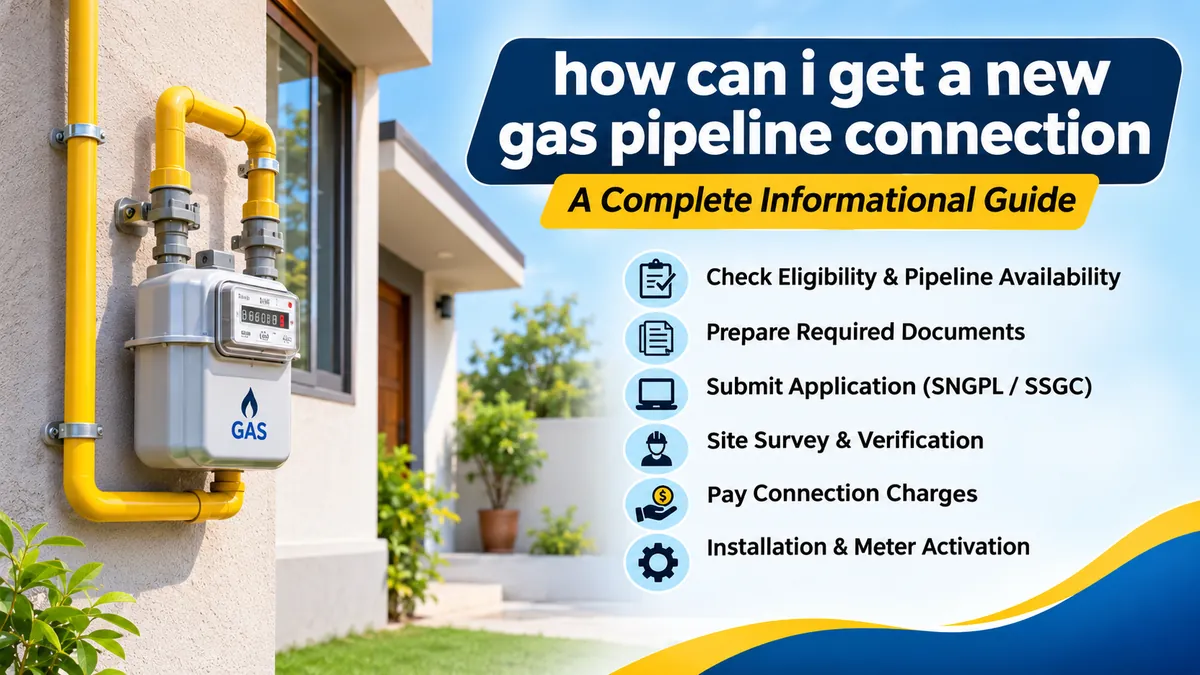
Getting a new gas pipeline connection for your home can seem complicated, especially when you are unsure which company to contact, what documents to prepare, or how much the installation will cost. The process becomes easier once you understand the eligibility requirements and the steps involved.
To get a new gas pipeline connection, identify your local gas distribution company, check whether its pipeline network serves your property, prepare identification and ownership documents, and submit an application. The provider will review your details, inspect the premises, confirm applicable charges, and arrange installation after approval.
In Pakistan, domestic gas connections are handled primarily by Sui Northern Gas Pipelines Limited (SNGPL) and Sui Southern Gas Company Limited (SSGC). Their current application procedures distinguish between conventional system gas and regasified liquefied natural gas (RLNG), which can affect your eligibility and monthly bills.
How can i get a new gas pipeline connection in Pakistan?
The application process depends on your location and the company responsible for distributing gas in your area.
Two major companies serve different regions:
| Gas company | Main service areas | Application method |
|---|---|---|
| SNGPL | Punjab, Khyber Pakhtunkhwa, Islamabad and designated service areas | Online domestic RLNG application |
| SSGC | Sindh and Balochistan | Application form and relevant sales office or Customer Facilitation Centre |
Both companies require applicants to provide accurate property information and confirm that an existing gas distribution pipeline serves their premises. sngpl.com.pk+1
Step 1: Identify your gas distribution company
Before applying, establish which utility supplies gas to your neighborhood.
For example, a homeowner in Lahore, Rawalpindi, Faisalabad, or Sargodha would generally contact SNGPL. Someone living in Karachi, Hyderabad, Quetta, or another SSGC service area would contact SSGC.
You can identify the provider by examining a neighboring property’s gas bill, checking the company’s official service information, or contacting its customer service department.
Step 2: Check pipeline availability near your property
Having a gas pipeline somewhere in your neighborhood does not automatically mean your house qualifies for a connection.
The distribution company must confirm that its existing network can serve your premises.
Check whether:
- An operational distribution pipeline runs in front of the property.
- The building is completed and occupied.
- The property falls within the utility’s authorized service area.
- The address is recognized by the relevant local authority.
- The property has no unresolved legal restrictions preventing gas supply.
SNGPL specifically states that applications can be rejected if the property is outside its gas network or the submitted details are incomplete. sngpl.com.pk
If there is no pipeline outside your property, ask the utility whether a network extension is possible. Such work is different from installing an individual service connection and may require separate technical approval.
Step 3: Gather the required documents
Preparing the documents before submitting an application can prevent unnecessary delays.
Typical requirements include:
| Document | Purpose |
|---|---|
| Valid CNIC | Verifies the applicant’s identity |
| Property ownership documents | Establishes the legal relationship with the premises |
| Complete property address | Identifies the installation location |
| Nearby gas consumer number | Helps locate the existing network |
| Active mobile number | Receives application updates |
| Approved building plan | Confirms property details where required |
| No Objection Certificate (NOC) | Provides required owner, society, or authority consent |
| Tenancy agreement | Supports applications submitted by tenants |
SSGC may also require an undertaking, approved completion documents, and an RLNG contract form. Requirements vary by applicant and property type. Sui Southern Gas Company Limited
Step 4: Submit your application
For SNGPL customers, the official online application facility is available at:SNGPL online domestic gas application
The form requests personal identification, the property address, nearby consumer details, and supporting documents.
For SSGC customers, the official application information is available at:SSGC new domestic RLNG connection application
SSGC instructs applicants to submit the completed form and supporting documents through the relevant sales office or Customer Facilitation Centre.
Always check the latest instructions before submitting, because online and in-person requirements may change.
Step 5: Wait for application verification and a site survey
Submitting the form does not guarantee approval.
The gas distribution company may verify the applicant’s identity, property records, existing pipeline location, and technical feasibility.
During the site survey, utility staff may examine the proposed meter location, pipeline accessibility, and installation requirements.
Ensure that a responsible person is available to provide access when the inspection is scheduled.
Step 6: Review the demand notice and pay official charges
After approval, the company may issue a demand notice specifying the applicable connection charges, security deposit, and other required payments.
Review the notice carefully before making payment.
Use only official payment channels and retain the payment receipt. Avoid handing money to unauthorized individuals claiming they can accelerate the connection process.
Step 7: Complete installation and meter activation
Once the necessary approvals and payments are completed, the utility arranges the applicable service-line and meter work.
Internal gas piping may be the customer’s responsibility, subject to the company’s technical requirements.
Before gas is supplied, the installation should be checked for compliance and safety. Never attempt to connect a private pipe directly to the public gas distribution network.
What is the cost of a new gas pipeline connection?
The total cost depends on the distribution company, property size, connection category, and any additional installation requirements.
For Pakistan’s new domestic RLNG connections, the published charges provide a useful starting point.
SNGPL new gas connection charges
SNGPL’s published domestic RLNG contract lists the following charges:
| Charge | Up to 10 marlas | Above 10 marlas |
|---|---|---|
| Refundable security deposit | Rs. 20,000 | Rs. 20,000 |
| Service-line charges | Rs. 1,500 | Rs. 3,000 |
| Basic total | Rs. 21,500 | Rs. 23,000 |
SNGPL also lists an optional Rs. 25,000 fast-track fee. Submitting a standard application is free. Other applicable costs may increase the final amount. SNGPL+1
SSGC new gas connection charges
SSGC publishes the following domestic RLNG charges for Sindh and Balochistan:
| Property size | Sindh | Balochistan |
|---|---|---|
| Up to 300 square yards | Rs. 22,725 | Rs. 21,725 |
| Above 300 square yards | Rs. 24,450 | Rs. 23,450 |
These amounts include the listed connection charges, security deposit, and applicable provincial taxes or stamp duty. Internal piping and labor are separate customer expenses. All published charges are subject to change. Sui Southern Gas Company Limited
Additional expenses to consider
The basic connection fee does not necessarily cover everything needed to make the property’s internal gas system ready for use.
Other expenses can include internal gas pipes, fittings, labor, approved modifications, and documentation.
For example, a house with a kitchen on the ground floor and a water heater upstairs may require a different internal piping arrangement from a small single-floor property.
Ask for a written estimate before arranging this work.
What is the difference between an RLNG and a normal gas connection?
Understanding the difference between RLNG and conventional system gas is essential because it affects future energy expenses.
RLNG stands for Regasified Liquefied Natural Gas. Natural gas is cooled into liquid form for transportation, then converted back into gas before being supplied through a pipeline network.
Conventional system gas generally refers to gas supplied under the established domestic tariff structure.
| Feature | RLNG connection | Conventional system gas |
|---|---|---|
| Gas source | Imported LNG that has been regasified | Gas supplied under the domestic system-gas arrangement |
| Distribution | Pipeline network | Pipeline network |
| Billing | RLNG tariff | Applicable domestic system-gas tariff |
| Typical cost | Generally higher | Generally lower |
| New domestic applications | Available subject to eligibility | Restricted under current new-connection policy |
SNGPL explicitly warns applicants that RLNG is billed at a higher rate than normal domestic system gas. SSGC also states that its new domestic connections are offered under the RLNG tariff. sngpl.com.pk+1
Why does RLNG usually cost more?
Imported LNG involves several stages before it reaches a household.
These include liquefaction, international transportation, regasification, and distribution. Associated costs and regulated tariff calculations influence the final price.
The Oil and Gas Regulatory Authority (OGRA) is responsible for notified gas tariff arrangements in Pakistan.
Actual bills can vary with consumption, tariff revisions, taxes, meter charges, and other applicable billing components.
A household should therefore consider not only the connection fee but also the likely ongoing cost of using gas for cooking, water heating, and space heating.
How long does it take to get a new gas pipeline connection?
There is no universal installation timeline.
The waiting period depends on application verification, pipeline availability, technical surveys, payment processing, contractor scheduling, and the utility’s existing workload.
The process generally moves through several stages.
| Stage | What happens |
|---|---|
| Application submission | Applicant provides personal and property details |
| Document verification | Company checks eligibility and supporting records |
| Site survey | Staff assess pipeline access and technical feasibility |
| Approval and demand notice | Charges and connection conditions are communicated |
| Payment verification | Company confirms required payments |
| Installation | Service line and meter work are arranged |
| Activation | Approved connection becomes ready for gas supply |
A property already located along an operational distribution network may be simpler to connect than one requiring a pipeline extension.
However, proximity alone does not guarantee immediate installation.
Can I get an urgent gas connection?
SNGPL publishes a fast-track application option with an additional fee of Rs. 25,000. The availability of this option does not mean that installation can bypass surveys, technical requirements, or necessary approvals. SNGPL
Applicants should confirm current fast-track conditions with the company before paying.
How can i get a new gas pipeline connection if there is no pipeline in my street?
A missing distribution pipeline is one of the most significant obstacles to obtaining a new connection.
When the existing gas network does not reach a property, the utility must first determine whether extending the network is technically and operationally feasible.
Check whether a pipeline extension is possible
Contact the gas distribution company and provide your complete address, nearby landmarks, and information about existing connections in surrounding streets.
The company can determine whether the location falls within its network and whether an extension can be considered.
Potential factors include:
- Distance from the existing distribution main.
- Available network capacity and pressure.
- Technical feasibility of laying additional pipeline.
- Road excavation and local authority permissions.
- Required infrastructure investment.
- Applicable company policies and approvals.
A pipeline extension is not automatically included in a standard domestic connection fee.
What if several households need gas?
If multiple households in a neighborhood lack pipeline access, residents can collectively request information about network expansion.
Each household may still need a separate application and individual approval.
A joint request can help the utility understand the scale of local demand, but it does not guarantee that a new pipeline will be approved.
Can a private contractor connect the house directly?
No unauthorized contractor should tap into a public gas main or activate a connection independently.
Gas distribution systems operate under technical and safety regulations. Unauthorized work can cause leaks, fires, explosions, and legal consequences.
Only work authorized by the responsible utility should be performed on its distribution network.
How can I check my new gas connection application status?
After submitting an application, keep the reference number or acknowledgment provided by the company.
This information is essential for tracking progress and resolving delays.
Checking SNGPL application status
SNGPL provides an online application tracking facility.
Visit its official application portal and use the application reference number to check your status.
A provisional reference number does not necessarily mean the application has passed all verification requirements. SNGPL may still reject an application if the documents, address, or network eligibility cannot be confirmed. sngpl.com.pk
Checking SSGC application status
SSGC provides application updates through SMS and its Customer Connect service.
Its official website also provides a new connection status page.
SSGC advises applicants who do not receive an SMS update within one week to contact its sales department at info.sales@ssgc.com.pk. Sui Southern Gas Company Limited
When contacting customer support, provide the application reference, applicant name, property address, and relevant submission date.
Avoid repeatedly submitting duplicate applications unless the company instructs you to do so.
Common reasons why a new gas connection application gets rejected
An application can be delayed or rejected even when the applicant has submitted the online form successfully.
Understanding the common reasons can help prevent mistakes.
Incomplete or incorrect property documents
Ownership records must be readable and correspond to the property where the connection is requested.
Missing pages, unclear scans, or inconsistent details can lead to verification problems.
If several pages are required, combine them into a clear PDF where the application system permits.
Incorrect CNIC or applicant information
The name and identification details entered on the application should match the applicant’s CNIC.
Check spelling, identification numbers, and the complete address before submission.
No existing pipeline in front of the premises
SNGPL and SSGC require an existing distribution network at the premises for their standard domestic connection applications.
A pipeline serving another street may not satisfy this requirement.
Property disputes or missing permissions
Tenants may require landlord consent, while certain properties need approvals from housing societies or development authorities.
SSGC’s application documentation also requires confirmation that no legal dispute prevents gas supply to the property. Sui Southern Gas Company Limited
Outstanding dues or incorrect connection details
SSGC’s application form requests information about outstanding dues associated with the premises.
Provide accurate information about existing meters, previous connections, and any known arrears.
How to reduce the risk of rejection
Before applying, verify that the gas network serves the property, gather valid documentation, confirm any required permissions, and enter consistent information throughout the form.
Do not assume that submitting the form guarantees approval.
Safety requirements for installing a new gas connection
Gas installation safety should be considered from the beginning of the application process.
The service line, gas meter, regulator, internal piping, and connected appliances must be suitable for the intended use.
Use suitable pipes and fittings
Gas piping materials and fittings must meet the utility’s applicable specifications.
Ordinary water pipes, unsuitable connectors, or improvised joints should not be substituted for approved gas installation materials.
Choose an appropriate meter location
The meter location should comply with the distribution company’s technical requirements.
Factors may include accessibility, ventilation, protection from damage, and safe separation from potential hazards.
The utility should approve the final arrangement.
Check the internal gas installation
Internal piping should be installed and tested by appropriately qualified personnel.
Leak and pressure testing must follow the applicable safety procedures before activation.
If a gas smell is detected after activation, avoid flames and electrical switches, leave the affected area, and contact the gas utility’s emergency service from a safe location.
Keep appliances properly maintained
Gas stoves, heaters, and water heaters need suitable installation, ventilation, and maintenance.
Poor combustion or inadequate ventilation can create carbon monoxide hazards.
Regular inspections and prompt attention to damaged fittings can help reduce risks.
What should homeowners consider before applying?
A new gas pipeline connection is a long-term household utility arrangement, so applicants should evaluate both the initial installation and the ongoing financial implications.
Estimate household gas consumption
A household using gas only for cooking may have different consumption needs from one using several water heaters and room heaters.
Higher consumption can lead to significantly higher monthly bills, particularly under RLNG pricing.
Compare available energy alternatives
If the pipeline network does not serve the property, other energy sources may be worth evaluating.
| Energy option | Main advantage | Main limitation |
|---|---|---|
| Pipeline RLNG | Continuous network-based supply when available | Higher tariff and network dependency |
| LPG cylinders | Can serve locations without a pipeline | Requires safe cylinder handling and refilling |
| Electric cooking | No household gas piping needed | Depends on electricity supply and appliance suitability |
| Electric water heating | No combustion at the appliance | May increase electricity consumption |
| Solar-assisted water heating | Can reduce purchased energy use | Requires upfront equipment investment |
The best option depends on local availability, household demand, equipment costs, and applicable energy tariffs.
Keep a record of every payment
Retain copies of the application, acknowledgment, demand notice, bank payment receipts, and any official correspondence.
These records can be useful if the application is delayed or billing questions arise after activation.
Final thoughts on how can i get a new gas pipeline connection
Understanding how can i get a new gas pipeline connection begins with identifying the correct utility provider and confirming that an existing pipeline serves your property.
For households in Pakistan, SNGPL and SSGC provide official application procedures for eligible domestic RLNG connections. Applicants should prepare their CNIC, ownership documents, address details, and required permissions before applying.
The most practical next step is to check the relevant gas company’s official application portal, confirm network availability, and review the current charges and RLNG tariff conditions.
Careful documentation, accurate information, and compliance with installation safety requirements can help make the process smoother while reducing the risk of avoidable delays.
