

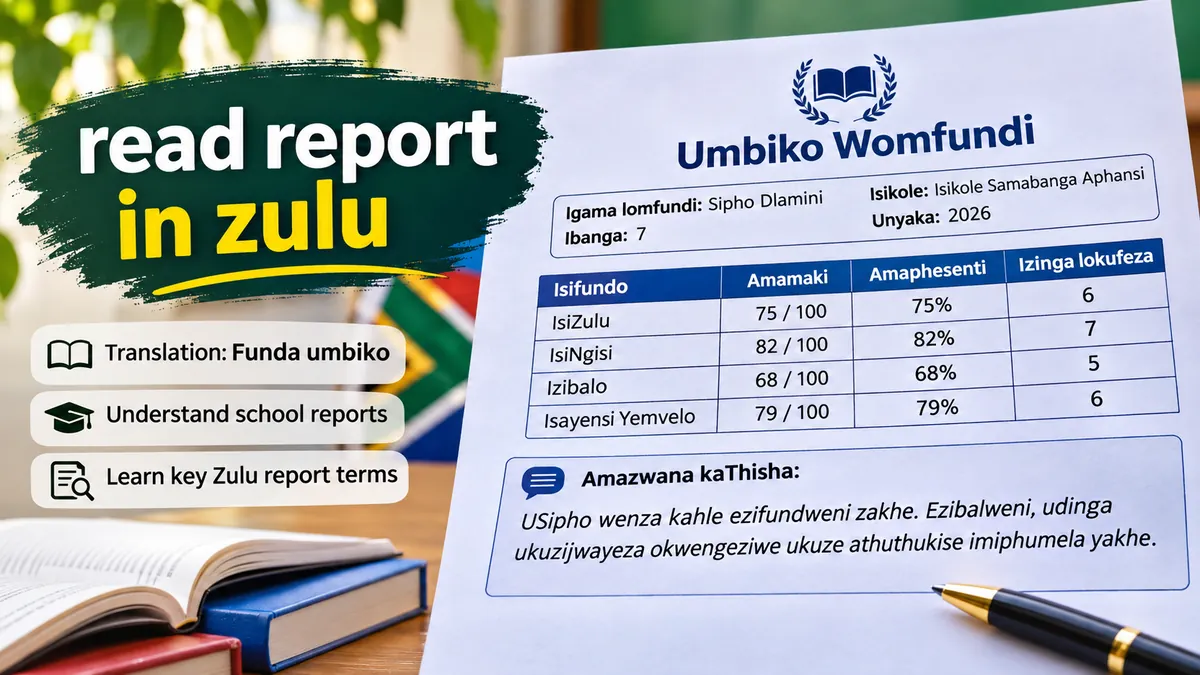
If you need to read a school report, understand a progress report, or explain academic results in isiZulu, knowing the correct vocabulary makes the process much easier.
The phrase read report in zulu can refer to translating the English instruction “read the report” into isiZulu or understanding a report written in the Zulu language. Both require attention to context, because the word “report” can describe a school assessment, a written document, or an account of an event.
Quick answer: In isiZulu, “read the report” can be translated as Funda umbiko. The word funda means “read” or “learn,” depending on context, while umbiko means “report.” For a school report, the phrase may refer to reading grades, teacher comments, academic progress, and assessment results.
What Does read report in zulu Mean?
The phrase combines three English words with a request involving the Zulu language, officially known as isiZulu.
Its meaning depends on the situation:
- Translation: Finding the isiZulu equivalent of “read the report.”
- School reporting: Understanding a learner’s academic report written in isiZulu.
- Reading comprehension: Reading a passage or report and answering questions about its contents.
- Document interpretation: Understanding information presented in an official or informational report.
The most direct translation of the instruction is:
Funda umbiko.
This is a singular command addressed to one person.
When addressing several people, the corresponding form is Fundani umbiko.
| English | isiZulu | Meaning |
|---|---|---|
| Read the report | Funda umbiko | Instruction to one person |
| Read the report (plural) | Fundani umbiko | Instruction to several people |
| Report | Umbiko | A written or spoken account |
| School report | Umbiko wesikole | A report associated with school |
| Read | Funda | Read, study, or learn |
| Write a report | Bhala umbiko | Prepare a written report |
These expressions provide a foundation for understanding instructions in educational and everyday settings.
How to Read a School Report in Zulu
A school report provides information about a learner’s academic performance, attendance, development, and progress during a reporting period.
In South Africa, reports may be written in English, isiZulu, or another language, depending on the school’s communication practices.
Although formats vary, many school reports contain similar types of information.
1. Identify the learner’s information
Begin by checking the basic details:
| isiZulu | English |
|---|---|
| Igama lomfundi | Learner’s name |
| Isikole | School |
| Ibanga | Grade |
| Unyaka | Year |
| Uthisha | Teacher |
| Isifundo | Subject |
| Usuku | Date |
For example:
Igama lomfundi: Sipho Dlamini
This means:
“Learner’s name: Sipho Dlamini.”
The name is illustrative rather than a reference to an actual learner.
2. Understand the subjects
School reports generally organize performance by subject.
Common subject names include:
| isiZulu | English |
|---|---|
| IsiZulu | Zulu language |
| IsiNgisi | English language |
| Izibalo | Mathematics |
| Isayensi | Science |
| Umlando | History |
| IJografi | Geography |
| Imfundo Yomzimba | Physical Education |
| Isayensi Yemvelo | Natural Sciences |
Some schools use official curriculum subject titles that differ from these everyday translations.
For example, a report might use Izibalo to identify the learner’s mathematics results.
3. Examine marks and percentages
A school report may show numerical marks, percentages, achievement levels, or descriptive assessments.
Consider this fictional example:
| Subject | Mark | Percentage |
|---|---|---|
| IsiZulu | 75/100 | 75% |
| English | 82/100 | 82% |
| Mathematics | 68/100 | 68% |
| Natural Sciences | 79/100 | 79% |
A mark of 75 out of 100 represents 75%.
The calculation is:
\[ \text{Percentage}=\frac{\text{Marks obtained}}{\text{Total marks}}\times100 \]
However, a percentage alone does not explain everything about a learner’s performance. Schools may also provide achievement descriptors, assessment criteria, and teacher comments.
4. Read teacher comments carefully
Teacher comments often explain strengths, challenges, classroom participation, and areas requiring improvement.
Useful isiZulu expressions include:
| isiZulu | English |
|---|---|
| Wenza kahle | He or she is doing well |
| Usebenza ngokuzikhandla | He or she works hard |
| Udinga usizo | He or she needs help |
| Uyathuthuka | He or she is improving |
| Udinga ukuzijwayeza okwengeziwe | He or she needs more practice |
| Ubonisa intuthuko | He or she shows progress |
A comment such as Umfundi wenza kahle ezifundweni zakhe means “The learner is doing well in their studies.”
When interpreting comments, read the complete sentence rather than translating each word independently.
Understanding Zulu Report Vocabulary
Reading a report becomes easier when you recognize frequently used words.
Some vocabulary relates to academic performance, while other terms describe administrative information or general observations.
Academic performance terms
| isiZulu | English |
|---|---|
| Imiphumela | Results |
| Amamaki | Marks |
| Ukuhlolwa | Assessment or examination |
| Impumelelo | Success or achievement |
| Intuthuko | Progress |
| Ulwazi | Knowledge |
| Amakhono | Skills |
| Umsebenzi | Work |
| Ukufunda | Reading or learning |
| Ukubhala | Writing |
| Ukuziphatha | Behaviour or conduct |
For example:
Imiphumela yokuhlolwa means “assessment or examination results.”
Intuthuko yomfundi means “the learner’s progress.”
Important differences between similar terms
Zulu vocabulary is contextual. A single English word may have different translations depending on how it is used.
For instance, funda can mean “read,” “study,” or “learn.”
Compare:
- Funda incwadi. — Read a book.
- Ngifunda isiZulu. — I am learning or studying isiZulu.
- Funda umbiko. — Read the report.
The surrounding words determine the intended meaning.
Similarly, umbiko generally refers to a report or communicated account, whereas isitatimende may refer to a statement, including certain formal or financial statements.
Understanding these distinctions helps prevent incorrect translations.
How South African School Report Grades Work
If you are learning how to read report in zulu, understanding South Africa’s assessment system is particularly useful.
The Department of Basic Education (DBE) provides national guidance for recording and reporting learner performance through the National Protocol for Assessment and the Curriculum and Assessment Policy Statements (CAPS).
These policies establish requirements for communicating academic progress to learners and parents. G+1
Understanding achievement levels
South Africa’s National Curriculum Statement uses seven achievement levels to describe learner performance.
| Level | Percentage | Achievement description |
|---|---|---|
| 7 | 80–100% | Outstanding |
| 6 | 70–79% | Meritorious |
| 5 | 60–69% | Substantial |
| 4 | 50–59% | Adequate |
| 3 | 40–49% | Moderate |
| 2 | 30–39% | Elementary |
| 1 | 0–29% | Not achieved |
These are achievement classifications, not universal pass-or-fail rules for every subject or grade. Promotion requirements depend on the applicable curriculum and assessment policies. Acts Online+1
For example, a learner receiving 82% in isiZulu would fall within achievement level 7.
A mathematics result of 55% would correspond to achievement level 4.
What information should appear on a report card?
A formal school report normally includes learner identification, school information, attendance details, subject performance, and constructive feedback.
The National Protocol for Assessment also addresses reporting practices across the Foundation, Intermediate, Senior, and Further Education and Training phases. G+1
Parents should examine both the numerical results and the written comments. A learner’s development cannot always be understood from one percentage.
Example of a Report Written in Zulu
A practical example helps demonstrate how familiar report vocabulary appears in a complete passage.
Sample isiZulu school report
ILLUSTRATIVE EXAMPLE
Umbiko Womfundi
Igama lomfundi: Sipho Dlamini
Ibanga: 7
Isikole: Isikole Samabanga Aphansi
Unyaka: 2026
USipho ungumfundi osebenza ngokuzikhandla. Wenza kahle esiZulwini naseSayensini. Ezibalweni, udinga ukuzijwayeza okwengeziwe ukuze athuthukise imiphumela yakhe. Uhlanganyela kahle emisebenzini yasekilasini futhi ubonisa intuthuko ezifundweni zakhe.
English translation
Learner’s Report
Learner’s name: Sipho Dlamini
Grade: 7
School: Primary School
Year: 2026
Sipho is a hardworking learner. He performs well in isiZulu and Science. In Mathematics, he needs additional practice to improve his results. He participates well in classroom activities and demonstrates progress in his studies.
Breaking down the report
The sentence USipho ungumfundi osebenza ngokuzikhandla describes Sipho as a hardworking learner.
The expression Wenza kahle communicates positive performance.
The phrase udinga ukuzijwayeza okwengeziwe indicates that more practice is needed.
Notice that the teacher identifies both strengths and an area for improvement. This makes the report more informative than a simple list of marks.
How to Translate an English Report Into Zulu
Translating an English report into isiZulu involves more than replacing individual words.
Zulu is a Bantu language with grammatical structures that differ considerably from English. Its noun-class system, subject agreement, and verb construction influence how sentences are formed.
Step 1: Understand the original sentence
Read the entire English statement before translating it.
For example:
“The learner is improving in mathematics.”
The sentence describes ongoing academic progress rather than a completed achievement.
A natural isiZulu rendering is:
Umfundi uyathuthuka ezibalweni.
Step 2: Identify important vocabulary
Separate the sentence into meaningful concepts.
| English concept | isiZulu |
|---|---|
| Learner | Umfundi |
| Improving | Uyathuthuka |
| Mathematics | Izibalo |
| Teacher | Uthisha |
| School | Isikole |
Do not assume the dictionary form of a word can always be inserted unchanged into a complete sentence.
Step 3: Apply correct grammar
Zulu verbs commonly include prefixes that agree with their subjects.
For example:
Umfundi uyafunda.
“The learner is studying.”
Abafundi bayafunda.
“The learners are studying.”
The verb changes when the subject changes from singular to plural.
This agreement is essential for producing grammatically coherent translations.
Step 4: Preserve the original meaning
Academic reports often contain carefully worded observations.
Consider the difference between:
“The learner needs additional support.”
And:
“The learner has failed.”
These statements communicate different information. A translation should never turn a recommendation for support into a claim of failure.
Likewise, Uyathuthuka indicates improvement; it does not automatically mean the learner has achieved the highest possible grade.
Step 5: Review the final translation
Check names, numerical results, subject titles, and reporting periods against the original document.
For formal reports, a proficient isiZulu speaker or qualified translator should review language accuracy, particularly where the document affects educational or administrative decisions.
Common Zulu Sentences Used in Reports
Learning complete sentences is often more effective than memorizing isolated vocabulary.
The following examples demonstrate useful expressions.
| isiZulu sentence | English meaning |
|---|---|
| Umfundi wenza kahle. | The learner is doing well. |
| Umfundi udinga usizo. | The learner needs help. |
| Umfundi uyathuthuka. | The learner is improving. |
| Uthisha ubhala umbiko. | The teacher is writing a report. |
| Ngifunda umbiko. | I am reading the report. |
| Umbiko uphelile. | The report is finished. |
| Imiphumela mihle. | The results are good. |
| Umfundi usebenza ngokuzikhandla. | The learner works hard. |
How do you say “I am reading the report” in Zulu?
The translation is:
Ngifunda umbiko.
The prefix ngi- identifies the first-person singular subject, meaning “I.”
The sentence can be used when describing the act of reading a document.
How do you say “The teacher is writing a report”?
A suitable translation is:
Uthisha ubhala umbiko.
Here, uthisha means “teacher,” ubhala means “is writing,” and umbiko means “report.”
What is the difference between umbiko and ukubika?
Umbiko is a noun meaning “report.”
Ukubika is a verb form meaning “to report.”
This distinction is reflected in English–Zulu dictionary entries. Glosbe+1
For example, writing a report and reporting an incident are related activities, but they require different grammatical constructions.
Reading Comprehension Reports in isiZulu
The keyword read report in zulu can also relate to school exercises in which learners read an informational passage and answer comprehension questions.
These activities test more than pronunciation. They assess whether the reader understands facts, identifies important details, and interprets meaning.
Example reading passage
Umbiko Ngesikole
Isikole sethu sinezihlahla eziningi. Abafundi bahlanza amagceke njalo ngoLwesihlanu. Othisha bakhuthaza abafundi ukuba bagcine isikole sihlanzekile. Wonke umuntu uyasiza ekunakekeleni indawo yesikole.
English meaning:
Our school has many trees. Learners clean the school grounds every Friday. Teachers encourage learners to keep the school clean. Everyone helps care for the school environment.
Comprehension questions and answers
1. What does the school have?
The school has many trees.
2. When do learners clean the school grounds?
Every Friday.
3. What do teachers encourage learners to do?
They encourage learners to keep the school clean.
4. What is the main idea of the passage?
The passage describes how learners and teachers help maintain a clean school environment.
How to answer comprehension questions accurately
Start by reading the entire passage without attempting to translate every unfamiliar word.
On the second reading, identify names, actions, dates, locations, and repeated ideas.
Next, locate the sentence that provides evidence for each answer.
If a question asks when an activity happens, look for time expressions such as ngoLwesihlanu (on Friday).
For a question about purpose or meaning, consider the whole paragraph rather than one isolated word.
This method improves both reading comprehension and vocabulary retention.
Common Mistakes When Reading Zulu Reports
Readers unfamiliar with isiZulu may misunderstand reports because of grammatical differences, unfamiliar vocabulary, or assumptions about academic terminology.
Translating every word literally
English and isiZulu do not always follow the same sentence structure.
Word-for-word translation can produce awkward or misleading results, particularly when subject agreement and noun classes are involved.
Translate complete phrases wherever possible.
Confusing reading with studying
The verb funda can express reading, learning, or studying.
Its meaning depends on the sentence.
For example, Ngifunda isiZulu usually means “I am learning isiZulu,” while Ngifunda umbiko means “I am reading the report.”
Misinterpreting achievement codes
A number such as 4 or 7 on a South African report may represent an achievement level rather than a raw mark.
Always consult the report’s grading key.
The achievement classification and the requirements for passing a subject are related but not identical.
Ignoring teacher feedback
Teacher comments may identify specific areas for improvement that percentages cannot explain.
For instance, a learner might demonstrate strong reading comprehension but need additional support with written expression.
Reading the comments alongside the grades provides a more complete picture.
Relying entirely on automated translation
Machine translation can help readers understand straightforward vocabulary, but it may mishandle grammatical agreement, educational terminology, or ambiguous sentences.
Use translated text as an aid to comprehension rather than assuming it is an authoritative interpretation of a formal document.
Practical Ways to Improve Zulu Report Reading Skills
Regular exposure to short, meaningful texts is one of the most effective ways to develop confidence in isiZulu.
Begin with familiar material, such as school announcements, classroom passages, and simple progress reports.
Build a vocabulary notebook containing common report terms and their meanings. Include full example sentences to show how each word functions in context.
Read short passages aloud to become more comfortable with word forms and sentence patterns. Listening to proficient isiZulu speakers can also help with pronunciation and comprehension.
For learners, practice identifying the main idea of a report, extracting supporting facts, and summarizing the information in simple English.
Parents reading school reports can focus on subject names, assessment results, teacher comments, and recommended next steps.
When a report contains unfamiliar terminology, consult a reliable dictionary or ask the school to explain the relevant assessment language.
The South African Department of Basic Education publishes curriculum and assessment resources that can help readers understand formal school reporting practices. Schools+1
Final Thoughts on read report in zulu
The simplest translation of “read the report” into isiZulu is Funda umbiko. However, understanding a complete Zulu report requires knowledge of vocabulary, sentence structure, academic terminology, and the context in which the document was written.
For school reports, start with the learner’s information, identify subjects and marks, understand achievement levels, and carefully interpret teacher comments.
For reading comprehension exercises, focus on the passage’s main idea, supporting details, and the exact information requested by each question.
With consistent practice and attention to context, reading reports in isiZulu becomes easier, more accurate, and more useful for learners, parents, and anyone studying the language.
