

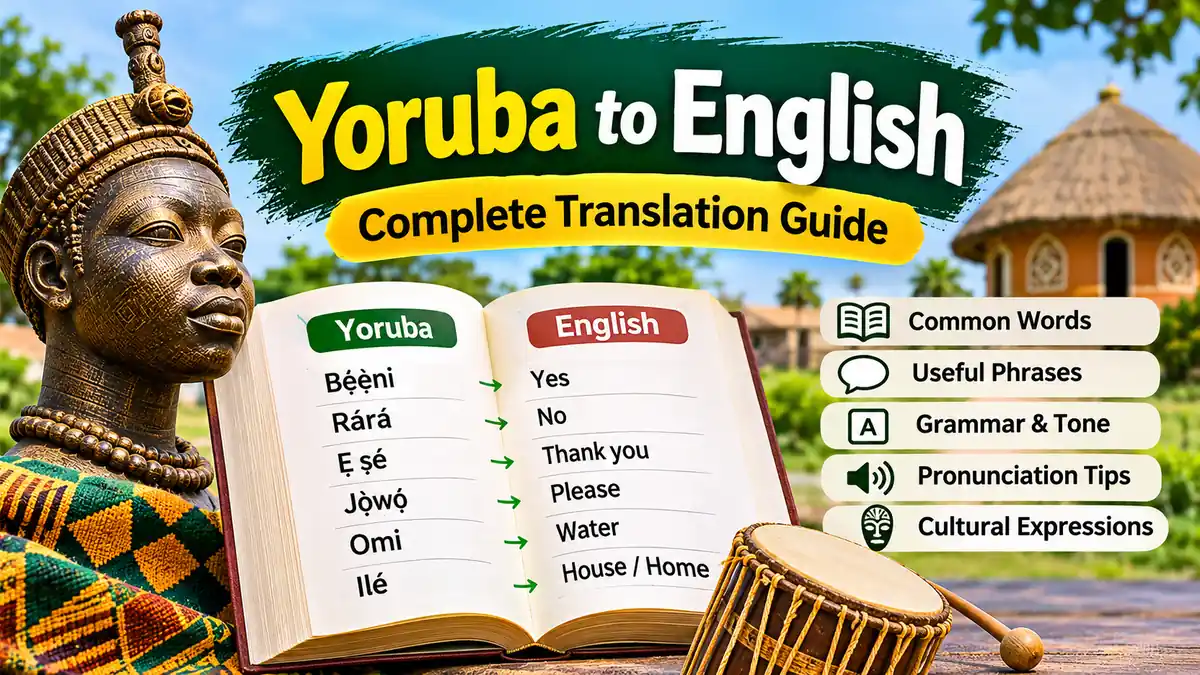
Yoruba is one of West Africa’s major languages, but translating it accurately into English involves more than replacing individual words. A single Yoruba expression can carry different meanings depending on its tone, spelling, and context.
If you’re learning Yoruba, communicating with Nigerian friends or family, or trying to understand a Yoruba message, this guide explains how translation works, introduces useful vocabulary, and helps you avoid common mistakes.
Yoruba to English translation means converting words, sentences, or spoken expressions from the Yoruba language into English while preserving their intended meaning. Accurate translation requires understanding Yoruba’s three-tone system, vowel distinctions, sentence structure, and cultural expressions, because literal word-for-word translations may miss important meaning.
Understanding the Yoruba Language
Yoruba, written as Yorùbá in its standard orthography, belongs to the Niger-Congo language family and is commonly classified within the Defoid branch of the Volta-Niger group.
It is primarily spoken in southwestern Nigeria, particularly in Lagos, Oyo, Ogun, Osun, Ondo, and Ekiti states. Yoruba-speaking communities also live in parts of Benin and Togo, while diaspora communities maintain the language in the United Kingdom, United States, Brazil, Cuba, and elsewhere.
Yoruba uses a Latin-based writing system with additional letters and diacritical marks. Unlike English, it is a tonal language: changes in pitch can distinguish words that otherwise look similar.
Yoruba alphabet and writing system
Standard Yoruba uses 25 letters, including the distinctive characters Ẹ, Ọ, and Ṣ. The alphabet does not include C, Q, V, X, or Z as independent letters in its traditional standard inventory.
Three written vowel pairs are especially important:
| Yoruba letter | Pronunciation guidance |
|---|---|
| E | Similar to the vowel in day, without the English glide |
| Ẹ | Similar to the vowel in bed |
| O | A relatively close, rounded vowel |
| Ọ | A more open, rounded vowel |
| S | Like English s in see |
| Ṣ | Like English sh in shoe |
The distinction between s and ṣ, or e and ẹ, is meaningful. Replacing one with another can change a word or make it incorrect.
Why tone matters in translation
Yoruba has three primary lexical tones:
- High tone, generally marked with an acute accent (á).
- Mid tone, generally left unmarked (a).
- Low tone, generally marked with a grave accent (à).
For example, owó means money, while ọwọ́ means hand. Their different vowels and tone markings help distinguish the words.
In informal text messages, speakers often omit tone marks. This makes it especially important to examine the complete sentence before choosing an English meaning.
Common yoruba to english Words and Meanings
Learning frequently used vocabulary is a practical starting point for understanding everyday conversations.
Basic Yoruba words
| Yoruba | English |
|---|---|
| Bẹ́ẹ̀ni | Yes |
| Rárá | No |
| Ẹ ṣé | Thank you (polite or plural) |
| Jọ̀wọ́ | Please |
| Omi | Water |
| Oúnjẹ | Food |
| Ilé | House or home |
| Ọmọ | Child |
| Bàbá | Father |
| Ìyá | Mother |
| Ọ̀rẹ́ | Friend |
| Ìwé | Book |
| Ilé ẹ̀kọ́ | School |
| Ọjọ́ | Day |
| Òru | Night |
| Orúkọ | Name |
| Ọkàn | Heart |
| Owó | Money |
| Iṣẹ́ | Work |
| Àlàáfíà | Peace or well-being |
Some words have broader meanings than their closest English equivalents. For example, ọmọ can refer to a child, offspring, or a younger person in certain contexts.
Common Yoruba greetings
Greetings are central to Yoruba social interaction. The appropriate expression can depend on the time of day, the relationship between speakers, and the level of respect expected.
| Yoruba phrase | English meaning |
|---|---|
| Ẹ káàárọ̀ | Good morning |
| Ẹ káàsán | Good afternoon |
| Ẹ kú ìrọ̀lẹ́ | Good evening |
| Ó dàárọ̀ | Good night |
| Báwo ni? | How are you? |
| Ṣé àlàáfíà ni? | Is everything well? |
| Dáadáa ni | I’m fine / It’s fine |
| Ẹ kú iṣẹ́ | Well done at work |
| Ẹ kú ilé | Greeting someone at home |
| Ó dàbọ̀ | Goodbye |
| Ẹ ṣé gan-an | Thank you very much |
The particle ẹ frequently marks respect or plural address. Consequently, Ẹ ṣé is more polite than O ṣé when speaking to an elder or someone deserving formal respect.
Yoruba numbers from 1 to 10
| Number | Yoruba |
|---|---|
| 1 | Ọ̀kan |
| 2 | Èjì |
| 3 | Ẹ̀ta |
| 4 | Ẹ̀rin |
| 5 | Àrún |
| 6 | Ẹ̀fà |
| 7 | Èje |
| 8 | Ẹ̀jọ |
| 9 | Ẹ̀sán |
| 10 | Ẹ̀wá |
Yoruba counting becomes more complex beyond these basic numbers. Its traditional number system uses combinations of addition, subtraction, and multiples of twenty, rather than simply following the English decimal naming pattern.
How to Translate yoruba to english Accurately
Accurate translation starts with understanding what a speaker intends to communicate, not simply matching words from a dictionary.
A reliable process involves five steps.
- Identify the complete expression. Read the entire sentence rather than translating isolated words.
- Check Yoruba spelling. Look for dotted letters such as ẹ, ọ, and ṣ, as well as tone marks.
- Understand the grammatical structure. Identify the subject, verb, object, and any tense or aspect markers.
- Consider cultural context. Greetings, proverbs, and respectful expressions may need natural English equivalents.
- Review the English translation. Ensure the result sounds natural without changing the original meaning.
For example, consider the sentence:
Mo fẹ́ omi.
Its English translation is “I want water.”
Here, mo means “I,” fẹ́ expresses wanting, and omi means “water.” The sentence follows a straightforward subject-verb-object pattern.
However, more complicated expressions may require a less literal approach.
Yoruba sentence translation examples
| Yoruba sentence | English translation |
|---|---|
| Mo nífẹ̀ẹ́ rẹ | I love you |
| Kí ni orúkọ rẹ? | What is your name? |
| Orúkọ mi ni Adé | My name is Ade |
| Mo fẹ́ jẹun | I want to eat |
| Mo ń lọ sí ilé | I am going home |
| Ẹ jọ̀wọ́, ẹ ràn mí lọ́wọ́ | Please help me |
| Mo dúpẹ́ | I am grateful |
| Níbo ni o ń lọ? | Where are you going? |
| Mo fẹ́ kọ́ Yorùbá | I want to learn Yoruba |
| Ọmọ náà wà ní ilé | The child is at home |
These examples demonstrate how Yoruba uses familiar sentence structures while expressing certain grammatical relationships differently from English.
Translating Yoruba without tone marks
A common challenge appears when someone writes a message using a standard English keyboard.
Consider the word igba.
| Yoruba spelling | English meaning |
|---|---|
| Igbá | Calabash |
| Igba | Two hundred |
| Ìgbà | Time or period |
Without tone marks, the intended meaning may be unclear.
For instance, a sentence discussing money or counting may suggest a numerical meaning, while a sentence describing a traditional container may refer to a calabash.
This distinction is documented in Yoruba grammar references and language-learning materials. Grammar-Yoruba.rtf+1
The safest approach is to use surrounding words, grammatical structure, and the conversation’s subject before deciding on a translation.
Yoruba Grammar Compared With English
Although Yoruba and English commonly use subject-verb-object sentence order, their grammatical systems differ considerably.
Understanding these differences improves both reading comprehension and translation accuracy.
Subject-verb-object sentence structure
Consider:
Adé ra ìwé.
English: “Ade bought a book.”
The sentence contains three main elements:
- Adé — subject
- ra — verb meaning buy or bought in context
- ìwé — object meaning book
English often expresses past tense through changes in verb form, such as “buy” becoming “bought.”
Yoruba generally relies more on context and grammatical markers to communicate time and aspect.
Yoruba pronouns
| Yoruba | English |
|---|---|
| Mo | I |
| O | You (singular, informal) |
| Ó | He, she, or it |
| A | We |
| Ẹ | You (plural or respectful) |
| Wọ́n | They |
One important difference is that Yoruba’s third-person singular pronoun does not inherently distinguish male and female individuals.
For example:
Ó wá.
This can mean “He came” or “She came,” depending on the context.
An English translator must determine whether the person’s gender is known. If it is not, a gender-neutral construction may be more appropriate than guessing.
How Yoruba expresses time and actions
Yoruba frequently uses markers before verbs to indicate aspects of an action.
| Yoruba sentence | English meaning |
|---|---|
| Mo ń jẹun | I am eating |
| Mo ti jẹun | I have eaten |
| Mo máa jẹun | I will eat / I usually eat, depending on context |
| Mo fẹ́ jẹun | I want to eat |
The marker ń commonly indicates an ongoing action, while ti can indicate a completed action. The marker máa can convey habitual or future meaning depending on its use.
These distinctions are important because an automatic translator may choose an English tense that does not fit the surrounding conversation. LinguaCommons+1
Questions and negation
Yoruba uses question words and particles to form questions.
For example:
Kí ni èyí? — “What is this?”
Níbo ni ilé rẹ wà? — “Where is your house?”
Negation often involves words such as kò.
Mi ò mọ̀. — “I don’t know.”
A translator should identify these grammatical elements before constructing the English sentence.
Yoruba Pronunciation for English Speakers
Yoruba pronunciation presents several challenges because English speakers are not accustomed to using pitch changes to distinguish the lexical meanings of words.
The seven oral vowels
Yoruba has seven oral vowel qualities, conventionally represented by:
A, E, Ẹ, I, O, Ọ, U.
The differences between E and Ẹ, and between O and Ọ, are especially important.
English spelling can provide rough guidance, but listening to native-speaker recordings is more reliable than memorizing approximate English sounds.
Understanding the three tones
A useful illustration is:
| Tone | Mark | Example |
|---|---|---|
| High | Acute accent | á |
| Mid | Usually unmarked | a |
| Low | Grave accent | à |
Tone is part of the word’s identity rather than simply emotional emphasis.
The University of Texas at Austin’s Yorùbá Yé Mi learning materials provide examples of tonal contrasts and their effect on meaning. Coerll
Consonants that require special attention
Two Yoruba consonants can be unfamiliar to English speakers.
Ṣ represents a sound similar to English “sh.”
Gb represents a single doubly articulated consonant produced with coordinated closures toward the back and front of the mouth. It is not simply the English letters G and B pronounced separately.
The Yoruba letter P also differs from the ordinary English P sound in standard descriptions of the language.
For accurate pronunciation, compare recordings from fluent speakers rather than relying exclusively on written phonetic approximations.
Yoruba Expressions, Proverbs, and Cultural Meaning
Some Yoruba expressions cannot be translated accurately through word-for-word substitution.
The language carries cultural concepts involving respect, community, family relationships, and traditional knowledge.
Everyday expressions with cultural meaning
| Yoruba expression | Natural English meaning |
|---|---|
| Ẹ kú iṣẹ́ | Well done / Greeting someone who is working |
| Ẹ kú ìsinmi | Hope you’re enjoying your rest |
| Pẹ̀lẹ́ | Sorry / Take it easy, depending on context |
| Ẹ ṣé púpọ̀ | Thank you very much |
| Àṣẹ | So be it / May it be so, in an appropriate context |
| Ọlọ́run | God |
| Àlàáfíà | Peace, wellness, or well-being |
For example, Ẹ kú iṣẹ́ is a conventional greeting or acknowledgment of someone’s work. Translating it only as “well done” may not fully communicate its social purpose.
Research into Yoruba cultural greetings emphasizes that such expressions are an important part of social interaction and cultural identity. ACL Anthology
Yoruba proverbs and their English meanings
Yoruba oral tradition includes numerous proverbs, known as òwe. Their meanings often extend beyond the literal words.
1. Ọgbọ́n ju agbára lọ.
English: “Wisdom is greater than strength.”
Meaning: Intelligence and good judgment can accomplish more than physical force.
2. Sùúrù ni baba ìwà.
English: “Patience is the father of character.”
Meaning: Patience is considered a foundation of good conduct and maturity.
3. Ilé la ti ń kẹ́ṣọ́ ròde.
Approximate English: “We prepare ourselves at home before going outside.”
Meaning: Good preparation and upbringing begin at home.
Proverbs often have several acceptable English renderings. A literal translation may preserve the original imagery, while an interpretive translation may better communicate the lesson.
Respect and social relationships
Yoruba distinguishes between informal and respectful forms of address.
For instance, the pronoun ẹ can be used when addressing elders, groups, or individuals in formal situations.
English does not have an equivalent everyday grammatical distinction between singular informal and respectful “you.”
Therefore, a translator may need to communicate respect through the tone of the English sentence rather than through a direct word substitution.
This is particularly relevant when translating conversations between younger and older family members.
Online Tools for yoruba to english Translation
Digital translation tools can help with individual words, basic conversations, and longer passages. Their accuracy varies, especially when Yoruba tone marks are missing or the text contains idioms.
Common translation resources
Google Translate Gains Offline Translation in 52 Languages – MacRumors
Google Translate
Useful for quickly translating short text and comparing possible meanings. Results involving idioms, dialects, or ambiguous spelling should be checked.
Glosbe Yoruba–English Dictionary
Provides dictionary entries, example sentences, and contextual translations, helping readers compare different meanings of the same word. Glosbe
Wikimedia Foundation Wiktionary Wikipedia Wikimedia Commons Encyclopedia PNG
Wiktionary
A multilingual dictionary that can help with vocabulary, word forms, and selected pronunciation information. Entry completeness varies.
How reliable is machine translation?
Machine translation is often useful for understanding the general meaning of simple text, but several issues can affect accuracy.
A system may struggle when:
- Tone marks are missing from a word.
- A sentence includes an unfamiliar regional expression.
- The text contains a proverb or metaphor.
- A pronoun has multiple possible English equivalents.
- The speaker uses informal abbreviations or mixes Yoruba and English.
For ordinary messages, these limitations may be manageable. For medical instructions, legal documents, official records, or other consequential material, professional review by a qualified Yoruba–English translator is advisable.
Translating Yoruba audio into English
Spoken-language translation adds another step: the speech must first be transcribed accurately.
Speech-recognition software may confuse words with similar sounds, especially when speakers use regional accents or background noise interferes with recording quality.
A practical workflow is to obtain a transcript, check it against the original audio, restore relevant tone marks where possible, and then translate the corrected text.
For important recordings, a fluent Yoruba speaker should verify the transcription before the English translation is finalized.
Common Yoruba Translation Mistakes and How to Avoid Them
Even simple expressions can become misleading when important linguistic distinctions are ignored.
Confusing similar-looking words
The words igbá, igba, and ìgbà demonstrate why tone marks matter.
A translator who ignores these marks may confuse a container, a number, and a period of time.
The solution is to preserve original spelling and check the sentence’s context.
Assuming every word has one English equivalent
Many Yoruba words have several related meanings.
For example, ilé generally means house or home, but it also appears in compounds referring to institutions and places.
Ilé ẹ̀kọ́ means school, while ilé ìwòsàn means hospital.
Translating each component separately may produce an unnatural result.
Misinterpreting respectful greetings
Expressions such as Ẹ kú iṣẹ́ and Ẹ kú ìrọ̀lẹ́ function as socially meaningful greetings.
Their English equivalents should reflect the situation rather than merely reproduce their individual components.
Guessing the gender of a speaker or subject
The pronoun ó can refer to he, she, or it.
Without sufficient context, selecting a gendered English pronoun may introduce information that was not present in the original sentence.
Ignoring dialect and informal language
Standard Yoruba is widely understood, but regional varieties and informal speech can differ in vocabulary, pronunciation, and usage.
Some speakers also use code-switching, combining Yoruba with English or Nigerian Pidgin within a single conversation.
A translator should identify which language each part belongs to instead of assuming that every unfamiliar word is Yoruba.
Practical Ways to Improve Yoruba and English Translation Skills
Translation ability develops through repeated exposure to real language rather than memorizing isolated dictionary entries.
Learn vocabulary in complete sentences
Instead of studying omi as only “water,” learn how it appears in everyday speech:
Mo fẹ́ omi. — “I want water.”
Omi wà níbí. — “There is water here.”
This helps connect vocabulary with grammar and usage.
Practice listening and reading together
Listening to a fluent speaker while following a correctly marked transcript helps connect written tone marks with spoken pitch.
A useful practice session involves listening to a short sentence, writing what you hear, checking the spelling, and translating it into natural English.
The process also reveals whether a misunderstanding comes from pronunciation, vocabulary, or grammar.
Keep a personal vocabulary journal
Organize new expressions by practical topics such as family, food, travel, school, and greetings.
For each entry, record the Yoruba spelling, English meaning, and one example sentence.
Where possible, include an audio reference so that pronunciation is learned alongside meaning.
Compare literal and natural translations
Consider the expression Ẹ kú iṣẹ́.
A literal analysis of its components is less useful than understanding its conventional function as a greeting or acknowledgment directed toward someone working.
Comparing both approaches helps distinguish grammatical meaning from communicative meaning.
Use educational resources
The University of Texas at Austin’s Yorùbá Yé Mi textbook is a useful resource for studying Yoruba pronunciation, tone, grammar, and vocabulary.
The Yorùbá Yé Mi textbook includes structured explanations and examples suitable for learners. Coerll
Language-learning resources are most effective when combined with listening practice and feedback from fluent speakers.
How Yoruba Translation Connects Language and Culture
Learning Yoruba involves more than understanding individual words. It also provides access to a rich cultural and literary tradition.
Yoruba is used in storytelling, music, poetry, religious practices, education, and everyday communication across West Africa and its diaspora.
Traditional praise poetry, known as oríkì, can include personal names, family histories, achievements, and symbolic descriptions.
A direct English translation may communicate the basic meaning of an oríkì passage while losing its rhythm, emotional significance, or cultural references.
Similarly, concepts associated with Ifá literary and philosophical traditions may require explanatory translation rather than simple dictionary substitution.
In these situations, translators often balance three goals: preserving the original meaning, maintaining cultural significance, and producing readable English.
The best translation is not necessarily the most literal. It is the one that communicates the intended message accurately while respecting the source language.
Final Thoughts on yoruba to english Translation
Learning yoruba to english translation becomes easier when you understand the relationship between vocabulary, tone, grammar, and cultural context.
Begin with everyday greetings and common expressions, then progress to complete sentences and conversations. Preserve Yoruba’s distinctive letters and tone marks whenever possible, and use dictionaries and translation tools as aids rather than unquestionable authorities.
With regular reading, listening, and practice, you can develop a more accurate understanding of Yoruba and communicate its meaning naturally in English.
