

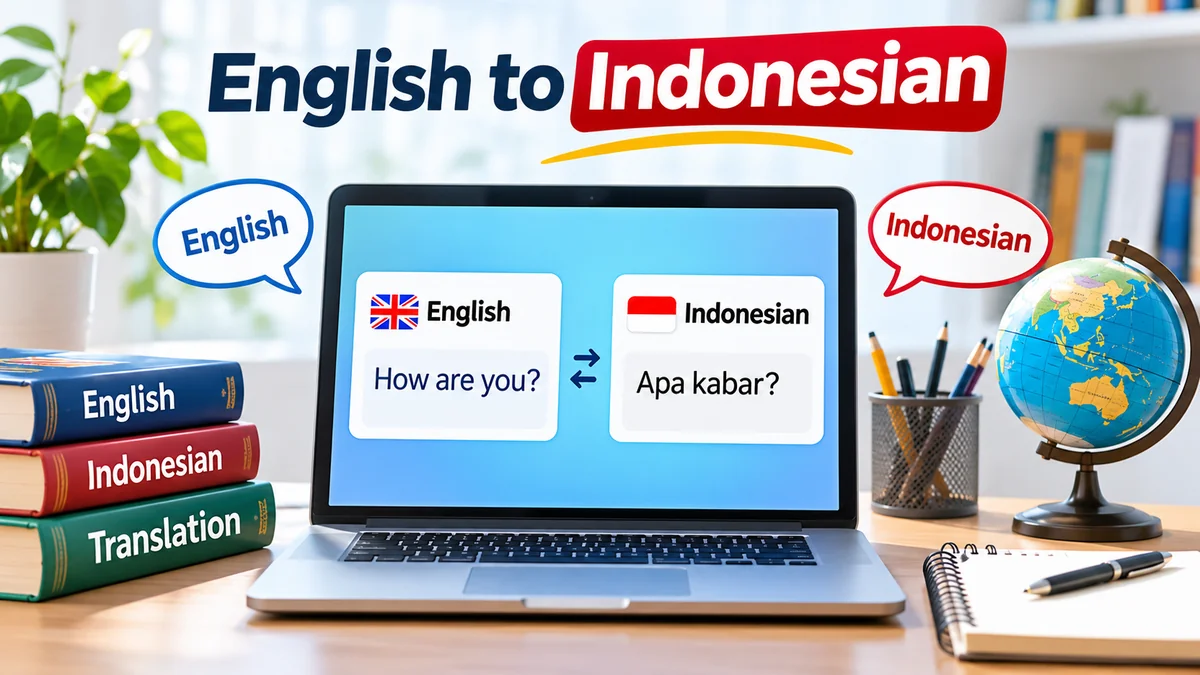
Translating English into Indonesian seems straightforward until a familiar English word produces several possible translations. A simple word such as “you” can change depending on whom you are speaking to, while an everyday expression may sound unnatural when translated word for word.
Learning english to indonesian translation involves understanding vocabulary, sentence structure, pronunciation, and cultural context. Indonesian, also called Bahasa Indonesia, is Indonesia’s national language and is widely used in education, government, media, and everyday communication.
English to Indonesian translation converts English words, sentences, and expressions into Bahasa Indonesia while preserving their intended meaning and tone. Accurate translation requires more than replacing individual words. It involves selecting appropriate vocabulary, understanding Indonesian grammar, and adjusting formal or informal expressions to suit the audience and situation.
This guide explains how English and Indonesian differ, provides useful translations for everyday situations, and shows how to avoid common mistakes.
What Is english to indonesian Translation?
English to Indonesian translation is the process of expressing English-language content in Bahasa Indonesia. It can involve individual words, conversations, documents, website content, subtitles, or complete articles.
The objective is to communicate the original message accurately while making the translated text sound natural to Indonesian speakers.
For example:
| English | Indonesian |
|---|---|
| Good morning | Selamat pagi |
| Thank you | Terima kasih |
| How are you? | Apa kabar? |
| I am fine | Saya baik-baik saja |
| What is your name? | Siapa nama Anda? |
| My name is John | Nama saya John |
| Where are you going? | Anda mau ke mana? |
| I don’t understand | Saya tidak mengerti |
| Please help me | Tolong bantu saya |
| See you later | Sampai jumpa nanti |
These examples use standard Indonesian suitable for learners and many everyday situations.
Is Bahasa Indonesia the Same as Indonesian?
Yes. Bahasa Indonesia is the Indonesian name for the Indonesian language.
The word bahasa means “language,” so Bahasa Indonesia literally means “Indonesian language.”
Indonesian belongs to the Austronesian language family and is closely related to Malay. The two languages share considerable vocabulary and grammatical features, although differences in pronunciation, word choice, and everyday usage remain.
Indonesian is written using the Latin alphabet, making its writing system relatively accessible to English speakers.
However, familiar letters do not always represent the same sounds as in English.
How to Translate english to indonesian Accurately
Accurate translation starts with understanding the complete meaning of an English sentence rather than translating each word separately.
A useful process includes five steps.
1. Understand the Original English Sentence
Read the complete sentence and identify its intended meaning.
Consider this example:
“I am looking for my keys.”
A natural Indonesian translation is:
“Saya sedang mencari kunci saya.”
The word sedang indicates an action currently in progress.
A literal translation that ignores how Indonesian expresses ongoing actions may sound awkward or communicate the wrong meaning.
2. Identify the Appropriate Level of Formality
Indonesian distinguishes between formal and informal communication.
For example:
| English | Formal or Neutral Indonesian | Informal Indonesian |
|---|---|---|
| I | Saya | Aku |
| You | Anda | Kamu |
| I am hungry | Saya lapar | Aku lapar |
| Thank you | Terima kasih | Makasih |
| I don’t know | Saya tidak tahu | Aku nggak tahu |
| What are you doing? | Apa yang sedang Anda lakukan? | Kamu lagi ngapain? |
Formal Indonesian is generally appropriate for professional writing, public announcements, official communication, and academic documents.
Informal Indonesian is common among friends, family members, and people who know one another well.
The distinction matters because a grammatically correct translation can still sound socially inappropriate.
3. Translate the Meaning, Not Individual Words
English expressions frequently contain meanings that cannot be reproduced through literal translation.
For example:
“It’s raining cats and dogs.”
Translating the animals individually would not communicate the intended meaning.
A natural Indonesian equivalent is:
“Hujan deras sekali.”
This means that it is raining very heavily.
Similarly, “break a leg” can be translated according to its intended meaning as “Semoga berhasil,” meaning “Good luck.”
4. Check Indonesian Sentence Structure
English and Indonesian often use subject–verb–object sentence order, but their grammatical systems differ.
English:
“She reads a book.”
Indonesian:
“Dia membaca buku.”
Indonesian verbs generally do not change form to indicate grammatical tense in the same way English verbs do.
Time expressions and contextual words often provide the necessary information.
5. Review the Translation for Naturalness
Read the Indonesian sentence as a complete message.
Check whether the vocabulary, tone, and sentence structure fit the situation.
For important documents, a fluent Indonesian speaker or qualified translator can identify subtleties that automated translation may miss.
Common English to Indonesian Words and Meanings
Building a foundation of frequently used words makes everyday communication easier.
Basic Vocabulary
| English | Indonesian |
|---|---|
| Hello | Halo |
| Yes | Ya |
| No | Tidak |
| Please (requesting help) | Tolong |
| Thank you | Terima kasih |
| Sorry | Maaf |
| Excuse me | Permisi |
| Good | Baik |
| Bad | Buruk |
| Beautiful | Indah |
| Happy | Senang |
| Sad | Sedih |
| Friend | Teman |
| Family | Keluarga |
| House | Rumah |
| School | Sekolah |
| Teacher | Guru |
| Student | Siswa |
| Water | Air |
| Food | Makanan |
| Money | Uang |
| Time | Waktu |
| Day | Hari |
| Night | Malam |
| Love | Cinta |
One interesting difference is that the Indonesian word air means water, not the substance we breathe. The English word “air” translates to udara.
Such false associations are a common source of confusion for new learners.
Everyday Action Words
| English | Indonesian |
|---|---|
| Eat | Makan |
| Drink | Minum |
| Sleep | Tidur |
| Go | Pergi |
| Come | Datang |
| Read | Membaca |
| Write | Menulis |
| Speak | Berbicara |
| Listen | Mendengarkan |
| Learn | Belajar |
| Work | Bekerja |
| Buy | Membeli |
| Sell | Menjual |
| Open | Membuka |
| Close | Menutup |
| Help | Membantu |
| Wait | Menunggu |
| Understand | Mengerti |
| Remember | Ingat |
| Forget | Lupa |
Indonesian verbs can contain prefixes and suffixes that modify their grammatical function or meaning.
For instance, baca means “read” as a root word, while membaca is a common active verb form meaning “to read.”
Recognizing these word patterns makes unfamiliar vocabulary easier to understand.
Everyday english to indonesian Phrases
Memorizing complete expressions is often more useful than learning isolated words.
The following phrases cover greetings, introductions, travel, and routine conversations.
Greetings and Introductions
| English Phrase | Indonesian Translation |
|---|---|
| Good morning | Selamat pagi |
| Good afternoon | Selamat siang |
| Good late afternoon | Selamat sore |
| Good evening | Selamat malam |
| Good night | Selamat malam |
| How are you? | Apa kabar? |
| I am fine, thank you | Saya baik-baik saja, terima kasih |
| Nice to meet you | Senang bertemu dengan Anda |
| Where are you from? | Anda berasal dari mana? |
| I am from America | Saya berasal dari Amerika |
| Welcome | Selamat datang |
| Goodbye | Selamat tinggal |
| See you again | Sampai jumpa lagi |
Indonesian greetings often reflect the time of day.
Selamat pagi is used in the morning, while selamat siang is commonly used around midday and early afternoon. Selamat sore refers to the later afternoon, and selamat malam is used in the evening or at night.
Unlike English, Indonesian does not rely on one universal phrase corresponding to “good afternoon” across the entire afternoon.
Useful Travel Phrases
Travelers visiting Jakarta, Bali, Yogyakarta, Surabaya, or other Indonesian destinations can benefit from a few practical expressions.
| English | Indonesian |
|---|---|
| Where is the airport? | Di mana bandara? |
| Where is the hotel? | Di mana hotelnya? |
| How much does this cost? | Berapa harganya? |
| I need a taxi | Saya butuh taksi |
| Please take me here | Tolong antar saya ke sini |
| Where is the bathroom? | Di mana kamar kecil? |
| I am lost | Saya tersesat |
| Can you help me? | Bisakah Anda membantu saya? |
| I don’t speak Indonesian | Saya tidak bisa berbahasa Indonesia |
| Do you speak English? | Apakah Anda bisa berbahasa Inggris? |
| Please speak slowly | Tolong bicara pelan-pelan |
| I need a doctor | Saya membutuhkan dokter |
A useful phrase is Berapa harganya?, which means “How much does it cost?”
It can be used when asking about prices in markets, shops, and other everyday situations.
Restaurant and Food Phrases
Food vocabulary is especially useful because Indonesian cuisine contains many regional dishes and ingredients.
| English | Indonesian |
|---|---|
| I am hungry | Saya lapar |
| I am thirsty | Saya haus |
| I want to eat | Saya mau makan |
| I want water | Saya mau air putih |
| This is delicious | Ini enak |
| Not spicy, please | Jangan pedas, ya |
| A little spicy | Sedikit pedas |
| Without sugar | Tanpa gula |
| I am vegetarian | Saya vegetarian |
| Can I see the menu? | Boleh saya lihat menunya? |
| The bill, please | Minta bonnya, ya |
| Thank you for the food | Terima kasih atas makanannya |
The word pedas means spicy, while enak is commonly used to describe something that tastes good.
In restaurants, air putih normally means plain drinking water.
Understanding Indonesian Grammar for Better Translation
Indonesian grammar has several features that distinguish it from English.
Learning these differences helps prevent translations that are technically understandable but unnatural.
Indonesian Verbs Do Not Conjugate for Tense Like English Verbs
English verbs often change depending on time.
For example:
- I eat.
- I ate.
- I will eat.
Indonesian can use the same basic verb, makan, in all three situations.
| English | Indonesian |
|---|---|
| I eat | Saya makan |
| I ate | Saya makan tadi |
| I have eaten | Saya sudah makan |
| I am eating | Saya sedang makan |
| I will eat | Saya akan makan |
Words such as sudah, sedang, and akan help express completed, ongoing, and future actions.
The word tadi refers to an earlier time.
Indonesian speakers can also communicate time through context without explicitly including a time marker in every sentence.
Indonesian Does Not Use Grammatical Gender Like Some European Languages
Indonesian nouns generally do not have masculine or feminine grammatical categories.
The pronoun dia can mean either “he” or “she.”
For example:
“Dia seorang dokter.”
Depending on context, this can mean:
“He is a doctor.”
Or:
“She is a doctor.”
This is particularly relevant when translating documents because the English source may specify gender while the Indonesian sentence does not.
Adjectives Usually Follow Nouns
English commonly places adjectives before nouns.
Indonesian generally places descriptive adjectives after the noun.
| English | Indonesian |
|---|---|
| Big house | Rumah besar |
| Beautiful flower | Bunga indah |
| Red car | Mobil merah |
| Good student | Siswa yang baik |
| Cold water | Air dingin |
| New book | Buku baru |
The English phrase “red car” becomes mobil merah, literally “car red.”
This pattern is essential when translating descriptions, product information, and everyday sentences.
Indonesian Uses Reduplication
Reduplication involves repeating a word, often with a hyphen in writing.
It can express plurality or create a different meaning, depending on the word.
Examples include:
| Indonesian | English |
|---|---|
| Buku | Book |
| Buku-buku | Books |
| Anak | Child |
| Anak-anak | Children |
| Rumah | House |
| Rumah-rumah | Houses |
| Hati-hati | Be careful |
| Jalan-jalan | Go for a walk or outing |
Not every plural noun needs reduplication.
For example, tiga buku already means “three books,” so repeating buku is unnecessary.
Likewise, banyak buku means “many books.”
Indonesian Uses Different Words for “We”
One of the most meaningful grammatical differences concerns the English pronoun “we.”
Indonesian has two common equivalents:
- Kita includes the listener.
- Kami excludes the listener.
For example:
“Kita akan pergi besok.”
“We will go tomorrow” — including the person being addressed.
“Kami akan pergi besok.”
“We will go tomorrow” — excluding the person being addressed.
Choosing the wrong word can change who is included in a plan, invitation, or announcement.
This distinction is also explained in Indonesian language guidance from Unbabel and educational materials from Northern Illinois University. Unbabel Community Support+1
Formal vs. Informal Indonesian Translation
The choice between formal and informal Indonesian affects how respectful, friendly, or distant a sentence sounds.
Standard formal Indonesian is widely used in government communication, business documents, journalism, and academic writing.
Informal Indonesian is more common in casual conversations, social media messages, and interactions between friends.
Understanding Indonesian Pronouns
| Meaning | Common Indonesian Form | Typical Usage |
|---|---|---|
| I | Saya | Neutral or polite |
| I | Aku | Familiar or informal |
| You | Anda | Formal or impersonal |
| You | Kamu | Familiar |
| You | Bapak / Ibu | Respectful address |
| He / She | Dia | General |
| He / She | Beliau | Respectful reference |
| We, including you | Kita | Inclusive |
| We, excluding you | Kami | Exclusive |
| They | Mereka | General |
The pronoun Anda is common in formal written instructions, but Indonesian speakers often prefer names or respectful forms of address in face-to-face conversation.
For instance, Pak and Bu are frequently used when addressing adults respectfully.
These distinctions help translators preserve interpersonal relationships and politeness rather than focusing solely on dictionary definitions. Speak Indo+1
Example: Translating a Polite Request
English:
“Could you please send me the document?”
Formal Indonesian:
“Bisakah Anda mengirimkan dokumen tersebut kepada saya?”
Informal Indonesian:
“Bisa kirim dokumennya ke aku?”
Both express a similar request, but the social tone differs.
A professional email would generally favor the first version, while the second might be suitable for a friend or close colleague.
Best Tools for English to Indonesian Translation
Online translation tools can help with unfamiliar words, short messages, pronunciation, and longer passages.
However, their strengths and limitations vary.
Google Translate
Google Translate is a widely used machine translation service that supports English and Indonesian.
It can be useful for quickly translating words, sentences, and passages.
Depending on the device and supported features, it can also help with speech, images, and camera-based translation.
Its main advantage is convenience. Its limitation is that translations can occasionally miss contextual meaning, cultural nuance, or the intended level of formality.
Cambridge Dictionary
The Cambridge English–Indonesian Translator provides translation functionality alongside English dictionary resources.
It is particularly useful when checking vocabulary meanings, learning alternative word senses, and understanding how individual English words are used.
Dictionary entries can help clarify whether a word is a noun, verb, adjective, or another part of speech.
This is valuable because the same English word may require different Indonesian translations depending on context. Cambridge+1
DeepL Translator
DeepL Translator is another machine translation platform. Its supported language pairs and available features should be checked directly before relying on it for a particular translation workflow.
As with any automated translator, important Indonesian text should be reviewed for meaning, tone, and accuracy.
Microsoft Translator
Microsoft Translator provides multilingual machine translation capabilities.
It can be useful for translating text within supported Microsoft products and translation workflows.
Translation quality may differ according to sentence complexity, terminology, and the amount of context available.
How to Evaluate a Translation Tool
Rather than assuming one translator is always best, compare the output using a short test sentence.
For example:
“Please send us the report tomorrow.”
A suitable formal Indonesian translation is:
“Mohon kirimkan laporan tersebut kepada kami besok.”
Check whether the tool preserves the request, the timing, and the meaning of “us.”
The word kami is appropriate when the recipients of the report are a group that does not include the person being addressed.
If the intended group includes the listener, a different construction may be needed.
English to Indonesian Pronunciation Guide
Indonesian pronunciation is generally more consistent with spelling than English pronunciation.
Once learners understand the common letter sounds, reading unfamiliar words becomes easier.
Important Indonesian Vowel Sounds
| Letter | Approximate Sound | Example |
|---|---|---|
| A | “ah” as in father | Makan |
| I | “ee” as in see | Ini |
| U | “oo” as in food | Buku |
| E | “eh” or a reduced “uh” sound | Enak, besar |
| O | Similar to the vowel in more, without an English-style glide | Orang |
These are approximate descriptions for English speakers, not exact phonetic transcriptions.
The letter e deserves particular attention because Indonesian uses more than one vowel sound represented by this letter.
For example, the e in enak differs from the reduced vowel in the first syllable of besar.
Common Pronunciation Examples
| Indonesian | Meaning | Approximate Pronunciation |
|---|---|---|
| Halo | Hello | HAH-loh |
| Terima kasih | Thank you | tuh-REE-mah KAH-see |
| Selamat pagi | Good morning | suh-LAH-maht PAH-gee |
| Makan | Eat | MAH-kahn |
| Minum | Drink | MEE-noom |
| Buku | Book | BOO-koo |
| Rumah | House | ROO-mah |
| Nama | Name | NAH-mah |
| Saya | I | SAH-yah |
| Tidak | No / Not | TEE-dahk |
Pronunciation guides written in English letters are only approximations. Listening to native speakers provides a more accurate understanding of rhythm, stress, and natural speech.
Sounds That English Speakers Often Find Difficult
The Indonesian letter c is usually pronounced like the English “ch” in “chair.”
For example, cari means “search” or “look for.”
The letter j is pronounced similarly to the English “j” in “jump.”
The combination ng represents a nasal sound similar to the ending of the English word “sing.”
In words such as ngerti, the sound can appear at the beginning of a word, which may initially feel unfamiliar to English speakers.
Common English to Indonesian Translation Mistakes
Several recurring mistakes can change the meaning of a translated sentence.
Translating “You” Without Considering Context
English uses “you” in both formal and informal situations.
Indonesian offers several alternatives, including Anda, kamu, and respectful titles.
Using kamu when addressing an unfamiliar older person may sound too familiar in some contexts.
The safest translation depends on the relationship, region, and communication setting.
Confusing “Tidak” and “Bukan”
Both words can express negation, but they have different grammatical uses.
Tidak commonly negates verbs and adjectives.
“Saya tidak lapar.”
“I am not hungry.”
Bukan commonly negates nouns or identifies something as not belonging to a particular category.
“Ini bukan buku saya.”
“This is not my book.”
Although both can correspond to “not” in English, they are not always interchangeable.
Translating English Articles Literally
English uses articles such as “a,” “an,” and “the.”
Indonesian does not have a directly equivalent article system.
For example:
“I bought a book.”
“Saya membeli buku.”
The English article “a” does not require a separate word in this Indonesian sentence.
Words such as sebuah, seorang, and seekor can indicate one item, person, or animal in appropriate contexts, but they are not automatically required wherever English uses “a.”
Misunderstanding “Sudah” and “Belum”
These words express whether an action or state has been completed or reached.
Sudah often means “already.”
Belum means “not yet.”
Examples:
“Saya sudah makan.”
“I have already eaten.”
“Saya belum makan.”
“I haven’t eaten yet.”
This distinction is useful in conversations about meals, work, appointments, and daily activities.
Confusing Indonesian and Malay Vocabulary
Indonesian and Malay are closely related, but they are not identical in every context.
A word commonly used in Malaysia may sound unusual or have a different meaning in Indonesia.
For Indonesian audiences, use standard Indonesian vocabulary and check region-specific expressions when necessary.
Translating English Sentences Into Natural Indonesian
Longer sentences require attention to context, word order, and the relationships between ideas.
Consider these examples.
Example 1: Everyday Conversation
English:
“I am going to the market because I need to buy some vegetables.”
Indonesian:
“Saya pergi ke pasar karena saya perlu membeli sayuran.”
The word karena means “because.”
The translation preserves the reason for visiting the market without copying every English grammatical feature.
Example 2: Professional Communication
English:
“Please let me know if you need any additional information.”
Indonesian:
“Mohon beri tahu saya jika Anda memerlukan informasi tambahan.”
The phrase mohon beri tahu saya communicates a polite request.
It is suitable for many professional messages.
Example 3: Education
English:
“The students are studying Indonesian at school.”
Indonesian:
“Para siswa sedang belajar bahasa Indonesia di sekolah.”
Here, para siswa refers to the students, while sedang belajar indicates that studying is in progress.
The word para is often used before nouns referring to groups of people, especially in formal writing.
Example 4: Travel
English:
“We will visit Bali next week.”
Indonesian:
“Kami akan mengunjungi Bali minggu depan.”
This translation assumes that “we” excludes the listener.
If the speaker is including the listener, kita would be appropriate instead.
Example 5: Website Content
English:
“Enter your email address to receive updates.”
Indonesian:
“Masukkan alamat email Anda untuk menerima pembaruan.”
The verb masukkan is a natural choice for an instruction asking someone to enter information into a form.
For website interfaces, translators should prioritize clarity, consistency, and terminology that Indonesian users recognize.
How to Improve English to Indonesian Translation Skills
Improving translation ability requires practice with complete sentences and realistic situations.
Learning isolated vocabulary helps, but understanding how words work together is more valuable.
Read Short Indonesian Texts
Start with simple dialogues, children’s stories, short news summaries, or beginner-level language lessons.
Look for familiar sentence patterns.
For example:
“Saya tinggal di Jakarta.”
“I live in Jakarta.”
The word tinggal can mean “live” or “stay” depending on context.
Seeing words in complete sentences helps distinguish their different meanings.
Practice Translating in Both Directions
Translate a short English sentence into Indonesian.
Then, without looking at the original, translate your Indonesian version back into English.
Compare the two versions.
This exercise can reveal missing information, incorrect pronouns, and unnatural sentence construction.
However, a successful back-translation does not automatically prove that the Indonesian sentence is natural.
Listen to Native Indonesian Speech
Indonesian films, podcasts, interviews, and educational videos expose learners to authentic pronunciation and conversational vocabulary.
Pay attention to the differences between formal written language and everyday speech.
You may hear nggak instead of tidak, or makasih instead of terima kasih.
These expressions are common in informal settings but are not always suitable for formal documents.
Keep a Vocabulary Notebook
Organize new vocabulary by practical categories such as food, travel, work, family, and education.
Include complete example sentences rather than recording only dictionary meanings.
For instance:
Belajar — to study or learn.
“Saya belajar bahasa Indonesia setiap hari.”
“I study Indonesian every day.”
This method reinforces both vocabulary and sentence structure.
Use Official Language References
For questions about standard spelling and word meanings, consult resources from Indonesia’s national language authority, Badan Pengembangan dan Pembinaan Bahasa, commonly called Badan Bahasa.
The Kamus Besar Bahasa Indonesia (KBBI) is an authoritative Indonesian dictionary.
The official online dictionary is available at KBBI Daring.
Standard spelling and punctuation guidance is also available through the Indonesian spelling framework known as Ejaan Bahasa Indonesia yang Disempurnakan (EYD).
These references are especially useful when preparing academic, editorial, or formal Indonesian content.
When Human Translation Is Better Than Machine Translation
Machine translation is convenient for understanding basic information, but some materials require closer review.
Legal contracts, medical instructions, immigration documents, academic research, and public safety information can contain terminology where small errors have significant consequences.
In such cases, a qualified translator with relevant subject expertise is preferable.
Human review is also useful for creative writing, advertising language, humor, idioms, and culturally sensitive messages.
For example, an English joke may rely on a double meaning that has no direct Indonesian equivalent.
A skilled translator can preserve the intended effect by adapting the expression rather than translating its individual words.
For ordinary personal messages, machine translation may be sufficient when the meaning is clear and the consequences of an error are minor.
The appropriate method depends on the text’s purpose, complexity, audience, and required accuracy.
Final Thoughts on english to indonesian Translation
Effective english to indonesian translation depends on understanding meaning, grammar, pronunciation, and cultural expectations.
Indonesian offers several features that English speakers may find approachable, including relatively consistent spelling, familiar sentence patterns, and verbs that do not conjugate for tense in the English manner.
At the same time, differences involving pronouns, formality, word formation, and contextual meaning require careful attention.
Begin with common vocabulary and everyday phrases, then practice translating complete sentences. Use dictionaries and translation tools to check unfamiliar expressions, and consult reliable language references when precision matters.
With consistent practice and attention to context, translating English into natural, understandable Indonesian becomes progressively easier.
