

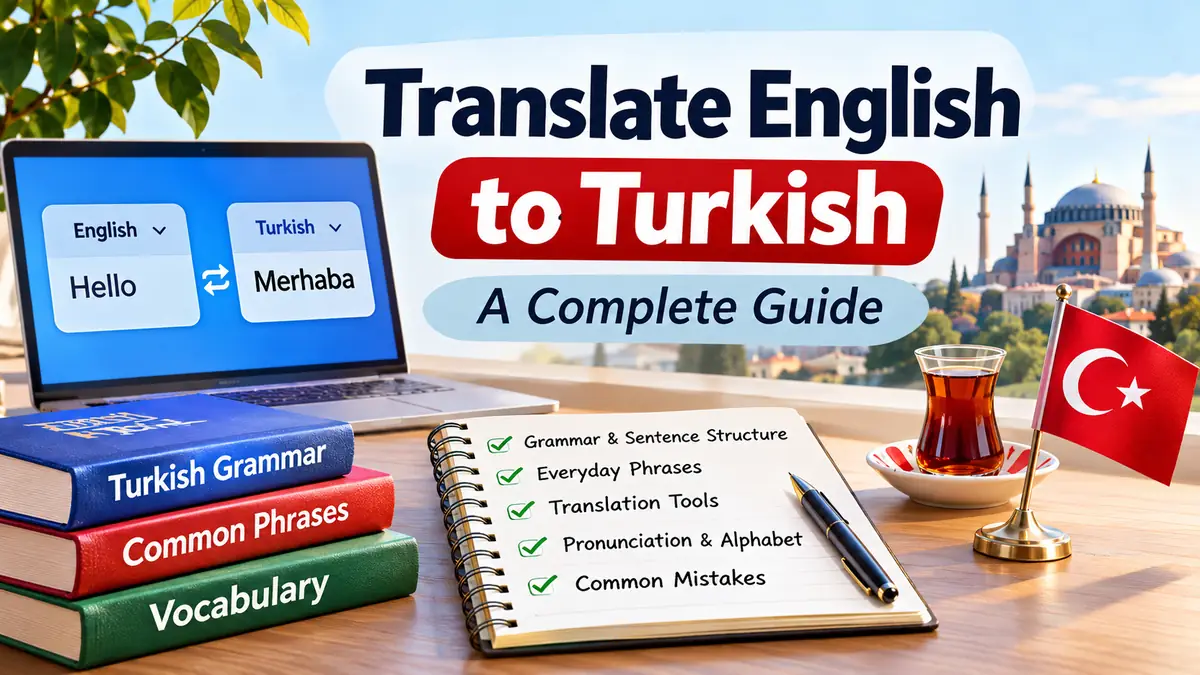
Translating English into Turkish involves more than replacing individual words. English and Turkish have different sentence structures, grammar systems, and ways of expressing politeness, meaning that a sentence translated word for word can sound unnatural or even convey the wrong message.
To translate english to turkish accurately, you need to understand Turkish word order, vowel harmony, suffixes, and context. Turkish generally follows a subject-object-verb structure, uses grammatical endings to express meaning, and distinguishes between informal and polite forms of address. Good translation preserves the original message while making it sound natural to Turkish speakers.
This guide explains the essential rules, common expressions, translation methods, and practical techniques that help you produce clearer English-to-Turkish translations.
How to translate english to turkish accurately
The most reliable approach is to translate the meaning of a sentence rather than its individual words. Start by identifying what the English sentence communicates, then express that idea using natural Turkish grammar.
For example:
| English | Turkish |
|---|---|
| Hello | Merhaba |
| Good morning | Günaydın |
| Thank you | Teşekkür ederim |
| How are you? | Nasılsın? |
| I love you | Seni seviyorum |
| What is your name? | Adın ne? |
| Where are you going? | Nereye gidiyorsun? |
| I don’t understand | Anlamıyorum |
| See you later | Sonra görüşürüz |
| Good night | İyi geceler |
These examples demonstrate that everyday expressions often have established Turkish equivalents.
Understanding the difference between English and Turkish
English belongs to the Germanic branch of the Indo-European language family, while Turkish belongs to the Turkic language family.
Turkish is primarily spoken in Türkiye and is also used by Turkish-speaking communities in Cyprus, Europe, and elsewhere.
Several structural differences affect translation:
- English usually follows subject-verb-object word order.
- Turkish generally follows subject-object-verb word order.
- English uses prepositions, while Turkish frequently uses suffixes and postpositions.
- Turkish nouns have no grammatical gender.
- Turkish verbs often indicate person, tense, and other grammatical information through endings.
- Turkish spelling is relatively consistent with pronunciation.
Understanding these differences is essential when converting longer sentences.
English to Turkish sentence structure and grammar
One of the biggest challenges in English-to-Turkish translation is sentence order.
Consider this example:
English: I read a book.
Turkish: Ben bir kitap okurum.
The English sentence follows:
Subject + Verb + Object
The Turkish sentence follows:
Subject + Object + Verb
In Turkish, ben means “I,” bir kitap means “a book,” and okurum means “I read” in a habitual or general sense.
The pronoun can also be omitted because the verb ending already identifies the subject:
Bir kitap okurum.
This is grammatically correct, although the natural choice depends on context.
Why Turkish verbs often appear at the end
Turkish is generally a verb-final language. The main verb commonly appears after its objects and other sentence elements.
| English sentence | Turkish translation |
|---|---|
| I drink water. | Su içerim. |
| She reads books. | O kitap okur. |
| We are learning Turkish. | Türkçe öğreniyoruz. |
| They went home. | Eve gittiler. |
| I want coffee. | Kahve istiyorum. |
| He is watching television. | O televizyon izliyor. |
Turkish word order can change to emphasize different parts of a sentence. However, subject-object-verb is the most useful starting point for learners.
Turkish vowel harmony explained
Vowel harmony is a fundamental feature of Turkish grammar.
Turkish vowels are:
a, e, ı, i, o, ö, u, ü
Many suffixes change their vowels according to the vowels in the word they attach to.
For example, the plural suffix has two common forms:
| Singular | Plural | English |
|---|---|---|
| Kitap | Kitaplar | Books |
| Ev | Evler | Houses |
| Araba | Arabalar | Cars |
| Göz | Gözler | Eyes |
| Çocuk | Çocuklar | Children |
The suffix -lar or -ler is selected according to vowel harmony.
Other suffixes follow four-way vowel harmony, making vowel selection more complex.
How Turkish suffixes change meaning
Turkish is an agglutinative language. This means multiple grammatical suffixes can attach to a word stem.
Consider:
Ev — house
Evler — houses
Evlerim — my houses
Evlerimde — in my houses
The word evlerimde combines several meaningful elements:
- Ev: house
- -ler: plural
- -im: my
- -de: in or at
This system allows Turkish to express information within a single word that English may express using several words.
translate english to turkish for everyday conversations
Everyday conversation is one of the most common reasons people need Turkish translations.
Learning practical phrases helps with travel, personal communication, and basic social interactions.
Greetings and polite expressions
| English phrase | Turkish translation |
|---|---|
| Hello | Merhaba |
| Hi | Selam |
| Good morning | Günaydın |
| Good evening | İyi akşamlar |
| Goodbye | Hoşça kal |
| Welcome | Hoş geldiniz |
| Please | Lütfen |
| Thank you very much | Çok teşekkür ederim |
| You’re welcome | Rica ederim |
| Excuse me | Affedersiniz |
| I’m sorry | Özür dilerim |
| Yes | Evet |
| No | Hayır |
Turkish distinguishes between informal and formal expressions.
For example, Nasılsın? means “How are you?” when addressing one person informally.
Nasılsınız? is used when addressing someone politely or multiple people.
Using the appropriate form is particularly useful in professional and unfamiliar social settings.
Useful questions in Turkish
| English | Turkish |
|---|---|
| What is this? | Bu nedir? |
| Where are you? | Neredesin? |
| How much does it cost? | Ne kadar? |
| Do you speak English? | İngilizce konuşuyor musunuz? |
| Can you help me? | Bana yardım edebilir misiniz? |
| Where is the bathroom? | Tuvalet nerede? |
| What time is it? | Saat kaç? |
| Are you ready? | Hazır mısın? |
| What are you doing? | Ne yapıyorsun? |
| When will you come? | Ne zaman geleceksin? |
Notice how Turkish questions may use interrogative words or question particles.
For example, mı, mi, mu, and mü are question particles whose form depends on vowel harmony.
English to Turkish travel phrases
Travelers visiting Türkiye can benefit from knowing essential expressions.
| English | Turkish |
|---|---|
| I need a taxi. | Taksiye ihtiyacım var. |
| Where is the airport? | Havalimanı nerede? |
| I have a reservation. | Rezervasyonum var. |
| I would like some water. | Biraz su istiyorum. |
| Can I have the menu? | Menüyü alabilir miyim? |
| The bill, please. | Hesap lütfen. |
| I am lost. | Kayboldum. |
| I need help. | Yardıma ihtiyacım var. |
| Where is the train station? | Tren istasyonu nerede? |
| I don’t speak Turkish. | Türkçe konuşamıyorum. |
Polite requests are often better than literal translations of direct English commands.
For instance, Menüyü alabilir miyim? is a natural way to request a menu in a restaurant.
English to Turkish translation tools and methods
Digital translation tools make it easier to understand unfamiliar Turkish words and sentences. However, different tools are useful for different tasks.
Google Translate Gains Offline Translation in 52 Languages – MacRumors
Google Translate
Supports English and Turkish text translation, voice input, image translation, and other features. Useful for everyday phrases and quick comprehension.
WWF Switzerland Adopts DeepL to Strengthen Global Environmental Communication
DeepL Translator
Offers English-to-Turkish translation with an emphasis on natural wording. Useful for comparing sentence-level translations and alternative phrasing.
Microsoft Translator icon in Windows 11 Color Style
Microsoft Translator
Provides text and speech translation for English and Turkish, making it useful for communication and language practice.
How to use an online translator effectively
A practical translation workflow involves five steps:
- Write the complete English sentence with proper punctuation.
- Select English as the source language and Turkish as the target language.
- Translate the complete sentence rather than isolated words.
- Check whether the Turkish version preserves the intended meaning, tone, and level of formality.
- Review important phrases using a reliable dictionary or a second translation method.
For example, consider the English phrase “I’m running late.”
A natural Turkish equivalent is:
Gecikiyorum.
Translating “running” and “late” separately would not produce the same natural expression.
Can AI translate English to Turkish accurately?
AI-based translation systems can produce fluent Turkish for many common sentences, emails, and informational texts.
However, fluent output is not always accurate.
Potential difficulties include:
- Idioms and culturally specific expressions
- Legal and medical terminology
- Ambiguous English sentences
- Formal versus informal address
- Specialized technical vocabulary
- Words with multiple meanings
For high-stakes documents, a qualified human translator should review the result.
Why translating Turkish back into English can help
Back-translation is a useful quality-checking technique.
Suppose you translate:
“I missed the train.”
Into Turkish:
Treni kaçırdım.
Translating this Turkish sentence back into English should produce something close to the original meaning.
However, back-translation alone cannot guarantee accuracy. Two incorrect translations can sometimes produce similar wording.
It works best alongside grammar checks and contextual review.
Common English to Turkish vocabulary
Building a vocabulary foundation makes translation easier because you begin recognizing common words without depending entirely on translation software.
Essential nouns
| English | Turkish |
|---|---|
| House | Ev |
| School | Okul |
| Book | Kitap |
| Water | Su |
| Food | Yemek |
| Friend | Arkadaş |
| Family | Aile |
| City | Şehir |
| Country | Ülke |
| Time | Zaman |
| Money | Para |
| Work | İş |
| Love | Aşk |
| Language | Dil |
| Day | Gün |
Common verbs
| English | Turkish infinitive |
|---|---|
| To go | Gitmek |
| To come | Gelmek |
| To eat | Yemek |
| To drink | İçmek |
| To speak | Konuşmak |
| To learn | Öğrenmek |
| To understand | Anlamak |
| To write | Yazmak |
| To read | Okumak |
| To see | Görmek |
| To know | Bilmek |
| To want | İstemek |
Turkish infinitives commonly end in -mak or -mek. These endings change when verbs are conjugated.
For example, gelmek means “to come,” while geliyorum means “I am coming.”
Turkish pronunciation and alphabet guide
The Turkish alphabet contains 29 letters and is based on the Latin script.
Unlike English, Turkish generally has predictable relationships between letters and sounds.
However, several letters may be unfamiliar to English speakers.
| Turkish letter | Pronunciation guidance | Example |
|---|---|---|
| C | Similar to English j in “jam” | Cam (glass) |
| Ç | Similar to ch in “chair” | Çay (tea) |
| Ğ | Usually lengthens or links surrounding vowels rather than producing a separate hard consonant | Dağ (mountain) |
| I / ı | A back, unrounded vowel without a direct standard English equivalent | Işık (light) |
| İ / i | Similar to ee in “see,” but usually shorter | İyi (good) |
| Ö | Similar to German ö | Göz (eye) |
| Ş | Similar to sh in “shoe” | Şeker (sugar) |
| Ü | Similar to German ü | Üç (three) |
The letters Q, W, and X are not part of the standard Turkish alphabet, although they may appear in foreign names and other contexts.
Why Turkish characters matter in translation
Removing Turkish diacritics can change the meaning of words.
For example:
- Sık means frequent, dense, or tight, depending on context.
- Sik is a vulgar word with a different meaning.
- Kar means snow.
- Kâr means profit, with the circumflex distinguishing the word in standard written usage.
Correct spelling is particularly important for professional translations, educational materials, and public communication.
Translating English tenses into Turkish
English and Turkish express tense, aspect, and mood differently.
English often relies on auxiliary verbs, while Turkish uses verb suffixes.
Present continuous tense
The Turkish present continuous commonly uses forms of the suffix -(I)yor.
| English | Turkish |
|---|---|
| I am coming. | Geliyorum. |
| You are reading. | Okuyorsun. |
| She is working. | Çalışıyor. |
| We are going. | Gidiyoruz. |
| They are waiting. | Bekliyorlar. |
The exact ending depends on vowel harmony and the grammatical subject.
Past tense
Turkish has different past-tense forms, including a direct past commonly marked by -di and related variants.
| English | Turkish |
|---|---|
| I came. | Geldim. |
| You went. | Gittin. |
| He slept. | Uyudu. |
| We ate. | Yedik. |
| They arrived. | Geldiler. |
Turkish also has an evidential or inferential past, often using -miş and its variants. It can indicate information learned indirectly, inferred, or discovered.
This distinction may require additional context because English does not consistently mark the source of information grammatically.
Future tense
Turkish future forms commonly use -(y)acak or -(y)ecek, followed by appropriate personal endings.
| English | Turkish |
|---|---|
| I will come. | Geleceğim. |
| You will learn. | Öğreneceksin. |
| She will go. | Gidecek. |
| We will meet. | Buluşacağız. |
| They will work. | Çalışacaklar. |
A translator should consider whether the English future refers to a prediction, plan, promise, or intention. Turkish may use different constructions depending on that meaning.
Common mistakes when translating English into Turkish
Even advanced translation systems can struggle with context-dependent expressions.
Translating idioms word for word
English idioms frequently require completely different Turkish expressions.
| English expression | Natural Turkish equivalent |
|---|---|
| Break a leg! | Bol şans! |
| It’s raining cats and dogs. | Bardaktan boşanırcasına yağmur yağıyor. |
| Better late than never. | Geç olsun güç olmasın. |
| No pain, no gain. | Emek olmadan yemek olmaz. |
| It’s a piece of cake. | Çocuk oyuncağı. |
These are meaning-based equivalents rather than exact word-for-word matches. Their suitability depends on context.
Confusing formal and informal speech
English uses “you” for both formal and informal situations.
Turkish distinguishes between sen and siz.
For example:
Informal: Nasılsın?
Formal or plural: Nasılsınız?
Both can translate as “How are you?” but the social relationship changes the appropriate wording.
In customer service, business emails, and unfamiliar social situations, the polite form is generally safer.
Ignoring words with multiple meanings
An English word can have several Turkish equivalents.
Consider “light”:
| English meaning | Turkish |
|---|---|
| Light as illumination | Işık |
| Light in weight | Hafif |
| Light color | Açık renk |
| To light a candle | Mum yakmak |
Similarly, “right” can refer to a direction (sağ), correctness (doğru), or an entitlement (hak).
The correct translation depends on the sentence, not the dictionary’s first suggestion.
Translating without sufficient context
Consider the English sentence:
“I saw her duck.”
This could mean the speaker saw a duck belonging to a woman or saw the woman lower her head.
Turkish translations would differ:
Onun ördeğini gördüm. — I saw her duck (the animal).
Başını eğdiğini gördüm. — I saw her duck (lower her head).
This illustrates why ambiguous English sentences should be clarified before important translations are finalized.
Translating documents, websites, and professional content
Long-form translation requires more attention than translating everyday phrases.
English to Turkish document translation
When translating documents, preserve the original structure and meaning while adapting the language.
A reliable process includes checking terminology, dates, measurements, names, headings, and formatting.
For official documents, requirements may vary depending on the receiving organization and jurisdiction. Some institutions require certified or sworn translations rather than ordinary machine-generated text.
Website localization into Turkish
Website translation is not identical to localization.
Translation changes the language. Localization also adapts content to the expectations and conventions of a particular audience.
For a Turkish-language website, localization may involve:
- Using Turkish-language navigation and interface labels.
- Displaying dates, numbers, and currencies appropriately.
- Choosing culturally natural calls to action.
- Adapting examples to Turkish readers.
- Using appropriate Turkish search terminology.
- Reviewing text length and layout changes.
For multilingual SEO, translated pages should have distinct language-specific content, appropriate language annotations, and clear navigation between language versions.
English to Turkish academic translation
Academic translation demands consistent terminology and accurate handling of specialized concepts.
A scientific term may have an established Turkish equivalent that differs from its literal English meaning.
For instance:
| English term | Turkish |
|---|---|
| Artificial intelligence | Yapay zekâ |
| Machine learning | Makine öğrenmesi |
| Climate change | İklim değişikliği |
| Renewable energy | Yenilenebilir enerji |
| Scientific research | Bilimsel araştırma |
| Data analysis | Veri analizi |
Consulting subject-specific glossaries and reviewing terminology throughout a document helps maintain consistency.
How to improve English to Turkish translation accuracy
Translation quality improves when the process combines language knowledge, context, and verification.
Use complete sentences
A single English word may have several meanings. Complete sentences provide context that helps select the correct Turkish equivalent.
Instead of translating “bank” alone, translate “I deposited money in the bank.”
The full sentence makes the financial meaning clear.
Check reliable dictionaries
Bilingual dictionaries can clarify meanings and show examples of words in context.
The Cambridge English–Turkish Dictionary provides definitions, Turkish equivalents, and usage examples that can support vocabulary checks. Cambridge Dictionary+1
Compare translations carefully
Different translation tools may produce different valid versions of the same English sentence.
Compare whether each version preserves:
- The original meaning
- The intended tense
- The level of politeness
- The emphasis
- The naturalness of the expression
Do not assume that a translation is better simply because it sounds more sophisticated.
Review the final Turkish text
Read the translation as a complete passage rather than checking each sentence in isolation.
Look for inconsistent terminology, missing details, unnatural phrasing, and incorrect pronoun references.
For important documents, ask a proficient Turkish speaker or professional translator to review the result.
Conclusion
Learning to translate english to turkish becomes easier when you understand the differences between the two languages. Turkish word order, vowel harmony, suffixes, verb conjugations, and formal expressions all influence how a sentence should be translated.
Online tools are useful for everyday communication, but accurate translation still depends on context and careful review.
Start with common Turkish phrases, practice complete sentences, and gradually develop your understanding of grammar. The most effective translation is not necessarily the most literal one—it is the version that communicates the original meaning clearly and naturally in Turkish.
