

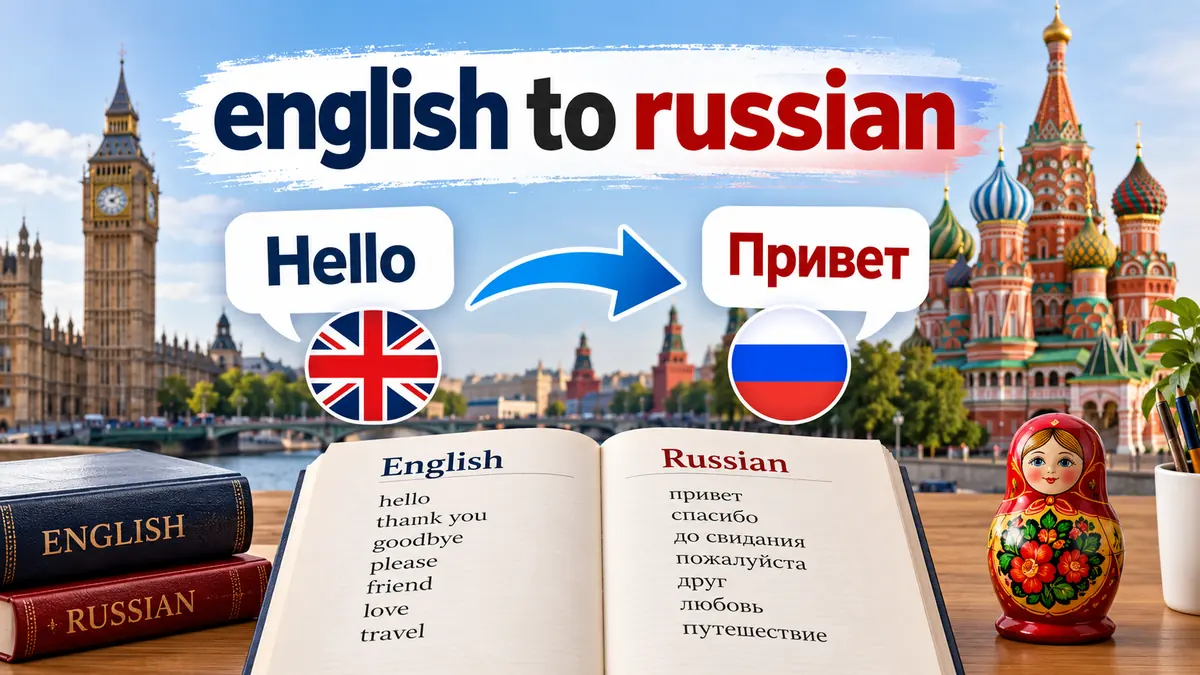
Translating English into Russian involves more than replacing one word with another. Russian uses a different alphabet, changes word endings according to grammatical roles, and expresses certain ideas differently from English.
If you are learning Russian, communicating with native speakers, translating documents, or preparing for travel, understanding these differences can help you produce translations that sound natural rather than awkward.
English to Russian translation converts English words, sentences, and meaning into the Russian language using Cyrillic script. Accurate translation requires attention to vocabulary, grammatical cases, verb aspect, pronunciation, and context. Online translation tools can provide quick results, but understanding Russian sentence structure helps you recognize errors and communicate more confidently.
How Does english to russian Translation Work?
English and Russian belong to the Indo-European language family, but they developed different grammatical structures and writing systems.
English generally follows a subject-verb-object sentence pattern. Russian also commonly uses this order, but its grammatical case system allows greater flexibility.
Consider this example:
| English | Russian | Approximate pronunciation |
|---|---|---|
| Hello | Привет | Pree-VYET |
| Thank you | Спасибо | Spa-SEE-ba |
| Good morning | Доброе утро | DOH-braye OO-tra |
| How are you? | Как дела? | Kak dee-LAH? |
| I love you | Я тебя люблю | Ya tee-BYA lyub-LYU |
| Good night | Спокойной ночи | Spa-KOY-nay NO-chee |
These examples demonstrate that Russian translation involves both a different script and different pronunciation patterns.
A phrase such as “How are you?” may be translated as “Как дела?” in casual conversation, even though the individual words do not correspond directly to the English sentence.
That is because natural translation prioritizes intended meaning over literal word order.
Literal Translation vs. Natural Translation
A literal translation follows the original wording closely. A natural translation expresses the same idea in a way Russian speakers would normally say it.
For example:
English: “I’m cold.”
Natural Russian: “Мне холодно.”
The Russian expression literally resembles “To me, it is cold,” but it communicates the English meaning correctly.
Similarly, “I am 20 years old” becomes “Мне 20 лет,” rather than a word-for-word reproduction of the English sentence.
These differences matter when translating everyday conversations, professional messages, and educational materials.
Understanding the Russian Alphabet and Pronunciation
One of the first challenges in learning Russian is its writing system.
Russian uses the Cyrillic alphabet, which contains 33 letters: 10 vowels, 21 consonants, and two signs that modify pronunciation.
Some Cyrillic letters resemble English letters and have similar sounds. Others look familiar but represent completely different sounds.
Russian Alphabet With English Sound Equivalents
| Russian letter | Approximate English sound | Example |
|---|---|---|
| А а | a in father | мама |
| Б б | b in book | банк |
| В в | v in voice | вода |
| Г г | g in go | город |
| Д д | d in dog | дом |
| Е е | ye in yes, or a softened e | еда |
| Ё ё | yo in yonder | ёж |
| Ж ж | s in measure | журнал |
| З з | z in zebra | зима |
| И и | ee in see | мир |
| Й й | y in boy | мой |
| К к | k in kite | кот |
| Л л | l in lamp | лампа |
| М м | m in moon | мама |
| Н н | n in nose | нос |
| О о | o in more when stressed | он |
| П п | p in spin | папа |
| Р р | rolled or tapped r | рука |
| С с | s in sun | сок |
| Т т | t in stop | там |
| У у | oo in food | утро |
| Ф ф | f in fish | фото |
| Х х | ch in Scottish loch | хлеб |
| Ц ц | ts in cats | центр |
| Ч ч | ch in cheese | чай |
| Ш ш | sh in ship, with a harder articulation | школа |
| Щ щ | long, soft sh | щука |
| Ъ ъ | hard sign; no independent sound | подъезд |
| Ы ы | central vowel without an exact English equivalent | мы |
| Ь ь | soft sign; softens a consonant | день |
| Э э | e in bed | это |
| Ю ю | yu in use | юг |
| Я я | ya in yard | яблоко |
These sound comparisons are approximations. Russian pronunciation also depends on stress and neighboring letters.
Why Word Stress Matters
Russian word stress is not always predictable.
An unstressed letter “о” often sounds closer to an English “a” or a reduced vowel.
For example, “молоко” means “milk” and is pronounced approximately “ma-la-KO,” with the stress on the final syllable.
The placement of stress can also distinguish meanings. For instance:
- за́мок — castle
- замо́к — lock
Both words use the same letters, but their pronunciation and meaning differ.
Russian dictionaries commonly mark stress to help learners pronounce unfamiliar vocabulary.
Transliteration Is Not the Same as Translation
Transliteration represents Russian letters using another writing system, usually the Latin alphabet.
For example:
Russian: Москва
Transliteration: Moskva
English name: Moscow
Transliteration helps readers pronounce or identify Russian words, but it does not necessarily communicate their meaning.
For names, passports, addresses, and official documents, use the transliteration standard required by the relevant authority rather than inventing your own spelling.
Common English to Russian Words and Everyday Phrases
Learning frequently used vocabulary provides a practical foundation for understanding basic conversations.
Greetings and Polite Expressions
| English phrase | Russian translation |
|---|---|
| Hello (formal) | Здравствуйте |
| Hi | Привет |
| Goodbye | До свидания |
| Bye | Пока |
| Please | Пожалуйста |
| Thank you very much | Большое спасибо |
| You’re welcome | Не за что |
| Excuse me | Извините |
| Sorry | Простите |
| Yes | Да |
| No | Нет |
| Good evening | Добрый вечер |
| See you tomorrow | До завтра |
| Nice to meet you | Приятно познакомиться |
Russian distinguishes between formal and informal communication.
“Привет” is suitable for friends, classmates, and people you know well. “Здравствуйте” is generally more appropriate when greeting strangers, older people, or someone in a professional setting.
The word “пожалуйста” can mean “please” or “you’re welcome,” depending on the situation.
Useful Russian Travel Phrases
Travelers benefit from learning complete expressions rather than isolated vocabulary.
| English | Russian |
|---|---|
| Where is the hotel? | Где находится отель? |
| How much does it cost? | Сколько это стоит? |
| I need help. | Мне нужна помощь. |
| Do you speak English? | Вы говорите по-английски? |
| I don’t understand. | Я не понимаю. |
| Please speak slowly. | Говорите, пожалуйста, медленно. |
| Where is the bathroom? | Где туалет? |
| I would like some water. | Я хотел бы воды. / Я хотела бы воды. |
| I am lost. | Я заблудился. / Я заблудилась. |
| Can you help me? | Вы можете мне помочь? |
Some Russian past-tense verbs and expressions change according to the speaker’s grammatical gender.
For example, “Я заблудился” is typically used by a male speaker, while “Я заблудилась” is typically used by a female speaker.
Learning these distinctions makes translated phrases more accurate.
Numbers in Russian
| Number | Russian | Approximate pronunciation |
|---|---|---|
| 1 | один | a-DEEN |
| 2 | два | dva |
| 3 | три | tree |
| 4 | четыре | chee-TY-re |
| 5 | пять | pyat |
| 6 | шесть | shest |
| 7 | семь | syem |
| 8 | восемь | VO-syem |
| 9 | девять | DYE-vyat |
| 10 | десять | DYE-syat |
| 20 | двадцать | DVAT-tsat |
| 100 | сто | sto |
Russian number expressions can become more complicated when combined with nouns because the noun form changes according to the number.
For example:
- один рубль — one ruble
- два рубля — two rubles
- пять рублей — five rubles
This grammatical pattern is especially useful when discussing prices, quantities, and measurements.
Essential Russian Grammar for Accurate Translation
Russian grammar is one of the biggest differences between English and Russian.
While English depends heavily on word order and auxiliary verbs, Russian uses grammatical endings to communicate relationships between words.
Understanding a few core rules can significantly improve translation accuracy.
The Six Russian Grammatical Cases
Russian nouns, pronouns, and adjectives change form according to their function in a sentence.
These changes are called grammatical cases.
| Case | Main function | Example |
|---|---|---|
| Nominative | Subject of a sentence | Это книга. — This is a book. |
| Genitive | Possession, absence, quantity | Нет книги. — There is no book. |
| Dative | Recipient or indirect object | Я дал книгу другу. — I gave a book to a friend. |
| Accusative | Direct object | Я читаю книгу. — I am reading a book. |
| Instrumental | Means, accompaniment, role | Я пишу ручкой. — I write with a pen. |
| Prepositional | Location or topic with certain prepositions | Я говорю о книге. — I am talking about a book. |
Notice how the Russian word for “book” changes from “книга” to “книги” or “книгу” depending on its grammatical role.
English generally expresses these relationships through word order and prepositions.
Russian case endings provide information that English often communicates through separate words.
Open Russian
+1
Russian Noun Gender
Russian nouns belong to three grammatical genders:
- Masculine: стол (table)
- Feminine: книга (book)
- Neuter: окно (window)
Gender affects adjective endings, certain pronouns, and past-tense verb forms.
For example:
| English | Russian |
|---|---|
| A new table | Новый стол |
| A new book | Новая книга |
| A new window | Новое окно |
The English adjective “new” remains unchanged, but its Russian equivalent changes to agree with the noun.
Russian Verbs and Aspect
Russian verbs distinguish between imperfective and perfective aspects.
Imperfective verbs generally describe ongoing, habitual, or repeated actions, while perfective verbs often emphasize a completed action or its result.
Consider:
- Я читал книгу. — I was reading a book / I read a book.
- Я прочитал книгу. — I read the book and finished it.
The correct choice depends on whether the speaker wants to emphasize the activity or its completion.
Russian also changes verbs according to person, number, tense, and, in certain forms, gender.
Formal and Informal Russian Pronouns
English uses “you” for both formal and informal situations.
Russian makes an important distinction:
| English | Russian | Usage |
|---|---|---|
| You | Ты | Informal singular |
| You | Вы | Formal singular or plural |
| Your | Твой | Informal singular |
| Your | Ваш | Formal singular or plural |
For example:
“Как тебя зовут?” means “What is your name?” in an informal setting.
“Как вас зовут?” communicates the same question more formally.
This distinction matters in business communication, customer support, and conversations with unfamiliar people.
nuss-rf.com
+1
Best Tools for english to russian Translation
Online translation services can help you understand unfamiliar words, translate paragraphs, and communicate across languages.
However, different tools serve different purposes.
Google Translate
Google Translate supports text translation, speech input, and camera-based translation across many languages.
For English to Russian, it is useful for quick vocabulary searches, everyday sentences, signs, and general communication.
Its main advantage is convenience. Users can translate short messages without studying Russian grammar beforehand.
However, machine-generated translations may struggle with idioms, ambiguous expressions, specialized terminology, and context-dependent language.
DeepL Translator
DeepL Translator provides English-to-Russian text translation and supports additional translation workflows, including documents.
DeepL
It can be useful for translating longer paragraphs where sentence flow and surrounding context matter.
Even when a translation sounds fluent, the output should be reviewed for factual accuracy, terminology, and intended meaning.
Cambridge English–Russian Dictionary
The Cambridge English–Russian Dictionary is especially useful for vocabulary learning.
It includes English definitions, Russian equivalents, and example sentences that help learners understand how words are used in context.
Cambridge Dictionary
Unlike a sentence translator, a bilingual dictionary helps users examine individual meanings and distinguish between similar expressions.
Yandex Translate
Yandex Translate is another option for Russian-language translation.
It can be useful when comparing translations, exploring alternative wording, or working with Russian-language text.
No single tool is guaranteed to provide the best translation for every sentence.
For important content, comparing translations and checking unfamiliar terms against a dictionary is more reliable than accepting the first result automatically.
Comparing Translation Tools
| Tool | Main strength | Best suited for |
|---|---|---|
| Google Translate | Convenient everyday translation | Short text, speech, signs |
| DeepL | Contextual text translation | Paragraphs and documents |
| Cambridge Dictionary | Definitions and examples | Vocabulary and language study |
| Yandex Translate | Alternative translation results | Cross-checking Russian wording |
The best choice depends on whether your priority is speed, learning, or careful interpretation.
How to Translate English to Russian Accurately
A systematic approach improves translation quality, particularly for longer or more complicated sentences.
Step 1: Understand the Original English Meaning
Read the complete English sentence before translating individual words.
Identify the main subject, action, and intended message.
For example:
“I missed the train.”
The word “missed” could have different meanings in other contexts, but here it means failing to catch a train.
A natural Russian translation is:
“Я опоздал на поезд.” — for a male speaker.
“Я опоздала на поезд.” — for a female speaker.
The translation expresses the intended situation rather than simply replacing each English word.
Step 2: Identify Context and Tone
Determine whether the translation is intended for a friend, teacher, customer, colleague, or general audience.
Russian formality influences pronouns, verb forms, and expressions.
For instance:
Informal: “Помоги мне, пожалуйста.”
Formal: “Помогите мне, пожалуйста.”
Both mean “Please help me,” but they address the listener differently.
Step 3: Translate Complete Phrases
Translate phrases or full sentences instead of assembling isolated dictionary equivalents.
Consider the English expression “make a decision.”
A natural Russian equivalent is “принять решение,” literally resembling “accept a decision.”
A word-by-word translation using the Russian verb for “make” would sound unnatural.
Step 4: Check Grammar and Word Endings
Review noun cases, adjective agreement, verb aspect, and tense.
For example:
English: “I see a beautiful city.”
Russian: “Я вижу красивый город.”
The adjective and noun must fit their grammatical roles.
With a feminine noun, the forms change:
English: “I see a beautiful girl.”
Russian: “Я вижу красивую девушку.”
Step 5: Review Names, Numbers, and Terminology
Proper names sometimes require transliteration rather than translation.
Technical expressions may have established Russian equivalents that differ from everyday vocabulary.
When translating dates, addresses, prices, or measurements, check the intended formatting conventions.
Step 6: Read the Russian Translation Naturally
Read the translated sentence as a complete statement.
Ask whether it sounds like something a Russian speaker would normally say.
For important communication, a qualified native-speaking reviewer can identify subtle problems that automated tools may overlook.
Common Mistakes in English to Russian Translation
Several recurring errors can make otherwise understandable translations sound unnatural or change their meaning.
Translating Idioms Word for Word
English idioms often cannot be translated literally.
For example:
“It’s raining cats and dogs.”
A natural Russian equivalent is:
“Льёт как из ведра.”
The Russian expression literally refers to rain pouring as though from a bucket.
Both communicate heavy rainfall, even though the imagery differs.
Ignoring Context-Dependent Words
One English word may have multiple Russian equivalents.
Take the word “light.”
| English meaning | Russian |
|---|---|
| Light from a lamp | Свет |
| Light in weight | Лёгкий |
| Light color | Светлый |
| To light a candle | Зажечь свечу |
Selecting the wrong meaning can produce an incorrect translation even when the dictionary entry itself is valid.
Forgetting That Russian Often Omits “To Be”
In present-tense sentences, Russian commonly omits the equivalent of the English verb “am,” “is,” or “are.”
English: “She is a doctor.”
Russian: “Она врач.”
Adding an unnecessary present-tense form of “to be” would usually make the sentence unnatural.
Past- and future-tense constructions work differently:
- Она была врачом. — She was a doctor.
- Она будет врачом. — She will be a doctor.
Confusing Similar-Looking Letters
Some Cyrillic letters resemble Latin letters but represent different sounds.
For example, Russian “В” sounds like English “v,” while Russian “Р” represents an “r” sound.
Russian “Н” corresponds to English “n,” not “h.”
Learning these differences early prevents common reading and transliteration mistakes.
Trusting Machine Translation Without Reviewing It
Machine translation can be helpful, but fluent wording does not guarantee accuracy.
Problems may appear in legal language, medical instructions, contracts, culturally sensitive messages, and highly specialized documents.
For consequential material, use professional translation and appropriate review rather than relying exclusively on automated output.
English to Russian Sentence Translation Examples
Complete sentences demonstrate how Russian expresses meaning through grammar and context.
Everyday Conversation
| English sentence | Russian translation |
|---|---|
| My name is Anna. | Меня зовут Анна. |
| I live in Moscow. | Я живу в Москве. |
| I am learning Russian. | Я учу русский язык. |
| Where are you going? | Куда ты идёшь? |
| What time is it? | Который час? |
| I am hungry. | Я голоден. / Я голодна. |
| I like this book. | Мне нравится эта книга. |
| I will call you tomorrow. | Я позвоню тебе завтра. |
| I don’t know. | Я не знаю. |
| Everything is fine. | Всё хорошо. |
Notice that “I like this book” becomes “Мне нравится эта книга.”
The Russian construction is closer to “This book is pleasing to me.”
This illustrates why understanding grammar is essential for natural translation.
Professional and Workplace Sentences
| English | Russian |
|---|---|
| Please send me the document. | Пожалуйста, отправьте мне документ. |
| Thank you for your response. | Спасибо за ваш ответ. |
| I have a question. | У меня есть вопрос. |
| We need more information. | Нам нужна дополнительная информация. |
| The meeting starts at ten. | Встреча начинается в десять. |
| I will review the report. | Я изучу отчёт. |
| Please confirm the details. | Пожалуйста, подтвердите детали. |
| We appreciate your help. | Мы ценим вашу помощь. |
These translations use polite or neutral professional language.
When writing formal emails, maintain consistent terminology and choose appropriate forms of address throughout the message.
Translating English Documents, Websites, and Audio Into Russian
Different content formats introduce different translation challenges.
Document Translation
Documents often contain headings, tables, numbers, abbreviations, and specialized terms.
For ordinary informational documents, automated translation can provide a useful first draft.
However, contracts, certificates, academic records, and official applications may require certified or otherwise officially accepted translations.
Requirements depend on the institution and jurisdiction receiving the document.
Keep names, dates, numerical information, and document references consistent.
Website and App Localization
Website localization goes beyond translating visible text.
A Russian-language website may require adjustments to navigation labels, forms, error messages, date formats, and user interface elements.
Russian words can be longer than their English equivalents, which may affect button widths and mobile layouts.
For multilingual websites, separate language-specific URLs and appropriate hreflang annotations can help search engines understand the relationship between language versions.
For example, an English page and its Russian counterpart should each have accurate, independently readable content.
Machine-translated text should be reviewed before publication, especially when instructions, product descriptions, or technical explanations could become misleading.
Voice and Audio Translation
Speech translation introduces additional challenges such as background noise, pronunciation differences, regional accents, and incomplete sentences.
A practical workflow is to transcribe the original English speech, verify the transcript, translate it into Russian, and then review the result.
For subtitles, timing and reading speed also matter.
A subtitle translation should preserve the speaker’s meaning while remaining concise enough to read comfortably.
How Long Does It Take to Learn Basic Russian?
Learning Russian depends on your previous language experience, study consistency, and goals.
A person who wants to recognize common travel phrases may progress much faster than someone who wants to read literature or translate technical documents.
The Common European Framework of Reference for Languages (CEFR) provides proficiency levels from A1 through C2.
At an A1 level, learners generally work with familiar everyday expressions and basic interactions. At higher levels, they develop the ability to understand and produce increasingly complex language.
The United Nations Russian Language Curriculum also identifies foundational topics such as personal pronouns, noun gender, and essential grammatical structures.
UN Human Resources
A Practical Learning Routine
A manageable daily routine can combine several skills:
- Spend a few minutes reading Cyrillic letters and unfamiliar words aloud.
- Learn useful vocabulary through complete example sentences.
- Study one grammar pattern, such as noun gender or a verb conjugation.
- Listen to Russian speech and repeat short phrases.
- Translate a short English paragraph, then check your work against reliable references.
A learner might begin with greetings, numbers, food vocabulary, and directions before moving to more complex grammatical cases and verb aspects.
Consistency is generally more useful than memorizing large vocabulary lists without practicing how words function in sentences.
Can You Learn Russian Without Knowing Cyrillic?
You can initially memorize a few spoken expressions using transliteration.
However, learning Cyrillic is strongly recommended for meaningful progress.
It allows you to read dictionaries, understand signs, recognize grammatical endings, and compare written translations accurately.
Because Russian uses only 33 alphabet letters, learning to recognize the script is a manageable early goal, even though mastering pronunciation and spelling takes longer.
Final Thoughts on english to russian Translation
Accurate english to russian translation depends on understanding both languages rather than matching individual words mechanically.
The Cyrillic alphabet, six grammatical cases, noun gender, verb aspect, and formal expressions all influence how English ideas are communicated in Russian.
Translation tools such as Google Translate, DeepL, Yandex Translate, and Cambridge Dictionary can make the process easier, but context and grammatical accuracy remain essential.
Start with common phrases and complete sentences, learn the Cyrillic alphabet, and gradually build your understanding of Russian grammar. With regular practice and careful review, you can translate everyday English into Russian more naturally, confidently, and accurately.
