

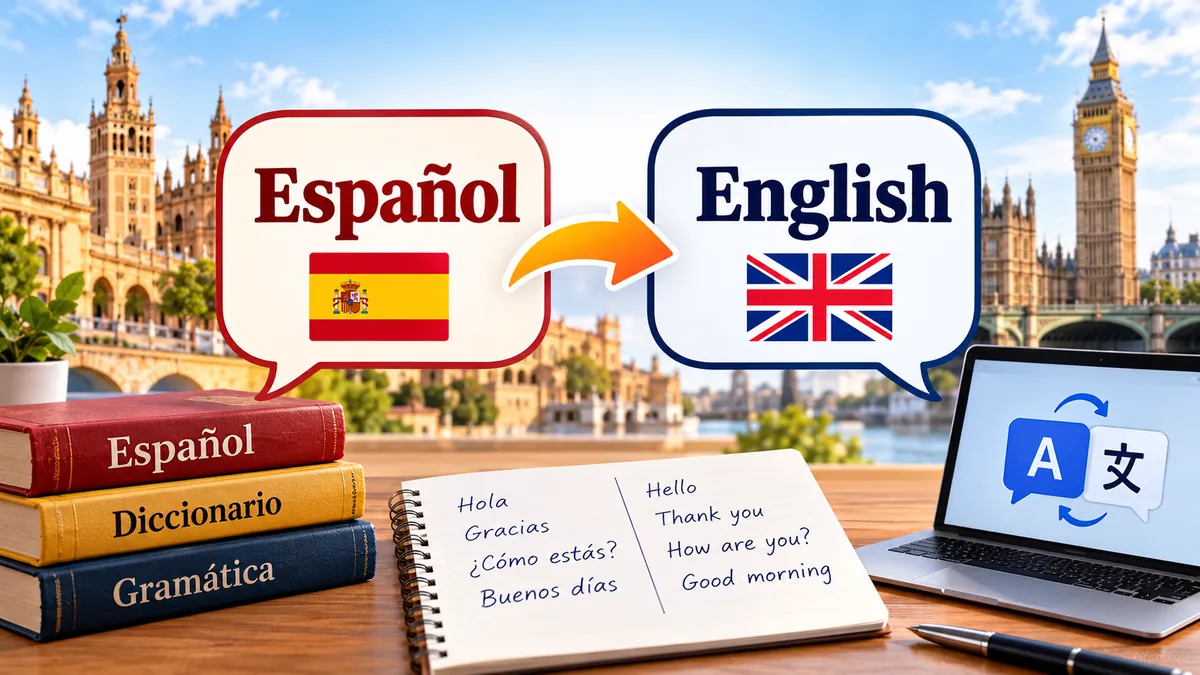
Translating Spanish into English is more than replacing individual words. A Spanish sentence may have a completely different structure, expression, or tone when translated naturally into English.
If you need to translate to spanish to english, start by understanding the original sentence, identifying its context, and choosing English wording that preserves its meaning. Online translation tools can help with everyday conversations, documents, travel phrases, and unfamiliar vocabulary, but checking grammar, idioms, and regional differences is essential for accuracy.
How to translate to spanish to english accurately
The simplest way to translate Spanish into English is to read the complete Spanish text, understand its meaning, and rewrite it in natural English rather than translating each word separately.
For example:
Spanish
¿Cómo estás?
English
How are you?
The Spanish expression translates naturally into English without requiring a word-for-word explanation.
Step-by-step translation process
- Read the entire sentence. Identify the main idea before translating individual words.
- Determine the context. Check whether the text is formal, informal, technical, or conversational.
- Identify the verb tense. Spanish uses several past tenses and a subjunctive mood that may require careful interpretation.
- Translate the meaning. Choose English expressions that communicate the original message.
- Review grammar and word order. Adjust the sentence to sound natural in English.
- Check unfamiliar expressions. Verify idioms, regional vocabulary, and words with multiple meanings.
- Proofread the result. Confirm that names, dates, numbers, and important details remain accurate.
Consider the sentence Tengo 25 años. A literal translation would be “I have 25 years,” but the correct English expression is “I am 25 years old.”
This illustrates why understanding grammatical differences matters.
Common Spanish words and their English meanings
Learning everyday Spanish vocabulary makes translation faster and helps you recognize errors in automated translations.
| Spanish | English |
|---|---|
| Hola | Hello |
| Adiós | Goodbye |
| Gracias | Thank you |
| Por favor | Please |
| Buenos días | Good morning |
| Buenas noches | Good evening / Good night |
| Sí | Yes |
| No | No |
| Agua | Water |
| Comida | Food |
| Casa | House / Home |
| Escuela | School |
| Trabajo | Work / Job |
| Amigo / Amiga | Friend |
| Familia | Family |
Some Spanish words have several possible English equivalents. For example, tiempo can mean “time” or “weather,” depending on the sentence.
In No tengo tiempo, the word means “time.” In Hace buen tiempo, it refers to pleasant weather.
Useful Spanish-to-English sentences
| Spanish sentence | Natural English translation |
|---|---|
| ¿Cómo te llamas? | What is your name? |
| Me llamo Ana. | My name is Ana. |
| ¿Dónde está el baño? | Where is the bathroom? |
| No entiendo. | I don’t understand. |
| ¿Hablas inglés? | Do you speak English? |
| Necesito ayuda. | I need help. |
| ¿Cuánto cuesta? | How much does it cost? |
| Tengo hambre. | I’m hungry. |
| Estoy cansado. | I’m tired. |
| Hasta mañana. | See you tomorrow. |
These expressions are useful for travel, language learning, everyday communication, and understanding basic Spanish conversations.
Best tools for Spanish-to-English translation
Online translators provide a convenient starting point for understanding Spanish text. However, different tools have different strengths, particularly when handling long sentences, pronunciation, and idiomatic language.
Google Translate
Google Translate supports Spanish-to-English text translation, speech translation, camera-based translation, and document translation in supported environments.
It is particularly useful for everyday vocabulary, short messages, travel situations, and signs.
For example, you can enter ¿Dónde está la estación de tren? and receive “Where is the train station?”
Its camera feature can also help interpret Spanish text printed on menus, notices, and other physical materials.
Machine-generated translations should still be reviewed when accuracy is critical.
DeepL Translator
DeepL Translator is another widely used translation tool. It can produce fluent English wording for many Spanish sentences, including longer passages.
It can be useful for emails, articles, and professional communication where sentence flow matters.
However, fluent output does not automatically guarantee that the translation is accurate. Important terminology and subtle meanings still require checking.
SpanishDict
SpanishDict combines dictionary entries, translations, conjugation information, pronunciation assistance, and examples.
It is especially helpful when a Spanish word has several meanings or when you need to understand how a verb changes.
For instance, looking up ser and estar can help explain why Spanish has two common verbs corresponding to the English verb “to be.”
Reverso Context
Reverso Context provides example translations in different contexts.
This is useful for expressions that cannot be translated accurately by looking at individual words.
When using example-based tools, compare multiple examples and check whether the source matches your intended meaning.
Comparing translation tools
| Tool | Particularly useful for | Main limitation |
|---|---|---|
| Google Translate | Everyday text, speech, camera translation | May miss nuance |
| DeepL | Fluent sentences and longer passages | Can still misinterpret context |
| SpanishDict | Vocabulary, conjugation, grammar | Not primarily a full-document workflow |
| Reverso Context | Expressions and contextual examples | Examples require interpretation |
For important translations, comparing two tools and checking uncertain phrases against a reliable dictionary can improve accuracy.
Understanding Spanish grammar when translating into English
Spanish and English share many linguistic features, but their grammar systems differ in several important ways. Understanding these differences helps prevent translations that sound awkward or change the original meaning.
Spanish sentence structure and word order
Both languages commonly follow a subject-verb-object pattern.
For example:
- Spanish: María come una manzana.
- English: Maria eats an apple.
However, Spanish allows greater flexibility in sentence structure. It also frequently omits subject pronouns because verb endings already indicate the person performing an action.
For example, Hablo español translates to “I speak Spanish.” The Spanish sentence does not need yo because hablo already identifies the first-person singular subject.
When translating, English subject pronouns often need to be added.
Understanding ser and estar
One common translation challenge involves the Spanish verbs ser and estar.
Both usually correspond to the English verb “to be,” but they describe different kinds of information.
| Spanish | English | Explanation |
|---|---|---|
| Soy estudiante. | I am a student. | Identity or role |
| Estoy feliz. | I am happy. | Emotional state |
| Ella es doctora. | She is a doctor. | Profession |
| Ella está enferma. | She is sick. | Physical condition |
| Madrid está en España. | Madrid is in Spain. | Location |
Ser generally describes identity, classification, origin, and defining characteristics. Estar commonly describes conditions, states, and locations. There are exceptions, so the distinction is more reliable than simply thinking of permanent versus temporary qualities.
SpanishDictionary.com
+1
Spanish verb tenses and English equivalents
Spanish has multiple past-tense forms that communicate different relationships between actions and time.
Consider these examples:
| Spanish | English |
|---|---|
| Yo trabajo. | I work. |
| Estoy trabajando. | I am working. |
| Trabajé ayer. | I worked yesterday. |
| Trabajaba aquí. | I used to work here. |
| He trabajado mucho. | I have worked a lot. |
| Trabajaré mañana. | I will work tomorrow. |
The Spanish imperfect tense often describes habitual or ongoing past actions, while the preterite commonly describes completed past events.
For example, Cuando era niño, jugaba al fútbol naturally translates to “When I was a child, I used to play soccer.”
Translating every past-tense verb simply as “did” or “was” can remove important meaning.
Gender and number agreement
Spanish nouns have grammatical gender, and adjectives generally agree with the nouns they describe.
For example:
- El libro rojo — The red book.
- La casa roja — The red house.
- Los libros rojos — The red books.
- Las casas rojas — The red houses.
English adjectives usually remain unchanged regardless of gender or number.
Spanish also distinguishes masculine and feminine forms in many occupations and descriptions. Translators should preserve the intended meaning without adding gender assumptions where the English sentence does not require them.
Translating Spanish expressions and idioms into English
Idiomatic expressions are among the most difficult parts of Spanish-to-English translation because their meanings cannot always be understood from individual words.
An idiom communicates an idea that may be completely different from its literal wording.
Common Spanish idioms
| Spanish expression | Natural English meaning |
|---|---|
| Estar en las nubes | To have your head in the clouds |
| Meter la pata | To put your foot in your mouth / Make a blunder |
| Costar un ojo de la cara | To cost an arm and a leg |
| Ser pan comido | To be a piece of cake |
| Estar hecho polvo | To be exhausted |
| Hablar por los codos | To talk someone’s ear off |
| No tener pelos en la lengua | To speak one’s mind |
| Dar en el clavo | To hit the nail on the head |
For example, Este examen es pan comido should be translated as “This exam is a piece of cake,” meaning that the exam is very easy.
Translating the expression as “This exam is eaten bread” would not communicate the intended meaning.
Words that look similar but mean different things
Spanish and English contain many cognates: words with similar forms and related meanings.
Examples include animal, hospital, and natural.
However, some similar-looking words have different meanings. These are known as false friends.
| Spanish word | Actual English meaning | Common confusion |
|---|---|---|
| Embarazada | Pregnant | Embarrassed |
| Actualmente | Currently | Actually |
| Éxito | Success | Exit |
| Carpeta | Folder | Carpet |
| Librería | Bookstore | Library |
| Asistir | To attend | To assist |
| Sensible | Sensitive | Sensible |
| Ropa | Clothing | Rope |
These vocabulary traps can produce serious misunderstandings, especially in professional, medical, and educational contexts.
MuyVerbs
A useful habit is to verify unfamiliar words even when they closely resemble English vocabulary.
How to translate to spanish to english for different purposes
Translation requirements vary depending on the type of content. A casual text message does not require the same approach as a legal agreement or academic document.
Translating everyday conversations
Conversational Spanish frequently includes contractions, slang, shortened expressions, and regional vocabulary.
For example:
¿Qué tal? can mean “How’s it going?” rather than the more literal “How such?”
Similarly, Vale is commonly used in Spain to express agreement and may translate as “Okay” or “All right.”
The goal is to preserve the speaker’s meaning and conversational tone.
Translating Spanish documents into English
Documents require careful attention to structure, terminology, dates, and names.
A practical process involves extracting the text, translating it, and checking each section against the original.
For PDF files, Microsoft Word documents, and presentations, tools such as DeepL offer document-translation functionality, although supported formats and usage limits may vary.
deepl.com
When translating official documents, preserve:
- Personal names and identification details.
- Dates, addresses, and reference numbers.
- Section headings and document structure.
- Legal, medical, or technical terminology.
- Units of measurement and monetary values.
For immigration, court, academic, or other official purposes, check whether the receiving institution requires a certified translation. Automated translation may not satisfy those requirements.
Translating Spanish audio into English
Spoken translation introduces additional challenges, including accents, background noise, pronunciation, and speaking speed.
Speech translation tools can help interpret conversations, but automatic speech recognition may mishear names or unfamiliar terminology.
For better results, use clear recordings, minimize background noise, and review the transcription before relying on its English translation.
Google Translate provides speech and image translation features, as described in its official help resources.
Google Support
Translating Spanish websites and online articles
Website translation requires attention to headings, navigation menus, hyperlinks, and context.
A browser’s built-in translation feature can help readers understand Spanish-language websites quickly.
However, automatically translated pages may contain errors in technical terminology or expressions that depend on cultural context.
For published English content, review the translation for clarity, factual accuracy, and consistency.
Regional differences between Spanish in Spain and Latin America
Spanish is spoken across many countries, including Spain, Mexico, Colombia, Argentina, Chile, and Peru.
Although speakers generally share the same language, vocabulary and everyday expressions can vary significantly.
Regional vocabulary differences
| Meaning | Spain | Common Latin American alternative |
|---|---|---|
| Computer | Ordenador | Computadora |
| Car | Coche | Carro / Auto |
| Mobile phone | Móvil | Celular |
| Juice | Zumo | Jugo |
| Apartment | Piso | Departamento / Apartamento |
These examples are broad regional tendencies rather than universal rules.
A word commonly used in Mexico may be unfamiliar in Spain, while an expression from Argentina may have a different meaning elsewhere.
SpanishDict includes regional translations and example sentences that can help identify these distinctions.
Spanish to English to Spanish Translator
Formal and informal Spanish
Spanish distinguishes between informal and formal forms of address.
Tú generally represents informal singular “you,” while usted is commonly used for formal or respectful address.
English normally translates both as “you.”
For example:
- ¿Cómo estás? — How are you?
- ¿Cómo está usted? — How are you?
Although the English translations are identical, the Spanish sentences communicate different levels of formality.
A translator can preserve this distinction through surrounding wording and tone when appropriate.
Spanish also uses vos in several Latin American regions, while vosotros is used for informal plural address in much of Spain.
Common Spanish-to-English translation mistakes
Many translation errors occur because Spanish and English express the same ideas through different grammatical patterns.
Translating every word literally
A literal translation may be grammatically incorrect even when every individual word has been identified correctly.
For example:
Me gusta la música.
Literal interpretation: “To me pleases the music.”
Natural translation: “I like music.”
The natural English sentence communicates the original meaning clearly.
Ignoring accent marks
Spanish accent marks can distinguish words with different meanings or grammatical functions.
| Spanish | English meaning |
|---|---|
| Sí | Yes |
| Si | If |
| Tú | You |
| Tu | Your |
| Él | He |
| El | The |
| Más | More |
| Mas | But (literary usage) |
Punctuation also matters. Spanish uses inverted question marks and exclamation marks at the beginning of questions and exclamations.
For example, ¿Qué quieres? translates to “What do you want?”
Missing the subject of a sentence
Spanish often omits subject pronouns.
For example, Está cansado can mean “He is tired,” “You are tired” in formal address, or another interpretation depending on context.
An automated translator may select one subject even when the original text does not identify it.
When the subject is unclear, check the preceding sentences rather than guessing.
Confusing por and para
The Spanish prepositions por and para can both correspond to English “for,” but they express different relationships.
For example:
Lo hice por ti. — I did it for you (because of you or on your behalf).
Este regalo es para ti. — This gift is for you (intended for you).
The distinction matters because translating both without considering their functions can alter the message.
How to improve Spanish-to-English translation accuracy
Accurate translation combines language knowledge, contextual understanding, and careful editing.
Use complete sentences rather than isolated words
A Spanish word may have several meanings.
For example, banco can mean a financial institution or a bench.
Translating the complete sentence makes it easier to identify the intended meaning.
Me senté en el banco del parque means “I sat on the park bench,” while Fui al banco a retirar dinero means “I went to the bank to withdraw money.”
Compare alternative translations
When a sentence seems unclear, compare results from different translation tools.
Look for differences in verb tense, subject identification, terminology, and tone.
If two tools produce different translations, investigate the original sentence rather than assuming either result is correct.
Check pronunciation when translating spoken Spanish
Spanish pronunciation is relatively consistent compared with English, but regional accents and connected speech can make listening difficult.
Learning basic sound patterns can improve recognition.
For example, Spanish h is normally silent, while the letter j commonly represents a sound similar to the English “h” in “house,” although its exact pronunciation varies by region.
Listening to native-speaker recordings can help connect written vocabulary with spoken language.
Preserve context and cultural meaning
Words sometimes carry cultural associations that do not have exact English equivalents.
For example, sobremesa refers to the time spent talking or relaxing at the table after a meal.
A translator may need to use a descriptive English phrase rather than searching for a single equivalent word.
Similarly, estrenar can mean to wear, use, or present something for the first time, depending on context.
These expressions demonstrate why cultural understanding contributes to accurate translation.
Review important translations manually
Before using a translated document, compare it with the Spanish original.
Pay particular attention to negation, numbers, conditions, obligations, and deadlines.
For example, confusing debe (“must” or “should,” depending on context) with puede (“can” or “may”) can substantially change instructions or contractual meaning.
Sensitive information should also be handled carefully. Avoid uploading confidential documents to translation services without checking their privacy and data-handling policies.
Practical Spanish-to-English translation examples
The following examples demonstrate how different Spanish sentence structures become natural English.
Everyday conversation
Spanish:
Hola, ¿cómo estás? Espero que tengas un buen día.
English:
Hello, how are you? I hope you have a good day.
This example shows how a common Spanish greeting and expression of goodwill translate naturally into English.
Professional communication
Spanish:
Le agradecemos su mensaje. Nos pondremos en contacto con usted lo antes posible.
English:
Thank you for your message. We will contact you as soon as possible.
The formal tone is preserved without unnecessarily complicated English wording.
Travel instructions
Spanish:
Gire a la derecha en la próxima calle y continúe hasta llegar a la estación.
English:
Turn right at the next street and continue until you reach the station.
This translation preserves the sequence of instructions and uses natural English imperatives.
Academic writing
Spanish:
Los resultados del estudio indican una relación significativa entre las dos variables.
English:
The study results indicate a significant relationship between the two variables.
Academic translation requires precise terminology and should avoid changing the strength or certainty of the original statement.
A sentence with multiple possible meanings
Spanish:
Se lo dije ayer.
Possible English translation:
I told him yesterday. / I told her yesterday. / I told you yesterday.
The Spanish sentence includes object pronouns whose exact English equivalents depend on the surrounding context.
Without additional information, choosing one interpretation with certainty would be inappropriate.
Can automated translation replace a human translator?
Machine translation has become increasingly useful for understanding foreign-language text, especially routine communication and common expressions.
Its main advantage is speed. A translation tool can process a sentence or long passage much faster than manual translation.
However, automated systems can misunderstand ambiguous sentences, specialized terminology, cultural references, and implied meanings.
Human translators remain valuable when precision, accountability, or cultural interpretation is essential.
For everyday reading, travel, and informal messages, automated translation is often sufficient as a starting point. For medical reports, legal documents, contracts, and official records, qualified human review is the safer approach.
Final thoughts on translate to spanish to english
Learning how to translate to spanish to english accurately involves more than understanding vocabulary. Grammar, verb tenses, regional expressions, idioms, and context all influence the final meaning.
Tools such as Google Translate, DeepL, SpanishDict, and Reverso can make the process easier, but careful review remains essential.
Start with complete sentences, identify the intended meaning, and choose natural English expressions. As your understanding of Spanish grammar and vocabulary improves, you will become better at recognizing translation errors and communicating the original message clearly.
