

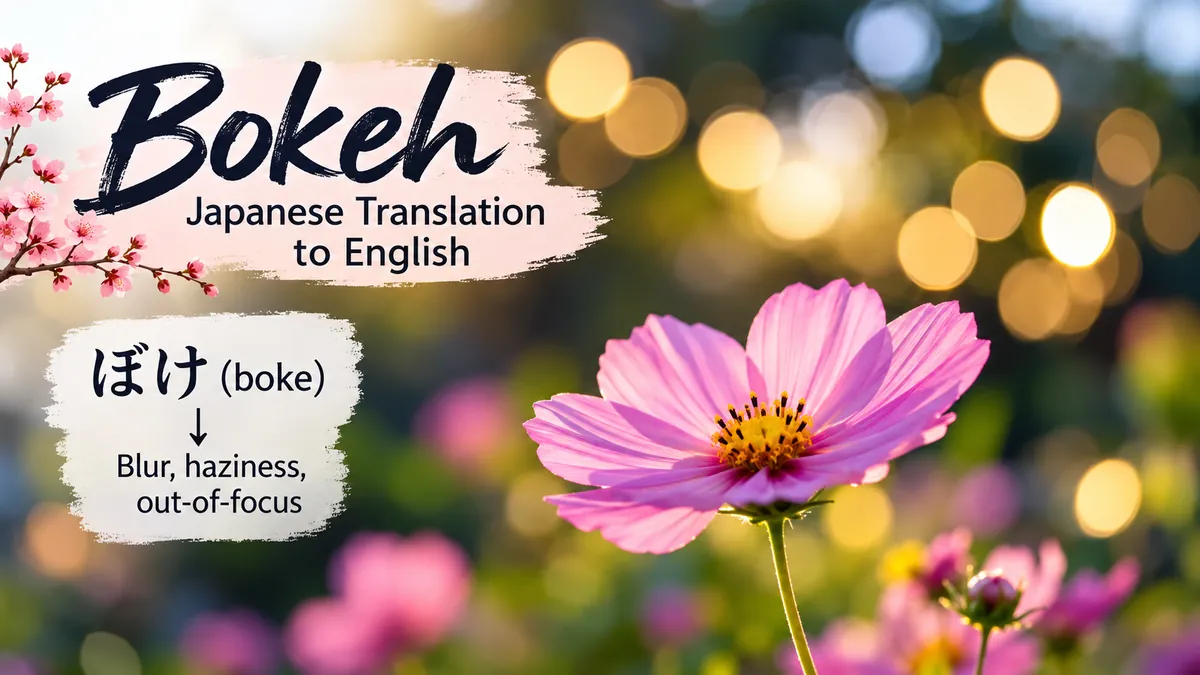
The word bokeh appears everywhere in photography, especially when describing portraits with beautifully blurred backgrounds. But what does it actually mean in Japanese, and how did it become such a familiar English photography term?
The bokeh japanese translation to english is closely related to the Japanese word boke (ぼけ), meaning blur, haziness, or an out-of-focus appearance. In photography, bokeh refers to the visual quality of out-of-focus areas in an image, particularly how background highlights and blurred details are rendered by a camera lens.
Although photographers often use bokeh to describe soft, dreamy backgrounds, its original Japanese meaning has a broader linguistic history.
What Does Bokeh Mean in Japanese?
Bokeh comes from the Japanese term boke (ぼけ or ボケ). Its meaning depends on the context in which it appears.
In photography, it generally refers to blur or the appearance of out-of-focus image areas. Outside photography, the same pronunciation can have other meanings.
| Japanese term | English meaning | Context |
|---|---|---|
| ぼけ (boke) | Blur, haziness | General and photographic usage |
| ボケ (boke) | Blur; comic fool or funny remark | Photography and Japanese comedy |
| 暈け (boke) | Blurring, indistinctness | Written Japanese |
| ぼける (bokeru) | To become blurred or unfocused | Verb |
| ボケ味 (boke-aji) | Quality or character of blur | Photography |
The Japanese expression boke-aji (ボケ味) is particularly relevant to photography. The second element, aji (味), literally means taste or flavor but can also describe a distinctive character or aesthetic quality.
Consequently, boke-aji can be understood as the character or quality of blur.
This explains why photographers distinguish between ordinary background blur and aesthetically pleasing bokeh.
bokeh japanese translation to english: Why the Word Has Different Meanings
Japanese words often have multiple meanings depending on their spelling, context, and usage.
The pronunciation boke illustrates this characteristic.
Bokeh as Blur or Haziness
The photographic meaning comes from the idea of something appearing indistinct, blurred, or out of focus.
For example, when a photographer focuses sharply on a flower while allowing distant lights to become soft circles, the background contains out-of-focus blur.
The visual characteristics of that blur are what photographers call bokeh.
Boke in Everyday Japanese
The related verb bokeru (ぼける) can describe something becoming blurry or indistinct.
Depending on context, it can also refer to mental absentmindedness or confusion. Certain uses involving cognitive decline may sound insensitive when applied to people, so context matters.
These everyday meanings should not be confused with the specialized photography term.
Boke in Japanese Comedy
In Japanese comedy, particularly manzai, the boke is the performer who says or does something deliberately foolish, while the tsukkomi responds with corrections or humorous criticism.
This comedic meaning is unrelated to photographic background blur, even though the romanized spelling is similar.
Understanding these distinctions prevents common translation mistakes.
How Did Bokeh Become an English Photography Term?
The English photography term developed from Japanese photographic vocabulary.
One influential moment came in 1997, when Photo Techniques magazine published a series of articles discussing bokeh.
Editor Mike Johnston helped popularize the spelling bokeh among English-speaking photographers.
The added final letter h helped guide English readers toward a pronunciation closer to the Japanese original.
The term subsequently became common in photographic discussions, lens reviews, and digital photography education.
Why English Uses Bokeh Instead of Boke
Japanese words written in the Latin alphabet are called romanized Japanese.
The Japanese pronunciation of ぼけ is approximately bo-keh, with two distinct syllables.
English readers might pronounce boke to rhyme with “poke,” which would differ considerably from the Japanese pronunciation.
The spelling bokeh helps discourage that interpretation.
Today, bokeh is an established English photography term rather than simply a foreign word requiring translation.
What Does Bokeh Mean in Photography?
In photography, bokeh describes the aesthetic quality of out-of-focus areas, not merely the amount of blur.
This distinction matters because two photographs can have similarly blurred backgrounds but noticeably different visual characteristics.
One lens might create smooth, rounded highlights and gentle transitions, while another produces bright-edged circles or distracting patterns.
Both images contain background blur, but their bokeh differs.

Example of shallow depth of field producing a sharply focused subject against a soft, out-of-focus background.
Bokeh vs. Background Blur
People sometimes use these terms interchangeably, but they describe different aspects of an image.
| Feature | Background blur | Bokeh |
|---|---|---|
| Main meaning | Out-of-focus background | Visual character of out-of-focus areas |
| Primary concern | Amount of blur | Appearance and rendering of blur |
| Influenced by | Aperture, distance, focal length | Lens optics, aperture design, aberrations |
| Common description | Strong or weak | Smooth, nervous, creamy, harsh |
| Visual example | Unfocused trees | Soft circular highlights among the trees |
A large amount of background blur does not automatically guarantee attractive bokeh.
The optical design of the lens influences how those blurred areas appear.
What Is Good Bokeh?
Photographers often describe attractive bokeh as smooth, creamy, soft, or unobtrusive.
Common characteristics include gentle transitions between light and dark areas, rounded out-of-focus highlights, and backgrounds that do not compete with the subject.
However, attractive bokeh is subjective.
Some photographers prefer perfectly smooth backgrounds, while others deliberately choose lenses that create unusual optical effects.
For example, vintage lenses sometimes produce swirling patterns that are visually distinctive even though they would not qualify as neutral or perfectly smooth rendering.
What Creates Bokeh in a Photograph?
Bokeh results from the way a camera lens renders light originating outside the plane of focus.
Several factors influence its appearance.
1. Aperture and F-Number
Aperture refers to the opening through which light enters a camera lens.
A wider aperture, represented by a smaller f-number such as f/1.4 or f/1.8, often produces shallower depth of field and stronger background blur under otherwise comparable conditions.
A narrower aperture, such as f/8 or f/11, generally increases depth of field.
However, aperture alone does not determine bokeh quality.
2. Aperture Blade Shape
Many lenses contain several aperture blades that form the opening through which light passes.
When the lens is stopped down, the number and curvature of these blades can influence the shape of out-of-focus highlights.
Rounded blades tend to preserve more circular highlights, while straight-edged blades may create polygonal shapes.
3. Subject and Background Distance
Distance plays a major role in the appearance of background blur.
When a subject is relatively close to the camera and the background is much farther away, the background can become substantially more blurred.
This is one reason portrait photographers often position subjects away from walls, trees, or other background objects.
4. Focal Length
Longer focal lengths can help produce prominent background blur, particularly when the camera position and framing are chosen appropriately.
For example, an 85mm portrait lens can produce a different background appearance from a 35mm wide-angle lens.
However, comparing focal lengths requires considering subject distance, framing, aperture, and sensor size.
5. Optical Lens Design
Lens design affects how light is distributed within out-of-focus highlights.
Spherical aberration, chromatic aberration, mechanical vignetting, and other optical characteristics can influence bokeh.
Some lenses produce smooth highlight discs, while others show bright outlines, onion-ring patterns, or cat’s-eye shapes near the image edges.
These effects are especially visible when photographing small lights against a darker background.
Different Types of Bokeh in Photography
Not all lenses render out-of-focus areas in the same way. Photographers use several descriptive terms to explain the differences.

Creamy Bokeh
Smooth, gentle blur with minimal distracting texture. Often preferred for portrait, flower, and product photography.

Circular Bokeh
Round out-of-focus highlights, commonly visible when photographing streetlights, decorative lights, or reflections.

Swirly Bokeh
Background details appear to curve or swirl around the center of the image. Certain vintage lens designs are known for this effect.

Cat’s-Eye Bokeh
Highlights near the edges of the frame become oval or elongated, often because of optical vignetting.
Another term, nervous bokeh, describes blur containing busy outlines or distracting detail. Photographers may find it less suitable for certain portraits, although it can create an interesting artistic effect.
How to Pronounce Bokeh Correctly
The Japanese word boke is pronounced approximately boh-keh, with two syllables.
The first syllable resembles the beginning of “bone,” while the second has a short vowel similar to the sound in “Ken.”
Japanese pronunciation does not use the same strong syllable stress commonly found in English.
In English, however, pronunciations vary. Dictionaries recognize versions such as “BOH-kuh” and “BOH-kay.”
PetaPixel
+1
The final letter h is not pronounced as a separate sound.
Common Pronunciation Mistakes
The most frequent mistake is treating bokeh as a one-syllable English word rhyming with “smoke.”
Another is assuming that the word originated in English because it appears in camera manuals and photography applications.
Its linguistic origin remains Japanese, even though its spelling and pronunciation have been adapted for English speakers.
How to Create a Bokeh Effect With a Camera
Understanding the bokeh japanese translation to english becomes more useful when you can recognize the effect in actual photographs.
You do not necessarily need an expensive professional camera to experiment with bokeh.
Try the following process:
- Choose a clear subject. A flower, decorative object, or pet can work well.
- Find a distant background. Look for trees, small lights, or textured scenery several feet behind your subject.
- Use a wide aperture. If your camera allows it, try f/1.8, f/2.8, or another relatively wide aperture.
- Move closer to the subject. Maintain enough distance for your lens to focus correctly.
- Focus precisely. Place the focus point on the most important detail of the subject.
- Take several photographs. Change your position and compare the appearance of the background.
- Inspect the highlights. Notice whether they appear round, smooth, outlined, or irregular.
You can repeat the experiment with different lenses or apertures to observe how the blur changes.
Can Smartphones Create Bokeh?
Yes. Modern smartphones can produce bokeh-like effects using optical blur, computational photography, or a combination of both.
Portrait mode commonly uses depth estimation and image processing to simulate a shallow depth of field.
This can produce attractive results, although software sometimes makes mistakes around hair, transparent objects, glasses, and other complicated edges.
For more natural results, use a clearly separated subject and background, avoid excessive simulated blur, and check the subject’s outline after taking the photograph.
Bokeh, Depth of Field, and Focus: Key Differences
Three photography concepts frequently appear together: bokeh, depth of field, and focus.
They are related but not identical.
Focus describes the distance at which the lens forms a sharply defined image of a subject.
Depth of field describes the range of distances that appear acceptably sharp in a photograph.
Bokeh describes the appearance of image areas outside that range.
A shallow depth of field often makes bokeh more noticeable because larger portions of the image are out of focus.
However, photographers can also create images with extensive depth of field, keeping foreground and background details relatively sharp.
Neither approach is inherently better. The appropriate choice depends on the subject and the intended visual result.
Related Japanese Words That Help Explain Bokeh
Several Japanese expressions demonstrate how the idea of blur, haziness, or indistinctness appears in everyday language.
| Japanese expression | Romanization | English meaning |
|---|---|---|
| ピンぼけ | Pinboke | Out of focus |
| ボケ味 | Boke-aji | Quality of blur |
| 時差ボケ | Jisa-boke | Jet lag |
| 寝ぼける | Nebokeru | To be half-asleep or groggy |
| ぼかし | Bokashi | Blurring, shading, or gradation |
| ぼかす | Bokasu | To blur or make indistinct |
These expressions are not interchangeable.
For example, pinboke often describes an image that is unintentionally out of focus, whereas boke-aji concerns the character of out-of-focus rendering.
Similarly, bokashi can refer to deliberate gradation or softening in visual arts, including painting and image processing.
The relationship between these terms demonstrates why translating bokeh as simply “blur” captures its basic origin but not its complete photographic meaning.
Wiktionary, the free dictionary
+1
Common Misunderstandings About the Meaning of Bokeh
Does Bokeh Mean Beautiful Blur?
Not literally.
The original Japanese word refers to blur or haziness without necessarily describing it as beautiful.
The idea of attractive or unattractive bokeh comes from how photographers evaluate the visual characteristics of out-of-focus areas.
Is Bokeh the Same as Motion Blur?
No. Motion blur occurs when movement is recorded during an exposure.
Bokeh concerns how the lens renders areas that are outside the plane of focus.
A photograph can contain both effects simultaneously, but they result from different mechanisms.
Is Bokeh a Japanese Aesthetic Philosophy?
Bokeh is a Japanese-derived photographic term, not a traditional philosophical system.
It is sometimes discussed alongside Japanese aesthetic concepts such as wabi-sabi, but these associations should not be mistaken for its literal linguistic meaning.
Does Every Lens Produce Bokeh?
Every conventional photographic lens can render out-of-focus areas, but the visibility and character of those areas vary.
Lens design, aperture, focal length, focusing distance, and scene composition all affect the result.
Some lenses are particularly admired for smooth blur, while others are valued for sharpness, portability, or distinctive rendering.
Is Bokeh Always in the Background?
No. Bokeh can also appear in the foreground.
For example, a photographer might focus on a distant subject while allowing nearby leaves or flowers to become blurred.
The aesthetic appearance of those out-of-focus foreground elements is also part of the photograph’s bokeh.
Why Understanding the Japanese Meaning Matters
Knowing the linguistic origin of bokeh helps explain why the term has a more specific meaning than ordinary background blur.
It also makes photography terminology easier to understand.
When a lens review describes smooth bokeh, it is evaluating how the lens renders out-of-focus details, not merely how much blur it creates.
When a Japanese photography article refers to boke-aji, it emphasizes the character or quality of that blur.
This distinction is useful when comparing lenses, learning portrait photography, interpreting photography tutorials, or translating Japanese camera terminology into English.
The term also provides an example of how specialized Japanese vocabulary can enter English while retaining much of its original meaning.
Final Thoughts on bokeh japanese translation to english
The simplest answer to bokeh japanese translation to english is “blur,” “haze,” or “fuzziness.”
The word originates from Japanese boke (ぼけ), while the related expression boke-aji refers to the quality or character of blur.
In modern photography, bokeh has developed a specialized meaning: the aesthetic appearance of out-of-focus areas produced by a lens or simulated digitally.
Remembering the distinction between blur and bokeh makes it easier to understand lens reviews, camera settings, and photographic composition. The next time you notice soft background lights or gentle out-of-focus details, you can recognize not only the visual effect but also the Japanese language behind its name.
