

Translating Latin can seem simple when you recognize familiar words. The difficulty begins when those words appear with unfamiliar endings, unusual word order, or meanings that change with context.
A reliable latin to english translation is not produced by replacing every Latin word with its nearest English equivalent. Latin is a highly inflected language, so endings communicate grammatical information that English often expresses through word order. Accurate translation requires identifying forms, understanding sentence structure, interpreting context, and then writing natural English. Loretrans
This guide explains how to translate Latin words, sentences, phrases, and longer passages into English while avoiding the mistakes that commonly produce awkward or incorrect results.
What Does latin to english Translation Mean?
Latin to English translation is the process of interpreting a Latin word, phrase, sentence, or passage and expressing its meaning accurately in English.
That distinction matters. Translation is about meaning, not merely matching vocabulary.
Consider:
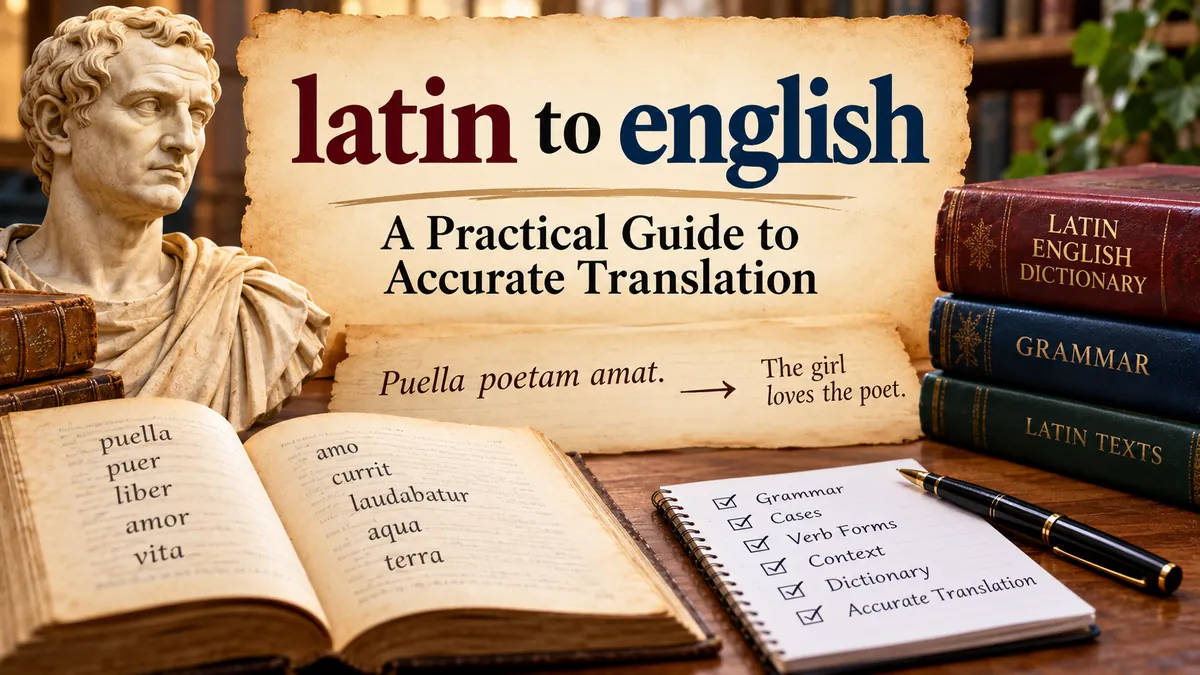
Puella poetam amat.
A basic dictionary gives:
- puella — girl
- poetam — poet
- amat — loves
The natural English translation is:
The girl loves the poet.
The endings help establish the grammatical roles. Puella is nominative and functions as the subject, while poetam is accusative and functions as the direct object.
This is one reason Latin cannot always be translated reliably by reading words strictly from left to right.
Why Latin to English Translation Can Be Difficult
English depends heavily on word order.
Compare:
The dog bites the man.
with:
The man bites the dog.
Changing the order changes who performs the action.
Latin works differently because inflectional endings carry much of this grammatical information. Nouns decline, verbs conjugate, and adjectives change their forms to agree with the words they modify.
Consequently, successful translation depends on several elements working together:
| Element | What You Need to Identify | Why It Matters |
|---|---|---|
| Noun | case, number, gender | Reveals grammatical function |
| Verb | person, number, tense, voice, mood | Reveals the action and how it functions |
| Adjective | case, number, gender | Shows which noun it modifies |
| Pronoun | form and antecedent | Clarifies who or what is referenced |
| Preposition | governing case | Helps establish relationships |
| Conjunction | relationship between clauses | Connects ideas correctly |
| Context | surrounding meaning | Helps select the right English definition |
A translator therefore has two jobs: decode the Latin grammar and reconstruct the meaning in natural English.
Understand Latin Cases Before Translating
One of the biggest improvements a beginner can make is to stop treating noun endings as optional details.
Latin nouns commonly appear in six principal cases: nominative, genitive, dative, accusative, ablative, and vocative. A locative case also survives in a limited group of words.
Nominative
The nominative commonly identifies the subject of a sentence.
Puer currit.
The boy runs.
Here, puer is the person performing the action.
Genitive
The genitive commonly expresses possession or association.
Liber pueri
The boy’s book or the book of the boy
English frequently expresses this relationship with of or an apostrophe-s construction.
Dative
The dative often represents an indirect object.
Puella puero librum dat.
The girl gives the boy a book.
Puero identifies the recipient.
Accusative
The accusative frequently marks a direct object.
Puer librum legit.
The boy reads the book.
It can also appear after particular prepositions and in other constructions.
Ablative
The ablative is especially flexible. Depending on the construction, it can express ideas such as means, manner, accompaniment, separation, place, or time.
That flexibility makes context particularly important.
Vocative
The vocative is used for direct address.
Marce, veni!
Marcus, come!
Recognizing cases before deciding on English word order prevents many basic translation errors.
Latin Word Order Is More Flexible Than English Word Order
A common beginner mistake is translating Latin in exactly the order in which the words appear.
Latin frequently uses subject-object-verb patterns, although its word order is flexible and authors can rearrange words for emphasis, style, rhythm, contrast, or literary effect.
Take a simple sentence:
Agricola aquam portat.
A literal sequence might be:
Farmer water carries.
Normal English requires:
The farmer carries water.
The grammatical endings—not merely position—help determine each word’s role.
This flexibility becomes increasingly important when reading authors such as Caesar, Cicero, Ovid, and Vergil, where sentence structures can become substantially more complex.
Do Not Assume the First Noun Is the Subject
Instead, examine the noun’s case.
Likewise, do not assume that a noun appearing before a verb performs the action. Its ending may show that it is actually the object.
A useful rule is:
Parse first; reorder second.
Start with the Verb
When facing an unfamiliar sentence, locating the main verb is often the fastest way to establish its basic structure. This approach also appears in traditional Latin translation instruction. Classical Conversations
A Latin verb can communicate several pieces of information at once.
For example:
amamus
can mean:
we love
The ending tells you information that English expresses partly through a separate pronoun.
When analyzing a verb, identify:
- Person
- Number
- Tense
- Voice
- Mood
- Dictionary form and meaning
Consider:
laudabatur
Before choosing an English translation, determine its morphology. Recognizing that a verb is passive rather than active can completely change the meaning of the sentence.
Watch for Implied Subjects
Latin does not always require a separate subject pronoun because the verb ending may already identify the subject.
Currimus.
means:
We run.
There does not need to be a separate Latin word meaning we.
Automatically searching for a visible subject can therefore create confusion.
A Step-by-Step Method for latin to english Translation
A systematic method is much more dependable than guessing from familiar vocabulary.
1. Read the Entire Sentence First
Do not immediately translate the first word.
Read through the complete sentence and notice punctuation, conjunctions, recognizable vocabulary, verbs, and possible clauses.
You want an initial picture before making decisions.
2. Find the Main Verb
Identify its person, number, tense, voice, and mood.
Ask:
What is happening?
Then determine who could logically and grammatically perform that action.
3. Identify Nouns and Their Cases
Look at each noun’s ending and determine its possible case and number.
Ask questions such as:
- Which noun is nominative?
- Is there an accusative direct object?
- Is a dative functioning as an indirect object?
- Does a genitive indicate possession?
- What role does the ablative play?
Do not commit too early when a form has multiple possible analyses.
4. Match Adjectives to Nouns
Latin adjectives normally agree with their nouns in case, number, and gender.
They do not necessarily appear directly beside those nouns.
That means proximity alone is not enough.
5. Identify Prepositional Phrases
Prepositions can help narrow down a noun’s grammatical role because particular prepositions govern particular cases.
For example:
cum amico
can mean:
with a friend
Recognizing the phrase as a unit makes the rest of the sentence easier to analyze.
6. Separate Clauses
Long sentences become manageable when divided into components.
Look for conjunctions, relative pronouns, infinitives, participles, and subordinating structures. Determine the main clause before trying to solve every subordinate clause.
7. Produce a Literal Draft
Create a rough version that preserves the grammatical relationships.
It does not need to sound elegant.
The goal at this stage is accuracy.
8. Rewrite It as Natural English
Once the structure is secure, improve the wording.
A good translation should communicate what the Latin says without sounding unnecessarily like Latin.
Quick Takeaway: Do not polish an English sentence before you understand the Latin grammar. A fluent mistranslation is still a mistranslation.
Using a Latin to English Dictionary Correctly
A dictionary is essential, but knowing how to use one matters just as much as owning one.
Latin words change form extensively. If you encounter an inflected form, the exact spelling in your text may not appear as the primary dictionary entry.
Modern digital dictionaries can make this process easier. Latin-English.com, for example, describes its system as capable of parsing Latin inflections and identifying stems while providing grammatical information such as declension and conjugation. Latin-English Dictionary
The Olivetti Latin Dictionary similarly supports searches within inflected Latin forms and recommends treating it as a dictionary rather than assuming it behaves like an automatic sentence translator. Online Latin Dictionary
Learn the Dictionary Forms
Typical dictionary entries provide standardized forms from which other forms can be understood.
For nouns, you might see:
puella, puellae
For verbs:
amo, amare
A serious Latin dictionary may also provide information about gender, declension, conjugation, usage, or alternative meanings.
Do Not Automatically Choose the First Definition
One Latin word may have several English meanings.
Suppose a dictionary offers five possible definitions. The correct choice depends on the sentence, author, period, subject, and grammatical construction.
Vocabulary lookup should therefore answer:
Which meaning fits this passage?
not merely:
What is the first English definition listed?
Dictionary vs. Automatic Latin Translator
These tools solve different problems.
| Tool | Best For | Main Limitation |
|---|---|---|
| Latin-English dictionary | Individual words and meanings | Requires grammatical analysis |
| Morphological parser | Identifying inflected forms | A form may have several possible parses |
| Automatic translator | Getting a quick draft | Can misinterpret complex grammar |
| Grammar reference | Understanding constructions | Requires more time |
| Scholarly lexicon | Detailed contextual meanings | Can overwhelm beginners |
For serious study, combining resources is often better than depending on a single tool.
The Oxford Latin Dictionary is a major lexicographical resource for Classical Latin, while Lewis and Short’s A Latin Dictionary remains another well-known Latin-English reference. Wikipedia
Online resources can be useful for speed. For example, dict.cc maintains a community-developed Latin-English vocabulary database, while other specialist tools provide morphological parsing alongside definitions. dict.cc
Why Automatic Latin Translation Can Go Wrong
Machine translation is convenient, especially when you need the general sense of a passage. But Latin presents several challenges.
Ambiguous Word Forms
One spelling may represent more than one grammatical analysis.
A computer must decide which interpretation fits the sentence.
Sometimes it chooses incorrectly.
Flexible Word Order
English translation systems need to reconstruct a more rigid sentence structure from Latin’s comparatively flexible arrangement.
Multiple Dictionary Meanings
Words change meaning according to context.
A mechanically valid dictionary definition may be completely inappropriate in a particular historical, legal, religious, or literary passage.
Ellipsis
Latin authors sometimes omit words that readers are expected to infer.
Automatic systems may struggle when information is grammatically or contextually implied rather than explicitly written.
Idioms
An idiomatic expression cannot always be translated by adding together the meanings of its individual words.
This is why a translation that looks grammatically polished may still misrepresent the original.
Literal Translation vs. Natural English
Students often wonder how literal a translation should be.
The answer depends on its purpose.
If you are analyzing grammar for a Latin class, a fairly literal version can demonstrate that you understand the construction.
If you are translating for an English reader, readability becomes more important.
Consider the principle:
First understand literally; then translate naturally.
A final translation should preserve essential details such as agency, tense, negation, relationships, emphasis, and logical connections without forcing Latin syntax onto English.
Avoid both extremes.
An excessively literal translation can sound incomprehensible, while an excessively free translation can introduce ideas that are not present in the original.
Classical, Medieval, and Ecclesiastical Latin
Not every Latin text comes from the same period or tradition.
This matters because vocabulary, spelling, syntax, style, and specialized terminology can vary.
Classical Latin
Classical Latin is associated especially with ancient Roman literary and historical texts.
Students may encounter writers such as:
- Cicero
- Julius Caesar
- Vergil
- Ovid
- Livy
A Classical Latin dictionary is usually appropriate for this material.
Medieval Latin
Latin remained important long after antiquity.
Medieval texts may contain vocabulary, meanings, constructions, names, and institutional terminology that differ from Classical usage.
A dictionary focused only on early Classical sources may therefore be insufficient for a medieval document.
Ecclesiastical Latin
Ecclesiastical Latin is strongly associated with Christian texts and the Roman Catholic tradition.
Its vocabulary can reflect theological and liturgical usage. Pronunciation conventions can also differ from reconstructed Classical pronunciation, although pronunciation usually has little effect on the grammatical process of translating a written passage.
Neo-Latin
Latin also continued to be used in scholarship, science, education, diplomacy, and other fields in later periods.
Always identify approximately when and where your text was written before assuming that every dictionary definition applies equally well.
Translating Common Latin Words and Phrases
Short phrases provide useful practice because they show why context still matters even when vocabulary is simple.
| Latin | Common English Meaning |
|---|---|
| salve | hello / greetings |
| vale | farewell / goodbye |
| gratias tibi ago | thank you |
| te amo | I love you |
| non | not / no |
| aqua | water |
| terra | earth / land |
| vita | life |
| amor | love |
| pax | peace |
Online translation resources commonly provide similar basic Latin-English vocabulary and phrase examples. Langlation
However, tables like this should be treated as starting points.
For instance, a Latin noun may need to be translated differently depending on context, and an inflected form encountered in a real text may look different from the nominative dictionary form shown in a vocabulary list.
How Do You Translate an Unknown Latin Word?
Suppose you encounter a word you do not recognize.
Do not simply paste it into a dictionary and accept the first result.
Use this process:
- Identify the likely part of speech.
- Examine the ending.
- Find the dictionary headword or lemma.
- List grammatically possible forms.
- Read the available definitions.
- Compare them with the surrounding sentence.
- Choose the meaning that fits both grammar and context.
Morphological parsing is particularly useful here because Latin’s inflections can make the surface form look quite different from the dictionary headword. Online parsing tools specifically address this problem by finding stems and analyzing inflected forms. Latin-English Dictionary
Common Mistakes When Translating Latin to English
Several habits repeatedly cause inaccurate translations.
Translating Strictly Left to Right
This treats Latin as though it follows English syntax.
Better approach: identify grammatical functions before establishing English word order.
Ignoring Endings
A student recognizes the stem and overlooks the ending.
That can cause the subject to become the object, singular to become plural, or active meaning to replace passive meaning.
Better approach: parse the complete form.
Choosing the First Dictionary Definition
Dictionary entries usually provide possibilities, not an automatic answer.
Better approach: choose meaning from context.
Ignoring Agreement
An adjective can be separated from its noun.
Better approach: match case, number, and gender rather than relying solely on proximity.
Missing the Verb’s Voice
Confusing active and passive forms can reverse the relationship between participants.
Better approach: identify voice before writing the English clause.
Making English Sound Too Literal
A translation can be technically recognizable but unpleasant or confusing to read.
Better approach: create an accurate literal draft and then revise it into idiomatic English.
Trusting an Online Translator Without Checking It
Automatic output is useful as a hypothesis, not necessarily as proof.
Better approach: verify uncertain words and constructions with a parser, dictionary, grammar reference, or trusted edition.
How to Check Whether a Translation Is Accurate
After translating a passage, perform a reverse grammatical check.
Ask:
- Did I account for every significant Latin word?
- Who is performing each action?
- What is the main verb?
- Did I preserve tense and voice?
- Are subjects and objects correctly identified?
- Did I recognize indirect objects?
- Do adjectives modify the correct nouns?
- Did I handle negatives?
- Did I interpret prepositional phrases correctly?
- Does my English add information that Latin does not support?
- Does the final sentence make sense in context?
Then compare your English against the Latin again.
This second pass catches many mistakes because you are no longer struggling to discover the sentence’s basic meaning.
Translating Longer Latin Passages
Paragraphs require more than translating individual sentences independently.
Meaning develops across sentences.
A pronoun may refer to a noun introduced earlier. A repeated word may take on a specialized meaning. A conjunction may establish contrast or cause. An author’s choice of tense may make sense only within the surrounding narrative.
For longer passages, use a layered process.
First Pass: Understand the Situation
Determine who is involved, what is happening, and the general subject.
Second Pass: Parse Difficult Sentences
Analyze verbs, noun cases, subordinate clauses, participles, infinitives, and unfamiliar constructions.
Third Pass: Resolve Vocabulary
Choose definitions according to the passage rather than in isolation.
Fourth Pass: Create the English Draft
Translate each sentence while preserving its relationship to neighboring sentences.
Fifth Pass: Edit for Coherence
Read the English passage by itself.
It should sound coherent without silently changing the original meaning.
What Actually Improves Latin Translation Skills?
Translation improves through repeated grammatical analysis, not simply memorizing larger vocabulary lists.
Vocabulary certainly helps. But knowing that amo relates to love does not automatically tell you what amabatur, amaverunt, or another inflected form is doing in a sentence.
The most productive practice combines:
vocabulary + morphology + syntax + context + revision
Try translating short passages manually before checking a published translation. When your version differs, investigate why.
Was the problem vocabulary?
Did you misidentify a case?
Did you overlook a subordinate clause?
Did the published translator choose a more natural English idiom?
That comparison turns mistakes into useful lessons.
When Should You Use a Human Translator?
For homework practice or casual reading, dictionaries, parsers, and automatic tools may be enough to help you work through a text.
Human expertise becomes much more valuable when the exact interpretation matters—for example:
- historical manuscripts
- inscriptions
- archival material
- specialized theological works
- academic research
- legal or institutional Latin
- ambiguous literary passages
- publication-quality translations
Older texts may also contain abbreviations, damaged passages, unusual spelling, scribal conventions, or vocabulary specific to a particular period.
In such situations, knowing Latin grammar is only part of the task. Historical and textual context can be equally important.
A Reliable latin to english Workflow
For everyday translation, the following workflow provides a strong balance between speed and accuracy:
- Read the complete Latin sentence.
- Locate and parse the main verb.
- Identify nominative and accusative forms.
- Analyze other noun cases.
- Match adjectives with their nouns.
- Identify prepositional phrases.
- Separate main and subordinate clauses.
- Look up unfamiliar lemmas in a Latin-English dictionary.
- Check ambiguous forms with a morphological parser.
- Produce a literal draft.
- Rewrite the sentence into natural English.
- Compare the finished translation against the Latin one final time.
The central principle of latin to english translation is simple: grammar determines structure, context determines meaning, and good English determines how that meaning should finally be expressed.
A translator who understands all three will usually produce a much more dependable result than someone relying on word-for-word substitution alone.
