

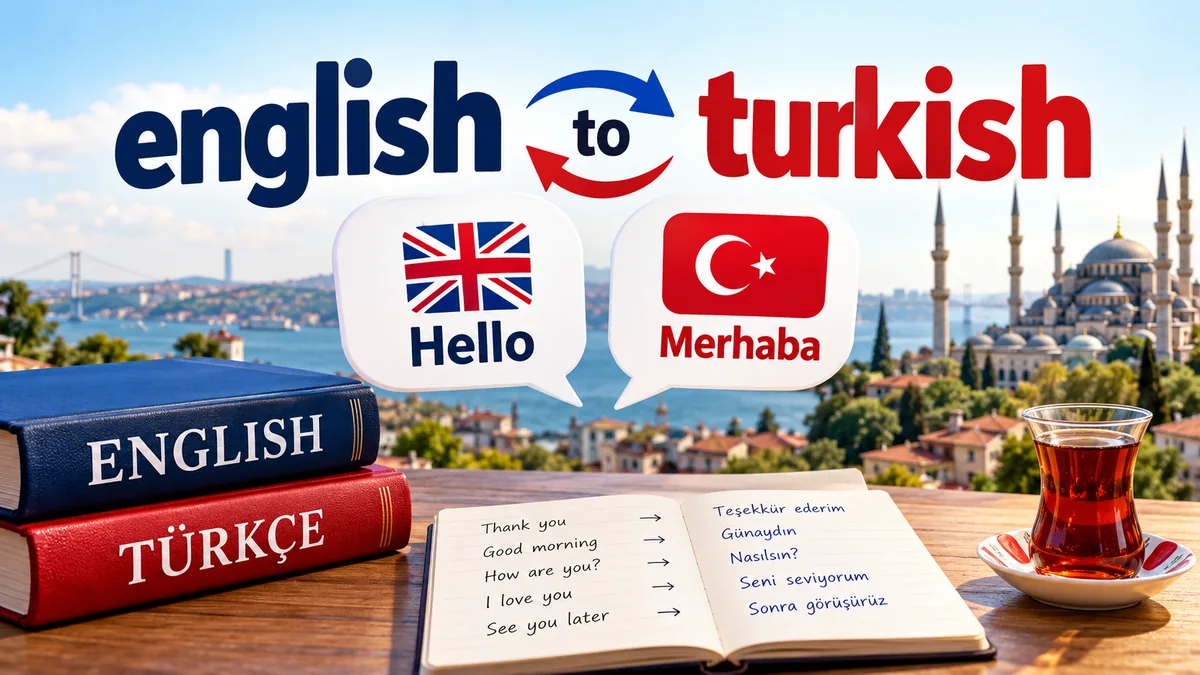
Translating English into Turkish can look simple when you are working with individual words, but complete sentences require more care. English and Turkish organize information differently, use different grammatical systems, and often express the same idea with very different sentence structures.
english to turkish translation means converting English words, phrases, or sentences into natural Turkish while preserving their meaning, tone, and context. Accurate translation involves more than replacing individual words: you also need to consider Turkish word order, suffixes, vowel harmony, pronouns, formality, idioms, and the intended meaning of the original English text.
For everyday phrases, an online translator may provide a useful starting point. For longer writing, business communication, academic material, or anything where nuance matters, understanding how Turkish works can help you recognize and correct awkward translations.
How english to turkish Translation Works
English and Turkish belong to different language families and have noticeably different grammatical structures. This is why literal word-for-word translation often produces unnatural results.
Consider this simple English sentence:
I read the book.
A natural Turkish version is:
Kitabı okudum.
The structure is different. Turkish can express information about the subject through the verb ending, so a separate equivalent of “I” is not always necessary.
Another example:
I am going to school.
Turkish:
Okula gidiyorum.
Instead of translating each English word independently, the translator has to understand the complete idea and reconstruct it according to Turkish grammar.
English and Turkish Sentence Order
A major difference is basic word order.
English commonly follows:
Subject + Verb + Object
Example:
Ali reads the book.
Turkish commonly follows:
Subject + Object + Verb
Example:
Ali kitabı okuyor.
This does not mean every Turkish sentence rigidly follows the same order. Turkish word order can change for emphasis and context. Still, placing the verb toward the end is a useful pattern for English speakers to recognize.
| English | Turkish |
|---|---|
| I drink coffee. | Kahve içiyorum. |
| She reads a book. | Kitap okuyor. |
| We are learning Turkish. | Türkçe öğreniyoruz. |
| They are watching television. | Televizyon izliyorlar. |
| I love Istanbul. | İstanbul’u seviyorum. |
Notice how Turkish frequently communicates the subject through the verb ending rather than a separate pronoun.
Understanding the Turkish Alphabet
Modern Turkish uses a Latin-based alphabet containing 29 letters, including several characters that English does not use as standard letters: ç, ğ, ı, İ, ö, ş, and ü.
These characters matter. Replacing them with visually similar English letters can produce misspellings and, in some cases, change meaning.
| Turkish Letter | Approximate Guidance |
|---|---|
| ç | similar to “ch” in chair |
| ş | similar to “sh” in shoe |
| ı | an unrounded vowel without a direct English equivalent |
| i | similar to “ee,” depending on the word |
| ö | similar to German ö |
| ü | similar to German ü |
| ğ | usually affects surrounding vowels rather than behaving like a typical English “g” |
One particularly important distinction is between i and ı. They are separate letters in Turkish.
Capitalization also differs:
i → İ
ı → I
This distinction matters when translating names, headings, databases, URLs, and other text where automated capitalization may be involved.
Why Turkish Uses So Many Suffixes
Turkish is an agglutinative language, meaning grammatical information is frequently added to a word through a sequence of suffixes. Turkish grammar distinguishes derivational and inflectional suffixes, and multiple suffixes can be attached to a stem.
English often uses separate words where Turkish can modify a single word.
For example:
ev = house
evler = houses
evim = my house
evimde = in my house
This characteristic is one reason a Turkish translation may contain fewer separate words than the original English sentence.
A translator therefore cannot assume that one English word must correspond to exactly one Turkish word.
Vowel Harmony in english to turkish Translation
Vowel harmony is one of the central features of Turkish grammar. The form of many suffixes changes according to the vowels in the word they follow.
Turkish has eight vowels:
a, e, ı, i, o, ö, u, ü
Two-way and four-way vowel-harmony patterns determine the vowels used in many suffixes. For example, the Turkish plural ending appears as either -lar or -ler depending on the preceding vowel pattern.
Examples:
kitap → kitaplar
book → books
ev → evler
house → houses
Similarly, other suffixes can appear in several forms.
This means you cannot safely translate an English plural by simply adding the same ending to every Turkish noun.
Why Vowel Harmony Matters
Incorrect suffix selection can make a translation sound obviously wrong even when the root vocabulary is correct.
A machine translator generally handles common vowel-harmony patterns automatically, but anyone reviewing English-to-Turkish content should understand why suffix spellings change.
There are also exceptions, including some loanwords and fixed suffixes, so vowel harmony should be treated as a grammatical system rather than a mechanical rule with no exceptions.
English Pronouns vs Turkish Pronouns
Another useful difference involves pronouns.
Basic Turkish personal pronouns include:
| English | Turkish |
|---|---|
| I | ben |
| you | sen |
| he / she / it | o |
| we | biz |
| you (plural/formal) | siz |
| they | onlar |
One striking difference is o.
Turkish does not use separate third-person singular pronouns equivalent to English he, she, and it. All three can correspond to o. Turkish therefore lacks the grammatical gender distinction found in English third-person singular pronouns.
For example:
O doktor.
Depending on context, this can mean:
He is a doctor.
or
She is a doctor.
Context becomes essential when translating such sentences back and forth.
Pronouns Are Often Omitted in Turkish
English normally requires an explicit subject:
I am coming.
Turkish can simply say:
Geliyorum.
The verb ending already indicates the first-person singular subject.
You can also say:
Ben geliyorum.
But including ben may add emphasis depending on the situation.
A weak word-for-word translation system might overuse pronouns because it follows English structure too closely. Natural Turkish often leaves them out when the verb already makes the subject clear.
Common english to turkish Words
Learning high-frequency vocabulary makes basic translation considerably easier.
| English | Turkish |
|---|---|
| hello | merhaba |
| yes | evet |
| no | hayır |
| please | lütfen |
| thank you | teşekkür ederim |
| good | iyi |
| bad | kötü |
| morning | sabah |
| night | gece |
| water | su |
| food | yemek |
| house | ev |
| school | okul |
| book | kitap |
| friend | arkadaş |
| family | aile |
| love | aşk / sevgi |
| beautiful | güzel |
| today | bugün |
| tomorrow | yarın |
The correct Turkish word still depends on context. An English term may have several possible equivalents.
For example, “love” can refer to romantic love, affection, the verb “to love,” or even a casual preference. Turkish may express these meanings differently.
Useful English to Turkish Phrases
Whole phrases are more useful than isolated vocabulary because they demonstrate how Turkish naturally expresses complete ideas.
| English Phrase | Turkish Translation |
|---|---|
| Hello | Merhaba |
| Good morning | Günaydın |
| Good evening | İyi akşamlar |
| Good night | İyi geceler |
| How are you? | Nasılsın? |
| I am fine. | İyiyim. |
| Thank you. | Teşekkür ederim. |
| Please. | Lütfen. |
| Excuse me. | Affedersiniz. |
| What is your name? | Adın ne? |
| My name is Ali. | Benim adım Ali. |
| Where are you from? | Nerelisin? |
| I don’t understand. | Anlamıyorum. |
| Do you speak English? | İngilizce konuşuyor musunuz? |
| How much is this? | Bu ne kadar? |
| Where is the hotel? | Otel nerede? |
| I need help. | Yardıma ihtiyacım var. |
| See you later. | Sonra görüşürüz. |
| Goodbye. | Hoşça kal. |
Some phrases change according to formality, number, and social context, so these should be understood as common equivalents rather than universal translations for every situation.
Formal and Informal Turkish
English uses “you” in both formal and informal situations. Turkish makes a clearer distinction.
sen is singular and informal.
siz is plural, but it is also commonly used when addressing one person politely or formally.
This is sometimes called the T–V distinction, where different second-person forms communicate familiarity or politeness.
For example:
Informal:
Nasılsın?
How are you?
More formal/polite:
Nasılsınız?
How are you?
This distinction matters in customer communication, business correspondence, interviews, hospitality, and conversations with unfamiliar people.
A translation can be grammatically correct yet socially inappropriate if it chooses the wrong level of formality.
Why Word-for-Word Translation Often Fails
One of the most common mistakes in english to turkish translation is assuming that every English word has one fixed Turkish equivalent.
Languages do not work that way.
Take the English word right.
Depending on context, it could mean:
- the opposite of left
- correct
- a legal or moral entitlement
- immediately, as in “right now”
Each meaning requires a different translation strategy.
The same issue appears with phrasal verbs such as:
give up
look after
take off
run into
Translating the individual words separately may completely lose the intended meaning.
The safest approach is to translate meaning first and words second.
Translating English Idioms Into Turkish
Idioms create an even bigger challenge.
Consider:
It’s raining cats and dogs.
A literal Turkish translation involving cats and dogs would not communicate the intended meaning naturally.
The translator needs to recognize that the sentence means:
It is raining very heavily.
Then an appropriate Turkish expression should be selected.
The same principle applies to expressions such as:
break the ice
piece of cake
under the weather
hit the nail on the head
once in a blue moon
The best translation may use a Turkish idiom, a straightforward explanation, or a completely different sentence that produces the same effect.
How to Translate English to Turkish Accurately
A reliable translation process can be divided into a few practical steps.
1. Read the Complete English Sentence
Do not start translating after reading only the first few words.
Determine what the entire sentence means first.
Ask:
- Who is speaking?
- Who is being addressed?
- What is happening?
- Is the tone formal or informal?
- Does any word have multiple meanings?
- Is there an idiom or phrasal verb?
Context resolves many translation problems before they occur.
2. Identify the Core Meaning
Reduce complicated English sentences to their central idea.
For example:
Could you possibly help me with this problem?
The core meaning is a polite request for help.
A good Turkish translation should preserve that politeness rather than mechanically reproduce every English word.
3. Rebuild the Sentence in Turkish
Do not force English syntax onto Turkish.
Determine the natural Turkish word order, choose the appropriate verb form, and add the necessary suffixes.
This is where knowledge of Turkish sentence structure becomes especially useful.
4. Check Suffixes and Vowel Harmony
Review plural, possessive, case, tense, and person endings.
Because suffix forms adapt to surrounding sounds, a correct root word can still produce an incorrect sentence when the ending is wrong.
5. Check Formality
Decide whether the situation requires sen or siz forms.
A conversation between friends is different from communication with a customer, professor, official, or stranger.
6. Read the Turkish as an Independent Sentence
This is one of the most useful quality checks.
Temporarily ignore the original English and ask:
Would a Turkish speaker naturally express this idea this way?
If the sentence feels like English grammar with Turkish vocabulary inserted into it, it probably needs revision.
Using an English to Turkish Translator
Online translation tools are useful for quick translations, especially for common vocabulary and straightforward sentences.
For example, the Cambridge English–Turkish translator provides quick translations and links users to relevant dictionary entries.
Automated translation can be useful for:
- understanding the general meaning of text
- translating everyday phrases
- checking basic vocabulary
- communicating simple information
- comparing possible translations
- getting an initial draft
It should be used more carefully when translating:
- contracts
- medical information
- academic work
- technical documentation
- advertising copy
- official documents
- culturally sensitive material
- literature
- idiomatic or humorous writing
The more important the consequences of misunderstanding the text, the more valuable human review becomes.
Translator vs Dictionary: Which Should You Use?
A dictionary and a translator solve different problems.
A dictionary helps you understand individual words, meanings, grammatical information, and possible equivalents.
A translator attempts to interpret an entire phrase or sentence.
For language learning, using both can be more useful than relying exclusively on automatic translation.
Suppose a translator gives you a Turkish sentence you do not recognize. Looking up its key words separately can help you understand why those words were chosen and how their meanings change with context.
This approach turns translation into a learning exercise rather than simple copying.
Common Mistakes When Translating English to Turkish
Several mistakes appear repeatedly.
Keeping English Word Order
Turkish syntax differs from English syntax. Copying the English structure can produce an understandable but unnatural sentence.
Ignoring Suffixes
Suffixes carry substantial grammatical information in Turkish. Leaving them out can change or obscure meaning.
Choosing the First Dictionary Definition
Many English words have multiple Turkish equivalents.
Always select the translation that matches the context rather than automatically choosing the first dictionary entry.
Ignoring Turkish Characters
Writing s instead of ş, c instead of ç, or i instead of ı is not simply a stylistic shortcut. These are different letters.
Translating Idioms Literally
Idioms need meaning-based translation.
If a sentence sounds strange despite every individual word appearing correct, check whether the original contains an idiom, metaphor, or phrasal verb.
Using the Wrong Level of Formality
Choosing informal Turkish in a professional setting can make otherwise accurate writing inappropriate for its audience.
Trusting Machine Translation Without Reviewing It
Automated translation can produce fluent-looking sentences that do not fully preserve the intended meaning.
Always reread important translations in context.
Turkish Cases and Why They Matter
English frequently uses prepositions and word order to show relationships between words. Turkish often uses case suffixes.
Common Turkish cases include forms corresponding to ideas such as:
- toward/to
- location at/in
- movement from
- definite direct object
- possession
For example:
ev — house
eve — to the house
evde — in/at the house
evden — from the house
These forms demonstrate why translating Turkish suffixes as isolated words is often misleading.
Understanding the role of the whole word is more useful than trying to match every suffix to a separate English word.
Does Turkish Have Grammatical Gender?
Turkish does not have grammatical gender in the same way that many European languages do. The third-person singular pronoun o can represent “he,” “she,” or “it.”
This simplifies some parts of English-to-Turkish translation.
However, it creates a challenge in the opposite direction. When translating Turkish into English, context may be required to determine whether o should become “he,” “she,” or “it.”
This is a good example of why translation cannot always be reversed mechanically.
How Do Turkish Questions Work?
English often forms questions by changing word order or adding auxiliary verbs:
Do you speak English?
Turkish uses its own grammatical patterns and question particles.
A common polite translation is:
İngilizce konuşuyor musunuz?
Another example:
Are you coming?
Geliyor musun?
The exact form changes according to person, tense, formality, and vowel harmony.
This makes question formation another area where translating the sentence as a complete grammatical unit is more reliable than translating individual words.
How to Improve Your English to Turkish Translation Skills
If you are learning Turkish rather than simply translating one sentence, focus on reusable patterns.
Start with high-frequency vocabulary and short sentences. Then study the systems that repeatedly appear in real Turkish:
- Learn the Turkish alphabet and pronunciation.
- Understand basic subject-object-verb sentence patterns.
- Learn common personal endings.
- Practice vowel harmony.
- Study frequently used case suffixes.
- Learn present, past, and future verb forms.
- Practice formal and informal speech.
- Study phrases rather than isolated words.
- Compare your translations with natural Turkish examples.
- Review your mistakes and identify the grammatical rule behind each one.
Learning these patterns makes unfamiliar sentences much easier to understand.
Instead of memorizing thousands of complete sentences, you begin recognizing how Turkish constructs them.
Is English to Turkish Translation Difficult?
The difficulty depends on the material.
A phrase such as:
Thank you
is straightforward:
Teşekkür ederim.
A longer sentence containing humor, cultural references, idioms, ambiguous pronouns, or specialized terminology may require much more interpretation.
Turkish suffixation and word order can initially feel unfamiliar to English speakers. Vowel harmony also takes practice. However, these systems are patterned, and once you understand them, many forms become easier to predict.
The biggest improvement usually comes from stopping word-for-word translation and starting to think in complete meanings.
When Should a Human Translator Be Used?
Machine translation is often sufficient when you only need to understand the rough meaning of casual text.
Human translation becomes more important when precision, tone, legal consequences, reputation, or specialized knowledge matters.
Examples include legal agreements, certificates, immigration documents, medical records, academic publications, business contracts, marketing campaigns, and public-facing professional content.
A professional translator can also account for cultural context and terminology that may not be obvious from the words alone.
Final Thoughts on english to turkish Translation
Good english to turkish translation is not simply a process of replacing English vocabulary with Turkish vocabulary. The translator must preserve meaning while adapting the sentence to Turkish grammar, word order, suffixes, vowel harmony, pronoun use, formality, and context.
For simple everyday phrases, translation tools and dictionaries can provide quick assistance. For important or nuanced material, review the entire sentence for meaning and naturalness rather than trusting a literal conversion.
The most useful rule is simple: translate the idea, not just the words. Once you understand how Turkish builds sentences and uses suffixes, English-to-Turkish translation becomes considerably clearer and more accurate.
