

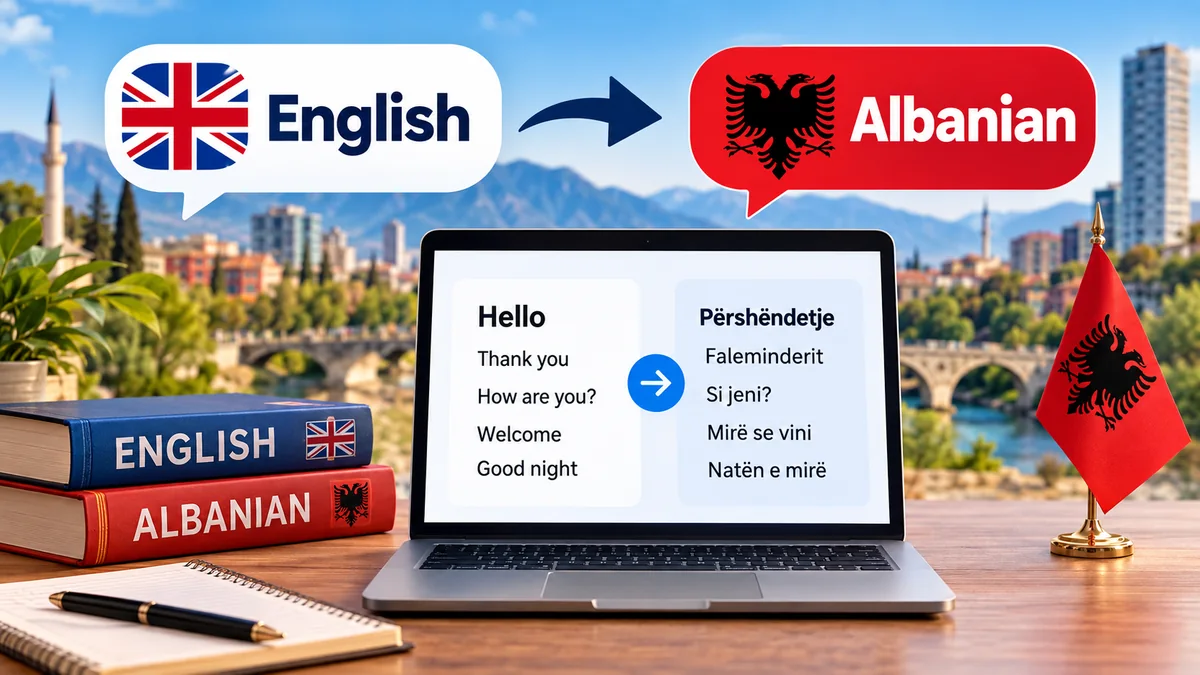
Translating English into Albanian can look straightforward when you are working with a single word. The difficulty appears when complete sentences introduce grammar, context, gender, cases, idioms, and differences between formal and informal speech.
If you want to translate english to albanian accurately, translate the meaning of the complete sentence rather than replacing individual English words. Albanian belongs to its own branch of the Indo-European language family and uses a Latin-based alphabet. Its grammar, noun forms, articles, and sentence patterns differ from English, so context is essential for natural translation.
This guide explains how English-to-Albanian translation works, where automatic translators can make mistakes, and how to produce Albanian that sounds clear and natural.
How to translate english to albanian accurately
A basic translation process has three parts:
- Understand what the English sentence actually means.
- Express that meaning using appropriate Albanian grammar and vocabulary.
- Review the Albanian result for context, tone, spelling, and natural phrasing.
That sounds simple, but word-for-word translation rarely handles every sentence correctly.
For example:
| English | Albanian |
|---|---|
| Hello | Përshëndetje |
| Thank you | Faleminderit |
| How are you? | Si jeni? |
| Welcome | Mirë se vini |
| See you later | Shihemi më vonë |
| Have a nice trip | Udhëtim të mbarë |
Common phrase resources show forms such as Përshëndetje, Faleminderit, Si jeni?, and Mirë se vini in everyday Albanian communication.
The key principle is that a translator should preserve meaning, not necessarily English word order.
Why literal translation can fail
English and Albanian do not build every sentence in the same way.
Consider an English expression such as:
“What’s up?”
A literal word-by-word conversion would not necessarily communicate the intended greeting. A translator first needs to recognize that the speaker is casually asking how someone is doing.
The same problem occurs with idioms such as:
- Break a leg
- Piece of cake
- Hit the road
- Under the weather
- Give me a hand
These expressions have meanings that cannot reliably be discovered by translating each individual word.
That distinction—between translating words and translating meaning—is one of the most useful things to remember when working between English and Albanian.
Understanding English and Albanian before translating
English and Albanian are both Indo-European languages, but they occupy very different positions within that enormous family.
English is a West Germanic language. Albanian forms an independent branch of the Indo-European language family rather than belonging to the Germanic, Romance, or Slavic branches.
That linguistic distance helps explain why apparently simple English sentences sometimes require substantial restructuring in Albanian.
Albanian uses the Latin alphabet
Modern Albanian uses a Latin-based writing system.
This makes Albanian visually more approachable to English speakers than languages written primarily in another script. However, sharing a script does not mean that the two languages have identical alphabets or pronunciation rules.
Albanian contains letters and letter combinations that English readers may not immediately recognize.
Examples include:
ç, ë, dh, gj, ll, nj, rr, sh, th, xh, zh
The marks on ë and ç matter. They should not automatically be discarded simply because an English keyboard makes them less convenient to type.
For example, a dictionary entry for “pronunciation” gives the Albanian word shqiptim.
Albanian is not simply English with different vocabulary
This is one of the most common misconceptions among new learners.
Translation requires more than finding an Albanian equivalent for each English word. The grammatical relationships inside the sentence also have to be represented correctly.
Depending on the sentence, you may need to consider:
- noun gender
- singular and plural forms
- definite and indefinite forms
- grammatical case
- adjective agreement
- verb conjugation
- pronouns
- word order
- formality
- context
An English sentence can therefore contain fewer visible grammatical clues than its Albanian translation requires.
English to Albanian grammar differences that affect translation
Grammar is where translation becomes considerably more interesting.
A machine can often recognize common vocabulary correctly while still producing a sentence that feels awkward because grammatical relationships were handled poorly.
Albanian nouns have grammatical gender
Albanian nouns are grammatically categorized by gender.
English generally does not require speakers to think about grammatical gender when using ordinary nouns such as “book,” “table,” or “house.”
That difference affects surrounding words and grammatical forms.
A translator therefore needs to understand the role of a noun within the complete sentence rather than treating it as an isolated vocabulary item.
Albanian uses grammatical cases
Albanian has a case system.
Cases help express relationships that English often communicates through word order and prepositions. Consequently, the correct form of an Albanian noun can depend on its grammatical function.
This is one reason dictionary lookup alone is not enough for reliable sentence translation.
The dictionary may give you the correct base word while leaving you to determine which form belongs in your sentence.
Definite and indefinite forms matter
English usually expresses definiteness through the articles a/an and the.
Albanian handles definiteness differently, including through noun morphology. This structural difference means that translating an English article independently from its noun can produce unnatural results.
A translation system needs to interpret the noun phrase as a unit.
Verbs change according to context
English verbs certainly change—go, goes, went, going—but Albanian verbal morphology works differently and can encode grammatical information that must be understood from context.
When translating, identify:
who performs the action + when it happens + the intended mood or meaning.
Only then should the appropriate Albanian form be selected.
translate english to albanian words, sentences, and paragraphs
Different types of content require different translation strategies.
A single vocabulary word can often be checked in a bilingual dictionary. A sentence requires grammatical analysis. A paragraph introduces an additional challenge: consistency across sentences.
Translating individual English words
For individual words, a dictionary is often more useful than a general-purpose machine translator because it can show multiple possible meanings.
For example, dict.cc gives përkthej for “to translate” and also lists shqipëroj for translating or rendering something into Albanian.
That example demonstrates why context matters.
One English word can have several Albanian equivalents depending on what the writer intends.
Before selecting a translation, ask:
What does this word mean in this particular sentence?
Consider the English word “light.”
It can refer to:
- illumination
- something that is not heavy
- a pale color
- igniting something
A translation tool must identify the intended sense before choosing the Albanian vocabulary.
Translating complete sentences
For sentences, enter the complete thought whenever possible.
Suppose you need to translate:
“I am looking for the train station.”
Sending the translator only isolated words such as “looking,” “train,” and “station” removes information that helps it understand the relationship between those words.
Complete sentences provide context for grammar and word sense.
Translating long paragraphs
Long text creates different risks.
A translator has to maintain:
- terminology
- names
- pronoun references
- tense
- tone
- formatting
- meaning across sentences
Some current translation platforms explicitly recommend working with manageable segments, while others support larger text or document imports. For example, Langlation advises translating shorter sections and checking the result, whereas TransWord describes support for longer materials and imported documents.
For important material, divide a document into logical sections rather than arbitrary fragments.
Do not split a sentence halfway simply to reduce character count.
How to use an English to Albanian translator
Most online translation tools follow essentially the same workflow.
1. Select English as the source language
Choose English as the input or source language.
Automatic language detection can be convenient, but manually selecting English removes unnecessary ambiguity, especially when the input contains names, abbreviations, or multiple languages.
2. Select Albanian as the target language
Choose Albanian as the output or target language.
The international language code you may encounter for Albanian is sq, while English is commonly represented as en.
3. Enter complete, well-written English
Paste or type the source text.
Clear English usually gives the translator better material to work with.
Instead of:
“Need hotel near airport cheap tomorrow.”
write:
“I need an inexpensive hotel near the airport for tomorrow.”
The second version makes the intended relationships clearer.
4. Generate the Albanian translation
Translation services generally process the text automatically after you submit it.
Modern systems may consider the surrounding sentence rather than translating vocabulary independently. Current English-to-Albanian services commonly emphasize contextual translation and support for sentences, messages, documents, or other extended content.
5. Review the output
Never assume that grammatical-looking output is automatically accurate.
Check:
- names
- numbers
- dates
- negation
- technical terminology
- formality
- pronouns
- idioms
- special characters
- sentence meaning
Pay particular attention to short English words with several possible meanings.
6. Read the Albanian as a complete sentence
Ask a different question from “Did every English word get translated?”
Ask:
“Does this Albanian sentence communicate the same message?”
That is a much better test of translation quality.
Common English to Albanian phrases
Everyday phrases are useful because they demonstrate how complete ideas transfer between languages.
| English phrase | Albanian |
|---|---|
| Hello | Përshëndetje |
| Thank you | Faleminderit |
| How are you? | Si jeni? |
| Welcome | Mirë se vini |
| See you later | Shihemi më vonë |
| Good night | Natën e mirë |
| Have a nice day | Kalofshi një ditë të mbarë |
| Have a good trip | Udhëtim të mbarë |
Several of these common equivalents are also listed in English-Albanian phrase references.
Treat phrase lists as learning aids rather than universal scripts. Formality, number of people being addressed, regional usage, and conversational context can affect the most natural expression.
Formal and informal Albanian matter
English uses “you” in a remarkably broad range of situations.
Albanian can make distinctions that require more context about the person being addressed. As a result, a translation appropriate for a friend may not always be the form you want in a formal conversation.
This becomes particularly relevant for:
- business communication
- customer messages
- official correspondence
- communication with strangers
- academic writing
When tone matters, tell an AI translator or human translator whether the desired output should be formal, neutral, conversational, or informal.
How accurate is English to Albanian machine translation?
Machine translation can be very useful, but accuracy is not a simple percentage that applies equally to every sentence.
Performance depends heavily on the material.
A straightforward sentence such as:
“The meeting starts at nine.”
is fundamentally different from translating:
“We need to get the ball rolling before the proposal loses momentum.”
The second sentence contains figurative language. Translating its surface words can destroy its intended meaning.
Machine translation works well for many everyday tasks
Automatic translation is particularly useful for getting the general meaning of:
- messages
- simple emails
- travel phrases
- social posts
- straightforward descriptions
- study material
- common questions
- basic website content
Current tools offer instant English-to-Albanian translation for words, phrases, messages, and longer text, although their character limits and features vary.
Where machine translation needs extra checking
Be more cautious with:
- idioms
- jokes
- slang
- poetry
- ambiguous statements
- technical terminology
- culturally specific expressions
- legal language
- medical information
- contracts
- certificates
A grammatically polished translation can still communicate the wrong meaning.
That distinction matters more than whether the output merely “sounds Albanian.”
How to check an Albanian translation for accuracy
A good review process catches many mistakes without requiring you to be completely fluent.
Compare meaning rather than vocabulary
Read the original English and identify its essential message.
Then verify that the Albanian output preserves:
- the same people
- the same action
- the same time
- the same quantities
- the same positive or negative meaning
- the same level of certainty
Negation deserves special attention.
Changing “can” to “cannot,” “did” to “did not,” or “required” to “optional” can reverse the meaning while leaving the rest of the sentence looking perfectly normal.
Use reverse translation as a warning system
One practical technique is back-translation.
Translate:
English → Albanian
Then take the result and translate:
Albanian → English
If the returned English expresses a noticeably different idea, inspect the Albanian more carefully.
Langlation similarly recommends reverse translation as a way to identify potentially problematic output.
Back-translation is not proof of accuracy. Two translation systems can reproduce similar wording while still missing a nuance. Think of it as a diagnostic check.
Check important words independently
If the sentence contains an essential word—especially a technical term—look it up separately in a bilingual dictionary.
Dictionary entries can reveal alternate meanings that a machine translator may have overlooked.
This is particularly useful for:
- professions
- technical terminology
- academic vocabulary
- legal terms
- specialized equipment
- medical terminology
Ask a native speaker when consequences are significant
The higher the consequences of a mistranslation, the stronger the review process should be.
Casual travel messages and private study notes rarely need the same level of verification as contracts, immigration documents, medical instructions, legal declarations, or material intended for publication.
For high-stakes content, professional human review is safer than relying exclusively on automatic output. Some translation services explicitly offer human verification for legal, medical, technical, and other sensitive material for this reason.
Albanian pronunciation and spelling tips
Accurate written translation is only part of the job when you intend to speak the result.
English speakers should avoid assuming that Albanian letters are always pronounced according to English spelling conventions.
Keep Albanian characters intact
Two especially noticeable Albanian characters are:
ë and ç
Other letter combinations also represent sounds in systematic ways, including:
dh, gj, ll, nj, rr, sh, th, xh, zh
If your translation includes these characters, preserve them when copying, publishing, or messaging.
Removing diacritics may make text less correct or harder to interpret.
Use audio for unfamiliar words
If your translator provides text-to-speech or pronunciation playback, listen to the Albanian result after translating.
This is especially helpful for:
- personal names
- directions
- restaurant phrases
- greetings
- transportation questions
- emergency phrases
Reading a word repeatedly does not guarantee that an English speaker will infer its Albanian pronunciation correctly.
Common mistakes when translating English into Albanian
Several errors appear repeatedly in machine-assisted translation.
Translating one word at a time
This removes context and increases ambiguity.
Better approach: translate the complete sentence, then investigate individual words only when something appears incorrect.
Keeping English sentence structure
A natural Albanian translation does not need to mirror the exact order of every English word.
Better approach: preserve the message and grammatical relationships rather than the visible structure.
Ignoring formal versus informal speech
The intended audience affects how a sentence should be expressed.
Better approach: establish the relationship between speaker and reader before finalizing important communication.
Translating idioms literally
Idioms often communicate figurative rather than dictionary meaning.
Better approach: identify what the expression means in English and translate that idea.
Removing ë and ç
Dropping Albanian characters can reduce orthographic accuracy.
Better approach: use Unicode text and keep the original Albanian spelling.
Trusting the first translation automatically
Machine-generated language can look convincing even when a subtle detail is wrong.
Better approach: reread the sentence, check ambiguous vocabulary, and verify important content independently.
English to Albanian translation for travel
Travel is one of the clearest situations where a small number of accurate phrases can be more valuable than hundreds of memorized vocabulary words.
Prioritize language for:
- greetings
- directions
- hotels
- restaurants
- transportation
- payments
- emergencies
- basic courtesy
Phrase-based translator apps commonly organize English-Albanian material around areas such as hotels, dining, hospitals, transportation, sightseeing, airports, and conversation.
For travel, save essential translations offline or as screenshots before you need them. Internet access is not guaranteed precisely when an unfamiliar phrase becomes urgent.
Also keep the English version beside the Albanian translation when asking for complicated directions or explaining a specific requirement.
Translating English documents into Albanian
Documents need a more disciplined process than short messages.
Modern translation platforms can handle formats such as PDF and DOCX, and some services support additional document types or preserve formatting.
However, successful file processing does not guarantee linguistic accuracy.
Protect names and numbers
Before translating, identify text that should not accidentally change:
- people’s names
- company names
- addresses
- telephone numbers
- email addresses
- identification numbers
- monetary amounts
- dates
- product codes
Compare these items directly against the source after translation.
Create a terminology list
For longer projects, decide how repeated terms should be translated before processing the entire document.
This is especially useful for academic, technical, business, and software content.
If the same English term is translated three different ways across a document, readers may assume those Albanian terms represent different concepts.
Consistency is part of accuracy.
Preserve structure
Headings should remain headings. Lists should remain lists. Table labels should correspond to the correct cells.
This becomes especially important with:
- manuals
- reports
- presentations
- websites
- subtitles
- forms
- spreadsheets
Translation quality includes both linguistic accuracy and correct placement of the translated text.
Using AI for better English to Albanian translation
AI-based translation becomes more useful when you give it instructions rather than supplying unexplained text.
Instead of requesting only:
“Translate this into Albanian.”
provide useful context:
“Translate this customer-service email from English into natural, formal Albanian. Preserve names and numbers exactly, and prioritize meaning over literal word order.”
Context tells the model what kind of language is expected.
Specify the audience
Tell the system who will read the translation.
For example:
- Albanian-speaking tourists
- university students
- business customers
- children
- general readers
- technical professionals
Vocabulary and tone can change accordingly.
Specify what must remain unchanged
For structured material, tell the translator to preserve:
- URLs
- HTML
- product names
- variables
- numbers
- headings
- placeholders
This reduces unnecessary changes to non-linguistic content.
Ask for alternatives when wording is ambiguous
Sometimes there is no single universally appropriate translation.
When an English phrase could mean two things, request:
- the most likely Albanian translation;
- an alternative interpretation;
- a brief explanation of the difference.
That approach is particularly useful for language learning because it reveals the reasoning hidden behind a polished final sentence.
Can you learn Albanian through translation?
Translation is useful for learning, but it works best as one component of a broader study routine.
Instead of repeatedly translating isolated vocabulary, compare complete sentences.
A practical routine is:
- Write a short English sentence.
- Translate it into Albanian.
- Identify the Albanian verb and noun forms.
- Listen to the pronunciation.
- Recreate the sentence without looking.
- Change one element and translate it again.
For example, start with an everyday greeting, then change the person, time, place, or action.
This teaches patterns rather than disconnected words.
Build vocabulary in context
A vocabulary list tells you that one English word corresponds to an Albanian word.
A sentence teaches you much more:
- where the word appears
- what grammatical form it takes
- what words commonly accompany it
- how it changes according to context
That contextual knowledge is what eventually reduces dependence on a translator.
When should you use a human Albanian translator?
Automatic translation is excellent for speed and convenience. Human expertise becomes more valuable as ambiguity, specialization, or consequences increase.
Consider professional review for:
- contracts
- court documents
- immigration paperwork
- medical records
- certificates
- academic publications
- marketing campaigns
- public-facing corporate documents
The reason is not that machine translation is always poor. It is that high-stakes translation requires accountability for subtle meaning.
A sentence that is “mostly correct” can be entirely inadequate when legal rights, health instructions, money, or official records depend on it.
A reliable workflow to translate english to albanian
For everyday translation, use this simple process:
- Write clear English. Remove unnecessary ambiguity and correct obvious spelling mistakes.
- Translate complete sentences. Give the system enough context to interpret each word.
- Preserve names and numbers. Compare them directly with the source.
- Review Albanian characters. Keep letters such as ë and ç intact.
- Check ambiguous vocabulary. Use a dictionary when one word has several possible meanings.
- Test important sentences. Back-translate them as a quick diagnostic.
- Review the tone. Make sure formal or informal language suits the reader.
- Verify high-stakes material professionally. Do not depend solely on automated translation where an error could have serious consequences.
The best way to translate english to albanian is therefore not to replace English words mechanically. Start with meaning, give the translator complete context, preserve Albanian spelling, and review the result as a natural Albanian message. For casual communication, modern machine translation can save considerable time; for important documents, combine that speed with careful human verification.
