

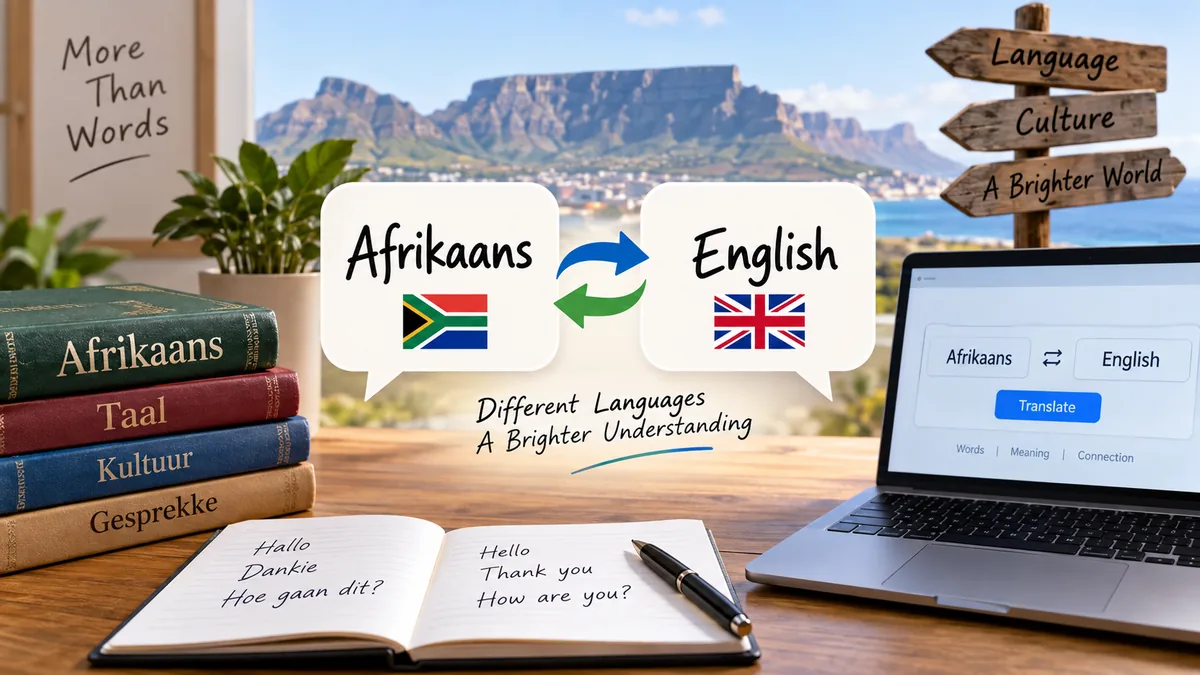
Afrikaans can look surprisingly familiar to an English speaker, yet literal translation often produces awkward or completely wrong results. Words may resemble Dutch or English, sentence structure can shift, and expressions frequently mean more than their individual words suggest.
afrikaans to english translation means converting Afrikaans words, sentences, conversations, or documents into natural English while preserving their original meaning, context, and tone. Accurate translation requires more than replacing individual words: grammar, double negatives, compounds, idioms, diminutives, word order, and regional usage can all affect the correct English interpretation.
Afrikaans is a West Germanic language with strong historical roots in Dutch and substantial development through contact with languages spoken in southern Africa and elsewhere. Modern research describes its history as involving Dutch alongside indigenous Southern African, South Asian, and European linguistic influences.
How to Translate afrikaans to english
For a short message, translating Afrikaans into English is usually straightforward. Longer passages require more attention to context.
A practical process is:
- Read the complete Afrikaans sentence first.
- Identify the main verb, subject, and object.
- Look for grammatical markers such as
nie ... nie. - Check compound words rather than translating fragments blindly.
- Determine whether an expression is literal or idiomatic.
- Write the meaning in natural English.
- Compare the translation with the original for missing details.
For example:
Afrikaans: Ek verstaan nie Afrikaans nie.
English: I do not understand Afrikaans.
Translating every word mechanically could make the sentence look like “I understand not Afrikaans not.” That is not natural English because Afrikaans commonly uses double negation where English normally uses one negative construction.
Quick Afrikaans to English Translation Examples
| Afrikaans | English |
|---|---|
| Hallo | Hello |
| Goeie môre | Good morning |
| Goeie middag | Good afternoon |
| Goeie aand | Good evening |
| Goeie nag | Good night |
| Dankie | Thank you |
| Asseblief | Please |
| Ja | Yes |
| Nee | No |
| Jammer | Sorry |
| Totsiens | Goodbye |
| Welkom | Welcome |
| Hoe gaan dit? | How are you? |
| Ek verstaan | I understand |
| Ek verstaan nie | I don’t understand |
| Kan jy my help? | Can you help me? |
| Waar is die badkamer? | Where is the bathroom? |
| Hoeveel kos dit? | How much does it cost? |
Common phrase lists across current Afrikaans translation resources include many of these everyday greetings and travel expressions.
Understanding Afrikaans Before Translating It
Knowing a little about the language makes translation considerably easier.
Afrikaans belongs to the West Germanic language family. It developed primarily from Dutch varieties spoken at the Cape, while language contact contributed significantly to its development.
Today, Afrikaans is used particularly in South Africa and Namibia. In South Africa, it is one of the country’s official languages. South African Sign Language is also now officially recognized, bringing the country’s current total to 12 official languages.
Is Afrikaans the Same as Dutch?
No.
Afrikaans and Dutch are closely related, but they are distinct languages. Their shared history explains why many words look similar, but differences exist in spelling, pronunciation, vocabulary, grammar, and everyday usage.
For an English reader, that relationship can sometimes make Afrikaans vocabulary easier to recognize because English is also a West Germanic language. Recognition, however, should not be confused with accurate translation.
Consider:
Afrikaans: water
English: water
That one is easy.
But:
Afrikaans: slim
English: clever / smart
An English speaker who assumes slim refers to someone’s body shape would misunderstand the sentence.
This is why context matters even when an Afrikaans word appears familiar.
Common Afrikaans Words in English
Building a basic vocabulary is one of the quickest ways to understand everyday Afrikaans.
Greetings and Polite Words
| Afrikaans | English |
|---|---|
| Hallo | Hello |
| Goeie môre | Good morning |
| Goeie middag | Good afternoon |
| Goeie aand | Good evening |
| Welkom | Welcome |
| Dankie | Thank you |
| Baie dankie | Thank you very much |
| Asseblief | Please |
| Jammer | Sorry |
| Verskoon my | Excuse me |
| Totsiens | Goodbye |
| Sien jou later | See you later |
Everyday Words
| Afrikaans | English |
|---|---|
| huis | house |
| skool | school |
| boek | book |
| kos | food |
| water | water |
| koffie | coffee |
| werk | work |
| geld | money |
| winkel | shop/store |
| straat | street |
| motor | car |
| vriend | friend |
| familie | family |
| kind | child |
| hond | dog |
| kat | cat |
Useful Question Words
| Afrikaans | English |
|---|---|
| wat | what |
| waar | where |
| wanneer | when |
| waarom | why |
| wie | who |
| hoe | how |
| hoeveel | how much/how many |
| watter | which |
These words are especially useful because they reveal the purpose of a sentence before you have translated everything else.
Common afrikaans to english Phrases
Individual words help, but complete phrases are more useful for understanding real conversations.
Everyday Conversation
Hoe gaan dit?
How are you?
Dit gaan goed, dankie.
I’m doing well, thank you.
Wat is jou naam?
What is your name?
My naam is Anna.
My name is Anna.
Waar woon jy?
Where do you live?
Ek weet nie.
I don’t know.
Ek verstaan nie.
I don’t understand.
Praat asseblief stadiger.
Please speak more slowly.
Kan jy dit herhaal?
Can you repeat that?
Travel Phrases
Waar is die toilet?
Where is the toilet?
Hoeveel kos dit?
How much does it cost?
Waar is die hotel?
Where is the hotel?
Ek het hulp nodig.
I need help.
Ek het ‘n dokter nodig.
I need a doctor.
Die rekening, asseblief.
The bill, please.
Several of these expressions also appear in current translation resources because they are among the most practical phrases for travelers and new learners.
afrikaans to english Grammar Differences That Affect Translation
Knowing vocabulary alone is not enough. Some of the biggest translation mistakes happen because Afrikaans grammar is interpreted according to English rules.
1. Afrikaans Double Negatives
One of the most recognizable Afrikaans structures is the double negative.
Consider:
Ek kan nie swem nie.
A word-for-word interpretation might resemble:
“I can not swim not.”
Natural English is simply:
I cannot swim.
The two occurrences of nie belong to the Afrikaans negative construction; English normally does not preserve both.
Another example:
Hy is nie hier nie.
He is not here.
When translating, focus on what the grammatical construction means rather than preserving every word.
2. Afrikaans Verbs Are Often Simpler
Afrikaans does not change verbs for grammatical person in the same way many European languages do.
For example:
Ek werk. — I work.
Jy werk. — You work.
Hy werk. — He works.
Ons werk. — We work.
Notice how werk remains unchanged while English uses works with “he.”
A translator must therefore generate the correct English verb form from context.
3. The Past Tense Often Uses “het”
A common Afrikaans past construction uses het with a past participle.
Ek het gewerk.
I worked / I have worked.
Sy het geëet.
She ate / She has eaten.
The precise English tense depends on context.
This is an excellent example of why there may be more than one grammatically valid translation.
4. “Die” Usually Means “The”
English speakers occasionally misinterpret Afrikaans die because it looks identical to the English verb “die.”
In Afrikaans:
die huis = the house
die motor = the car
die kind = the child
The word is functioning as the definite article, not referring to death.
5. “Het” Can Mean “Have” or “Has”
Afrikaans het is another word that can confuse readers familiar with Dutch.
Examples:
Ek het ‘n boek.
I have a book.
Hy het ‘n motor.
He has a car.
The English verb changes according to the subject even though the Afrikaans form remains het.
Why Word-for-Word Afrikaans Translation Can Fail
Literal translation is useful for studying vocabulary, but it is unreliable when the goal is natural English.
Imagine translating:
Hoe gaan dit?
Word by word, it resembles:
“How goes it?”
An English speaker would understand that sentence, but the normal English equivalent is:
How are you?
This distinction is central to good translation.
A translator should preserve meaning first, then reproduce that meaning using natural English syntax.
Literal vs. Natural Translation
| Afrikaans | Literal Rendering | Natural English |
|---|---|---|
| Hoe gaan dit? | How goes it? | How are you? |
| Ek weet nie | I know not | I don’t know |
| Kan jy my help? | Can you me help? | Can you help me? |
| Ek verstaan nie | I understand not | I don’t understand |
Literal translation can help learners see sentence structure. Natural translation is normally better for communication.
Quick Takeaway: Use literal translations to study how Afrikaans works, but use idiomatic English when translating messages, articles, conversations, or documents.
Afrikaans Pronunciation and Special Characters
Translation and pronunciation are different tasks.
You may understand what a word means in English without knowing how to pronounce the Afrikaans original correctly.
Afrikaans primarily uses the Latin alphabet, but written text may contain diacritics that matter.
Examples include:
- môre — morning
- hê — have
- sê — say
- wêreld — world
- reën — rain
Do not automatically remove these marks when copying Afrikaans text. Changing spelling can sometimes make automatic language detection or dictionary lookup less reliable.
Pronunciation can also differ substantially from what an English speaker expects from the spelling. Listening to native audio is therefore more useful than applying English pronunciation rules to Afrikaans words.
Afrikaans Compound Words Need Special Attention
Afrikaans, like Dutch and German, frequently creates compound words.
Instead of translating an unfamiliar long word as an indivisible unit, identify its components.
For example:
skool + boek → skoolboek
- skool = school
- boek = book
- skoolboek = schoolbook/textbook
Compound words can become considerably longer, particularly in technical, administrative, academic, and professional writing.
An automatic translator may correctly understand a common compound but struggle with an unusual, newly created, or highly specialized one.
When a translation looks strange, breaking the compound into meaningful components is a useful troubleshooting method.
Diminutives Can Change the Meaning and Tone
Afrikaans makes frequent use of diminutives, often with endings such as -jie, -tjie, or related forms.
For example:
hond = dog
hondjie = little dog / puppy
The diminutive does not always mean physically small. Depending on context, it can communicate affection, familiarity, or another nuance.
That creates a translation choice.
If someone affectionately uses a diminutive, translating every example as “little…” may sound unnatural in English. Sometimes the base noun is enough; elsewhere, the affectionate tone should be expressed differently.
Current Afrikaans translation guidance also identifies diminutive forms as a recurring issue when moving into English.
Formal and Informal “You” in Afrikaans
Afrikaans distinguishes between forms of address that English often collapses into the single word you.
jy is commonly used informally.
u is a formal or respectful form.
Both can become “you” in English, so part of the social meaning can disappear during translation.
For ordinary conversation, that loss may not matter. In a formal letter, historical text, interview, or literary work, it can matter considerably.
A careful translator considers the relationship between the speakers rather than merely substituting one pronoun for another.
Afrikaans Idioms and Expressions
Idioms are among the hardest elements to translate accurately because their meaning cannot always be calculated from the individual words.
A good translation should ask:
What is the speaker actually trying to communicate?
Then it should choose an English expression that communicates the same idea.
This matters especially in:
- informal conversations
- social media
- literature
- jokes
- song titles
- advertising
- regional speech
- slang
Machine translation systems increasingly use sentence-level context, but ambiguous idioms can still produce misleading results.
When an expression sounds bizarre in English even though every individual word appears correctly translated, check whether the original is idiomatic.
How Accurate Are Online Afrikaans to English Translators?
Modern online translation tools are useful for everyday Afrikaans text, but accuracy depends heavily on what you give them.
Short, grammatically complete sentences generally provide more useful context than isolated fragments.
Current online translators commonly advertise support for Afrikaans text, phrases, documents, speech, or other formats. DeepL’s current supported-language documentation, for example, lists both Afrikaans and English among its available languages.
However, no machine-generated translation should automatically be treated as authoritative.
Accuracy can fall when the text contains:
- slang
- regional expressions
- spelling errors
- code-switching
- idioms
- unusual compounds
- specialized terminology
- ambiguous pronouns
- legal language
- medical terminology
- literary wordplay
How Can You Improve Translation Accuracy?
A few habits make a noticeable difference.
Use complete sentences.
“Bank” alone could have multiple meanings. A sentence provides clues.
Preserve punctuation.
Commas, quotation marks, and sentence boundaries help establish structure.
Keep Afrikaans spelling intact.
Do not remove unfamiliar characters merely because they do not occur often in English.
Split very long passages.
Translate logical paragraphs or sections rather than feeding unrelated material into one block.
Check ambiguous words.
If one word controls the meaning of the sentence, verify it with a dictionary.
Read the final English naturally.
Ask whether an English speaker would actually phrase the sentence that way.
Back-translation can be a useful check.
Translating the English result back into Afrikaans can expose obvious meaning changes, although it does not prove that the first translation was correct. Some current translation services recommend this as a checking technique.
Dictionary vs. Translator: Which Should You Use?
An Afrikaans-English dictionary and an automatic translator solve different problems.
| Tool | Best For | Main Limitation |
|---|---|---|
| Dictionary | Individual words and definitions | Limited sentence context |
| Machine translator | Sentences and paragraphs | Can mishandle ambiguity |
| Phrasebook | Common conversation | Limited vocabulary |
| Human translator | Complex or high-stakes material | Requires more time/resources |
| Language-learning resource | Understanding grammar | Not designed for instant translation |
Use a dictionary when you want to understand a specific word.
Use a translator when you need the meaning of a complete sentence.
For contracts, immigration documents, medical information, court materials, certificates, or other high-stakes content, professional review may be necessary because a plausible-sounding machine translation can still contain a consequential error.
Translating Afrikaans Documents into English
Document translation requires more care than translating a chat message.
A document may contain:
- headings
- tables
- abbreviations
- names
- addresses
- dates
- quotations
- technical terminology
- footnotes
- formatting that affects meaning
Several current Afrikaans translation platforms support or advertise document import, including PDF and DOCX workflows.
The safest workflow is to preserve the original document and review the translation section by section.
A Practical Document Translation Process
- Keep an untouched copy of the Afrikaans original.
- Extract or paste the text without changing its spelling.
- Translate complete paragraphs rather than disconnected lines.
- Preserve names, numbers, dates, and reference codes carefully.
- Verify technical terms separately.
- Compare each translated section against the source.
- Edit the final English for readability.
- Obtain qualified human review when the document has legal or official consequences.
Do not assume that polished English means the underlying translation is accurate.
Translating Afrikaans Images and Screenshots
Sometimes the Afrikaans text is not available to copy. It may appear in a photograph, scanned document, menu, sign, textbook, or screenshot.
In that situation, translation has two stages:
Image → recognized text → English translation
This creates an extra opportunity for errors.
Optical character recognition may confuse letters, punctuation, diacritics, or low-quality printing before translation even begins.
For better results:
- use a sharp image
- crop unnecessary background
- keep the text horizontal
- avoid glare and shadows
- check recognized Afrikaans text before translating
- compare names and numbers manually
If the recognized source text is wrong, even an excellent translation engine will translate the wrong words.
Translating Spoken Afrikaans to English
Speech introduces another layer of complexity.
The system must first recognize the Afrikaans audio and then translate the transcription into English.
Accuracy can be affected by:
- background noise
- microphone quality
- speaking speed
- regional accent
- multiple speakers
- slang
- code-switching
- names and place names
For important recordings, first create an Afrikaans transcript. Check the transcript against the audio, then translate the verified text into English.
This separates speech-recognition errors from translation errors and makes corrections much easier.
Afrikaans and English in South Africa
Afrikaans and English are both part of South Africa’s multilingual environment.
Afrikaans remains one of the country’s constitutionally recognized official languages, alongside English and other South African languages. South African Sign Language became the 12th official language following the constitutional amendment.
This multilingual setting means Afrikaans translation is relevant across education, media, public communication, travel, family life, literature, and business.
It also means real-world Afrikaans does not always appear in a perfectly standardized textbook form.
Speakers may mix Afrikaans and English within the same conversation. Regional vocabulary and pronunciation can also differ.
A translation system therefore needs to handle language as people actually use it, not merely dictionary entries.
Common Mistakes When Translating Afrikaans into English
The most frequent mistakes are usually predictable.
Translating Every Word Separately
This ignores grammar and idiomatic meaning.
Translate the complete idea first.
Ignoring Double Negation
Do not carry both occurrences of nie into English simply because both appear in the source sentence.
Assuming Familiar Words Mean the Same Thing
Shared Germanic roots can help, but they can also create false confidence.
Verify unfamiliar words even when they look English.
Losing the Tone
“Technically correct” English may still fail to represent whether the original was friendly, formal, humorous, affectionate, angry, or sarcastic.
Ignoring Context
Consider:
Hy is bank toe.
A translator must interpret the sentence as a whole. Is bank referring to a financial institution, a bench, or something else in the particular context?
Context resolves ambiguity.
Trusting Fluent Output Too Quickly
Machine translation can produce grammatically smooth English even when it misunderstands part of the source.
Fluency and accuracy are not the same thing.
Quick Takeaway: The best afrikaans to english translation is not necessarily the one that follows the original wording most closely. It is the one that preserves the original meaning most accurately while sounding natural in English.
How to Check an Afrikaans Translation
When accuracy matters, review the result systematically.
First, compare all names, numbers, dates, locations, and measurements.
Next, check negatives. Missing or incorrectly interpreted nie can reverse the meaning of an entire sentence.
Then review pronouns and relationships between speakers. Determine who is doing what to whom.
Check unusual compounds individually.
Finally, read the English without looking at the Afrikaans. If it sounds unnatural, determine whether the awkwardness comes from the source or from overly literal translation.
For an important passage, use more than one reference source or have a proficient speaker review it.
Learning Afrikaans Through English Translation
Translation is also a useful language-learning exercise when it is not treated as a shortcut.
Start with simple sentence pairs:
Ek lees ‘n boek.
I am reading a book.
Sy drink water.
She drinks water.
Ons gaan huis toe.
We are going home.
Then compare the structures.
Notice which words correspond directly and which require grammatical changes.
As your vocabulary improves, move to short conversations, news passages, stories, and audio transcripts. Instead of immediately translating every unfamiliar word, try to infer meaning from context first.
This develops comprehension rather than dependence on translation software.
Final Thoughts on afrikaans to english Translation
Accurate afrikaans to english translation goes beyond swapping Afrikaans vocabulary for English vocabulary. The translator must account for sentence structure, double negatives, compounds, diminutives, formal and informal language, idioms, pronunciation, regional usage, and context.
For everyday words and messages, an online translator or dictionary can provide a fast starting point. For longer text, translate in logical sections and review the English against the source. For legal, medical, official, or otherwise high-stakes documents, add qualified human review.
The simplest rule is also the most useful: translate the meaning, not merely the words.
