

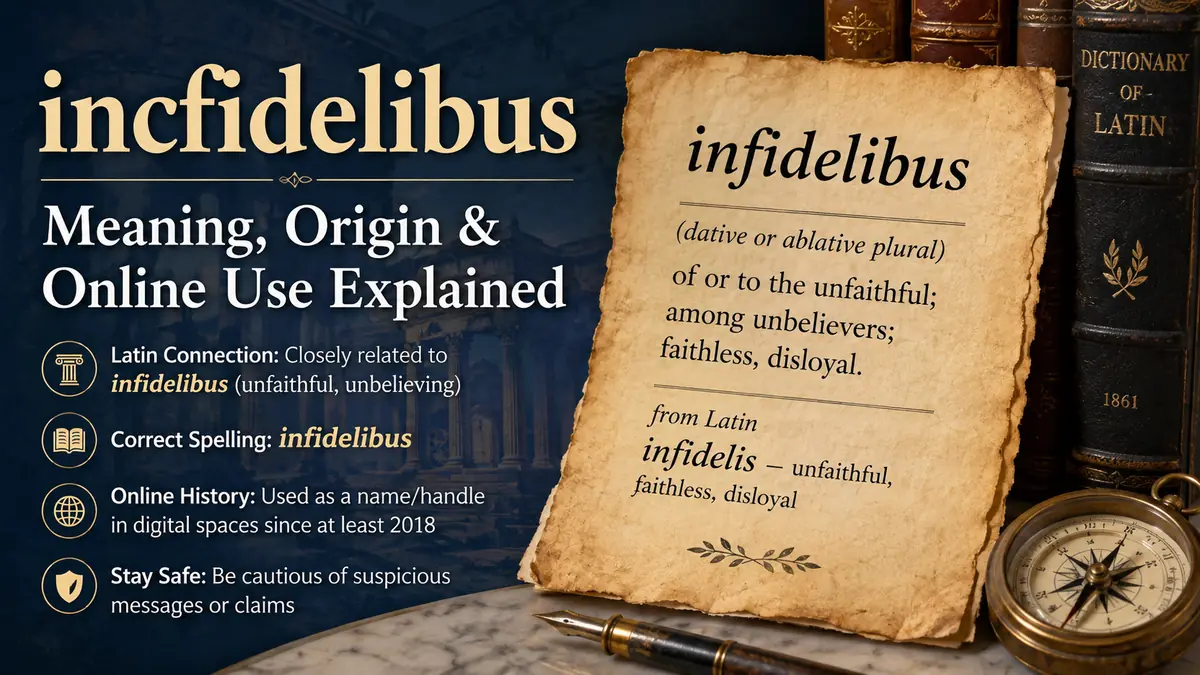
If you searched incfidelibus expecting to uncover an obscure Latin expression, the spelling itself is the first thing worth examining. It looks convincingly Latin, yet established Latin references point to a nearly identical word without the extra letter “c.”
incfidelibus is not established as a standard Latin word. The documented form is infidelibus, the dative or ablative plural of the Latin adjective infidelis, meaning unfaithful, faithless, disloyal, or—in ecclesiastical contexts—unbelieving. The unusual spelling may reflect a typo, transcription error, OCR mistake, or deliberate modern online name.
That distinction explains much of the confusion surrounding the term. There is a genuine Latin story here, but there is also a separate modern internet history that should not be mistaken for ancient usage.
What Does incfidelibus Mean?
The safest answer is that incfidelibus does not have a verified independent dictionary definition in standard Latin.
It closely resembles infidelibus, which belongs to the Latin adjective infidelis. Major Latin dictionary resources define infidelis with senses including unfaithful, faithless, unreliable, and disloyal. In ecclesiastical Latin, it can also mean unbelieving or refer to an unbeliever.
This means statements such as “incfidelibus means among the unbelievers” need qualification. That interpretation is based on the genuine word infidelibus, not evidence that incfidelibus itself has that fixed meaning.
A useful distinction is:
| Form | Status | General meaning |
|---|---|---|
| fides | Latin noun | faith, trust, confidence |
| fidelis | Latin adjective | faithful, loyal |
| infidelis | Documented Latin adjective | unfaithful, faithless, disloyal; unbelieving |
| infidelibus | Documented inflected form | dative/ablative plural of infidelis |
| incfidelibus | Non-standard/uncertain spelling | No independently established Latin definition |
The extra c changes the issue from straightforward translation to identifying where the unusual spelling came from.
Is incfidelibus a Real Latin Word?
Available linguistic evidence does not support treating incfidelibus as a standard Classical or Ecclesiastical Latin form.
The recognized adjective is infidelis. The Scaife ATLAS dictionary hosted through the Perseus ecosystem identifies infidelis as an adjective meaning “not to be trusted, unfaithful, faithless.” The Lewis and Short entry likewise documents those senses and notes the specifically ecclesiastical sense of “unbelieving” or “infidel.”
The spelling incfidelibus, however, contains an additional c between in- and fidelibus.
That letter is not part of the standard formation.
Why the Extra “c” Matters
Latin morphology is structured. You cannot normally insert a consonant into a word and assume it remains an alternative grammatical form.
The underlying formation is essentially:
in- + fidelis → infidelis
The negative prefix in- contributes the sense of “not,” while fidelis relates to faithfulness or reliability. The documented form is therefore infidelis, not “incfidelis.”
The plural case form becomes:
infidelis → infidelibus
So incfidelibus should not be presented as an alternative declension simply because it looks similar.
The Correct Latin Form: infidelibus
Understanding infidelibus resolves most questions about incfidelibus.
Infidelibus is a grammatical form of infidelis, a third-declension Latin adjective. The related adjective has masculine/feminine infidelis and neuter infidele.
The -ibus ending indicates the dative or ablative plural.
That matters because Latin relies heavily on case endings. English often communicates grammatical relationships with word order and prepositions, while Latin can encode those relationships in a word’s ending.
Consequently, there is no single English phrase that infidelibus must always mean.
Depending on the sentence, a translator might need language involving:
- to or for the unfaithful;
- with the unfaithful;
- by the unfaithful;
- among unbelieving people;
- or another context-sensitive construction.
The surrounding sentence determines the best translation.
Why “Among the Unbelievers” Is Not a Universal Translation
One common mistake in online explanations is assigning a single dramatic translation to an isolated Latin word.
Latin does not work that way.
Because infidelibus can be either dative or ablative plural, its function depends on the verb, preposition, noun, and broader construction around it. Translating it automatically as “among the unbelievers” can therefore be misleading.
For example, historical Latin contains constructions using infidelibus in different grammatical relationships. Thomas Aquinas’s works include the form in discussions contrasting fideles (believers/faithful) and infideles (unbelievers/unfaithful), demonstrating that this word family genuinely belongs to medieval theological Latin.
The historical evidence supports infidelis, infideles, and infidelibus. It does not automatically validate incfidelibus.
Where Does the Latin Root Come From?
The linguistic trail goes deeper than infidelibus.
The genuine word infidelis is formed from the negative prefix in- and fidelis. Wiktionary’s Latin etymology likewise traces infidelis to in- plus fidelis.
The larger family is associated with Latin fides, referring to ideas such as faith, trust, confidence, and reliability.
That gives us a logical semantic progression:
fides → fidelis → infidelis → infidelibus
Conceptually, it moves from faith/trust toward faithful, then unfaithful, followed by an inflected plural form required by a sentence.
This linguistic chain is far more defensible than assigning incfidelibus an independent philosophical definition.
Classical and Ecclesiastical Meanings Differ
Context also matters historically.
In Classical Latin, infidelis could describe something or someone as unreliable, untrustworthy, faithless, or disloyal. Lewis and Short provides examples from writers including Cicero, Caesar, Horace, Plautus, and Pliny.
Later Christian usage gave the word a more explicitly religious dimension.
In ecclesiastical contexts, infidelis could mean unbelieving, while related plural forms could refer to people outside the faith. Lewis and Short specifically records this ecclesiastical sense.
This historical shift is why modern translations should consider the source period.
If infidelibus appears in a Classical Roman text, “unbelievers” may be completely inappropriate. If it appears in medieval theological writing, the religious sense may be central.
Why Does incfidelibus Appear Online?
This is where the subject becomes more complicated.
The unusual spelling can now be found across websites and search results. Recent pages discussing incfidelibus generally converge on the same linguistic distinction: infidelibus is documented, while the spelling containing the extra c is not established as a normal Latin form.
Several mechanisms could explain how such a variation spreads.
1. A Simple Typographical Error
The least dramatic explanation is often the strongest.
Someone may simply have typed an additional letter. Once an unusual spelling appears on a webpage, forum, database, or document, search engines can index it.
Other writers can then copy it.
Eventually, the typo itself becomes searchable.
2. OCR Errors in Digitized Documents
Another plausible source is optical character recognition, usually shortened to OCR.
Libraries, archives, universities, and digitization projects use OCR software to convert images of printed pages into searchable text. The process is extremely useful, but imperfect.
Older documents create particular problems because of:
- faded ink;
- damaged pages;
- unusual historical typefaces;
- closely spaced characters;
- stains and page artifacts;
- poor scans;
- archaic printing conventions.
OCR software can therefore create a word that never existed in the physical source.
This does not prove that OCR created incfidelibus specifically. Without identifying the earliest occurrence and checking its original document, the exact origin cannot be established.
That distinction is important: a plausible explanation is not the same thing as documented provenance.
3. Transcription or Copying Errors
Before OCR, humans made similar mistakes.
A researcher, editor, student, archivist, or website owner copying a Latin passage could accidentally introduce another letter.
Subsequent websites might reproduce the mistake without consulting the original source.
This creates what might be called a digital copying chain: one uncertain spelling gets repeated until search results make it appear established.
4. Deliberate Modern Use
Not every unusual spelling is accidental.
People deliberately alter words for:
- usernames;
- screen names;
- website names;
- fictional characters;
- project names;
- aliases;
- branding;
- online handles.
A deliberately created name does not need to follow Latin grammar.
Therefore, somebody using incfidelibus as an identifier would not make it a genuine historical Latin word.
incfidelibus and Its Separate Online History
There is another reason people encounter this search term.
The spelling Incfidelibus has reportedly appeared online as a name or handle associated with posts advertising access to phones, email accounts, social-media accounts, or monitoring-related services. Recent investigations of indexed material report examples dating back to at least 2018.
This requires a clear distinction between documenting a claim and verifying it.
An old comment claiming that someone can access a phone does not prove that the advertised capability existed. Nor does it establish the identity of the person behind the name.
Likewise, the existence of such posts does not turn incfidelibus into a cybersecurity term.
The linguistic question and the online-name question are separate.
Is incfidelibus Malware?
No evidence establishes the word itself as malware.
A word appearing in a search result, email, comment, username, or webpage cannot compromise your device merely because you read or search for it.
Risk comes from actions such as opening malicious attachments, entering credentials on phishing pages, installing unknown software, granting remote access, or sending money to unverified people.
If you encounter incfidelibus inside a suspicious message, judge the message’s behavior, not how mysterious the word sounds.
What If You Received an Email Mentioning incfidelibus?
An unfamiliar Latin-looking name can make a threatening email seem more sophisticated than it really is.
Do not assume the sender has access to your computer simply because a strange word appears in the sender name, subject line, or message.
Instead, check for ordinary scam indicators.
Warning Signs Worth Taking Seriously
Be cautious when an unsolicited message:
- claims your device or account has already been hacked;
- demands cryptocurrency or another difficult-to-reverse payment;
- pressures you to act immediately;
- contains unexpected attachments;
- asks you to follow an unfamiliar login link;
- requests passwords, verification codes, or recovery information;
- promises unauthorized access to another person’s accounts.
Those behaviors matter much more than the presence of the term incfidelibus.
If an email claims to know one of your passwords, remember that credentials from older data breaches can be reused in extortion messages to make generic threats appear personalized.
Do not reply merely to test whether the sender is genuine.
Can Searching for incfidelibus Harm Your Device?
Simply searching for the term is not the same as installing malicious software.
The distinction is basic but useful:
| Activity | Typical risk |
|---|---|
| Typing incfidelibus into a reputable search engine | Low |
| Reading a reputable informational page | Low |
| Opening an unknown attachment | Potentially high |
| Downloading unverified software | Potentially high |
| Entering credentials on an unfamiliar website | Potentially high |
| Paying someone promising unauthorized account access | High-risk behavior |
The spelling itself has no technical power.
Treat unfamiliar websites according to normal web-safety practices rather than assuming the keyword is inherently dangerous.
Is incfidelibus an Ancient Philosophy or Religious Concept?
There is no strong evidence supporting that interpretation.
This is one of the most significant areas where online explanations can drift from documented facts.
Because incfidelibus resembles Latin and the authentic infidelis word family has religious associations, it is easy to construct philosophical interpretations involving faith, doubt, betrayal, loyalty, or unbelief.
They may sound plausible.
Plausibility, however, is not historical evidence.
A genuine ancient or medieval term should normally be supportable through materials such as:
- established Latin dictionaries;
- manuscript evidence;
- critical editions;
- inscriptions;
- historical corpora;
- identifiable primary texts.
The recognized infidelis family passes that test. For example, Latin texts by Thomas Aquinas contain infidelibus and related forms in theological discussions.
That does not demonstrate an independent doctrine called incfidelibus.
Claims that the unusual spelling represents an ancient philosophy, forgotten religious movement, or established historical concept should therefore be treated skeptically unless accompanied by primary-source evidence.
incfidelibus vs. infidelibus: The Key Differences
The entire subject becomes easier when the two spellings are placed side by side.
| Feature | incfidelibus | infidelibus |
|---|---|---|
| Standard Latin form | Not established | Yes |
| Extra “c” | Yes | No |
| Related to infidelis | Apparently/indirectly | Directly |
| Independent dictionary definition | Not established | Grammatical form of documented adjective |
| Grammatical status | Uncertain/non-standard | Dative or ablative plural |
| Historical Latin evidence | Not reliably established | Documented |
| Modern online use | Yes | Yes, mainly linguistic/historical contexts |
| Religious associations | Often inferred online | Documented in ecclesiastical usage |
| Safe to translate without context | No | No; grammatical context still matters |
The most important takeaway is that the two should not be treated as interchangeable in scholarly writing.
If you are quoting a document containing incfidelibus, preserve the original spelling when accuracy to the source matters. But if you are identifying or translating the Latin vocabulary, investigate whether the intended reading is infidelibus.
How to Verify an Unusual Latin Word Yourself
The confusion around incfidelibus offers a useful lesson for researching unfamiliar historical vocabulary.
Step 1: Search Established Dictionaries
Start with recognized lexical resources rather than modern blog posts.
For this term, authoritative dictionary evidence quickly leads to infidelis. Scaife ATLAS/Perseus and the Lewis and Short tradition document the genuine adjective and its established meanings.
Step 2: Examine the Word’s Morphology
Ask whether the prefix, stem, and ending follow normal grammatical patterns.
For infidelibus, they do.
For incfidelibus, the unexplained c creates an immediate reason for caution.
Step 3: Search Historical Corpora
Look for the exact spelling in digitized primary sources.
More importantly, distinguish between a transcription and an image of the original page.
A searchable OCR result is evidence that software produced that text. It is not necessarily proof that the printed document contains the same letters.
Step 4: Check the Sentence
Never translate an inflected Latin word entirely in isolation when grammatical precision matters.
Ablative and dative constructions can require very different English wording.
Step 5: Separate Ancient Evidence From Modern Internet Use
A username created in 2018 tells you something about modern internet history.
It tells you virtually nothing about Roman vocabulary.
Keeping those evidence categories separate prevents modern web material from being mistaken for historical documentation.
Why Search Results Can Make an Error Look Legitimate
Search engines index what exists online; they do not certify every indexed spelling as linguistically authentic.
Imagine that one webpage accidentally publishes incfidelibus.
Another writer discovers the unusual term and writes an explanation. Several websites then summarize that article. Search engines detect growing content around the phrase, while users begin searching it because they see it elsewhere.
Soon there may be dozens of pages discussing a term that began as an error.
The quantity of search results has increased, but the underlying linguistic evidence has not.
This is particularly relevant for obscure words because users often assume that repeated definitions represent independent confirmation. In reality, multiple pages may ultimately depend on the same unsupported statement.
Quick takeaway: repetition is evidence of online circulation, not necessarily evidence of historical authenticity.
Could incfidelibus Be Used as a Modern Word?
Language is flexible enough that virtually any spelling can become a modern proper name, fictional term, username, or creative expression.
Someone could deliberately use incfidelibus for a novel, artwork, online identity, or project.
That would establish a modern usage, not retroactively create a Classical Latin word.
This distinction matters in dictionaries and historical research. Lexicographers typically establish words through attested usage, while scholars determining whether something belongs to ancient Latin look for historical evidence appropriate to the claimed period.
So if a modern creator defines incfidelibus in a particular way, that definition may apply within that creator’s work. It should not automatically be presented as the word’s ancient Latin meaning.
Common Mistakes When Explaining incfidelibus
The biggest mistake is being more certain than the evidence allows.
Calling incfidelibus simply “an ancient Latin word meaning among the unbelievers” combines several unsupported assumptions.
A more accurate approach separates what is known from what is probable.
Known: infidelis is a documented Latin adjective.
Known: infidelibus is an inflected plural form associated with that adjective.
Known: meanings in this word family include unfaithful, faithless, disloyal, unreliable, and, in ecclesiastical usage, unbelieving.
Known: infidelibus and related forms occur in genuine historical Latin material, including medieval theological texts.
Not established: that incfidelibus, with the extra “c,” is a standard historical Latin word.
Possible but not conclusively proven: that the spelling originated through a typo, OCR problem, or transcription error.
That last distinction is especially valuable. Saying “probably a typo” is reasonable; claiming to know exactly when and where the typo originated requires evidence identifying its earliest source.
What Does incfidelibus Ultimately Refer To?
For most readers, incfidelibus leads to one of two subjects.
The first is linguistic. Someone sees an unfamiliar Latin-looking term and wants its translation. In that case, the key finding is that the established word is infidelibus, derived from infidelis. Its precise translation depends on grammatical and historical context.
The second is digital. Someone encounters incfidelibus as an online name, strange search term, comment, or suspicious message. In that context, its modern use needs to be investigated independently rather than explained through Latin etymology.
Those two histories can overlap in search results without being the same thing.
Final Takeaway on incfidelibus
incfidelibus looks like an obscure Latin expression, but current linguistic evidence points toward a simpler explanation: it is not established as a standard Latin form.
The genuine word to know is infidelibus, the dative or ablative plural of infidelis. Established dictionaries document infidelis with meanings involving unfaithfulness, faithlessness, unreliability, disloyalty, and—in ecclesiastical Latin—unbelief.
The additional c in incfidelibus may have resulted from a typo, transcription problem, OCR error, or intentional modern spelling, but its exact origin should not be stated as fact without primary evidence.
Its separate appearance as an online identifier also deserves caution: modern posts or suspicious messages using the name do not prove that it is malware, an ancient concept, or a legitimate service.
For historical or academic work, use the documented spelling infidelibus when that is the intended Latin form, check the surrounding sentence before translating it, and verify unusual spellings against established dictionaries and original sources.
