

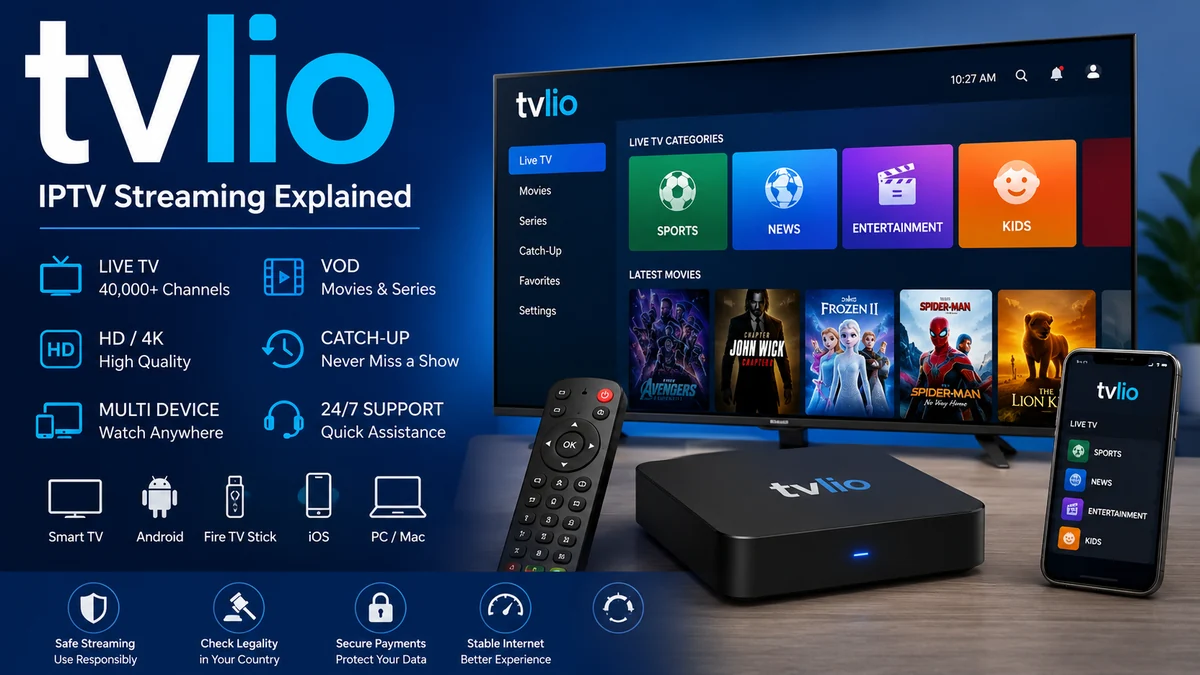
If you searched for tvlio, you probably encountered the name while looking for live television, sports, movies, or internet-based streaming. Current search results connect the term mainly with an IPTV service, although some pages use TVLIO more broadly as an unfamiliar digital or streaming-related brand.
TVLIO is currently associated with an IPTV streaming service that delivers live television and video-on-demand content through an internet connection rather than traditional cable or satellite infrastructure. Its promotional material advertises a large channel library, movies and series, HD/4K playback, catch-up features, and compatibility with common streaming devices. These claims should be independently verified before subscribing.
Understanding the technology is fairly straightforward. Deciding whether a particular IPTV provider is reliable, secure, and properly licensed requires considerably more care.
What Is tvlio?
tvlio is a brand name appearing in current search results primarily in connection with IPTV, or Internet Protocol Television. Instead of receiving television signals through a cable network, satellite dish, or terrestrial antenna, IPTV sends video through an internet connection.
The current TVLIO website describes online streaming in terms of internet-based servers, adaptive bitrate technology, progressive playback, device compatibility, and modern video codecs. It also links to areas for channels, video on demand, a store, documentation, and customer support.
Third-party descriptions of the service generally associate TVLIO with:
- Live television channels
- Sports programming
- Movies and television series
- Video on demand, usually shortened to VOD
- HD, Full HD, and 4K streaming
- Smart TV and mobile-device support
- IPTV players and login credentials
- Electronic Program Guide functionality
- Catch-up television on supported channels
Promotional figures should be treated carefully. Different pages have cited different library sizes, including claims exceeding 40,000 live channels and either 120,000 or 200,000 on-demand titles. That inconsistency is a good reason not to treat a headline catalog number as independently established fact.
The practical question is not simply how many channels are advertised. More useful questions are whether the specific channels you want actually work, whether they remain stable at peak times, whether the provider has distribution rights, and whether its billing and refund policies are transparent.
How Does tvlio IPTV Work?
IPTV works by transmitting television and video data across an IP network. In everyday terms, your television program arrives through the same general internet infrastructure that delivers websites, online videos, cloud applications, and other digital services.
The process normally involves a content source, streaming server infrastructure, a subscription or authorization system, and a compatible IPTV player on the viewer’s device.
A typical setup works like this:
- The customer receives subscription credentials from an IPTV provider.
- Those credentials are entered into a compatible player or application.
- The application connects to the provider’s server.
- Available live channels or VOD content are presented through the interface.
- Selecting a program requests the appropriate video stream.
- The video is delivered through the internet and decoded by the device.
Some IPTV systems use an M3U playlist, while others use credentials commonly described as Xtream Codes login details. A service and an IPTV player are not necessarily the same thing. An IPTV provider supplies access to streams, while a player is the software used to display them.
This distinction matters with TVLIO because public guides indicate that customers may use third-party IPTV players instead of one universal official application.
What Is Adaptive Streaming?
Streaming platforms can adjust video quality according to network conditions. This is commonly called adaptive bitrate streaming.
If the available bandwidth drops, the system may temporarily deliver a lower-quality version of the video rather than stopping playback completely. When bandwidth improves, picture quality can rise again.
TVLIO’s current website specifically discusses adaptive bitrate adjustment as part of modern online streaming technology.
That said, adaptive streaming cannot solve every performance problem. An overloaded IPTV server, poor source feed, unstable Wi-Fi network, overloaded home connection, or inefficient player can still cause interruptions.
What Content Does tvlio Claim to Offer?
Current promotional material connects tvlio with a broad collection of live and on-demand entertainment.
Live TV Channels
The service has been advertised as carrying tens of thousands of live television channels, potentially covering programming from many countries.
The attraction is obvious for users interested in international broadcasting that may be difficult to access through a conventional local cable provider.
However, a large channel count does not automatically mean a better service. IPTV lists can contain duplicate feeds, regional variants, inactive streams, temporary channels, or channels that are rarely watched.
For most viewers, 50 dependable channels they genuinely use are more valuable than an enormous directory containing thousands they never open.
Movies and Series
Video on demand allows users to choose a film or episode whenever they want rather than waiting for a scheduled broadcast.
Promotional descriptions of TVLIO mention a substantial VOD library, although different sources report different totals. Those numbers therefore should be understood as advertising claims rather than audited inventory figures.
Sports
Sports are frequently one of the strongest reasons people investigate IPTV.
Traditional broadcast rights can be divided among several networks and streaming platforms, particularly for football, boxing, basketball, motorsport, cricket, hockey, and other major competitions.
The difficulty is licensing. A provider displaying a sports channel does not automatically prove that it has permission to redistribute that channel.
Public analyses of TVLIO have noted that clear, independently verifiable broadcasting-license information is difficult to establish from available promotional material.
That distinction becomes especially important when evaluating unusually inexpensive access to a very large collection of premium sports networks.
Catch-Up TV
Catch-up functionality allows viewers to return to a program that has already been broadcast.
This feature is different from VOD. VOD usually refers to a dedicated catalog of movies or episodes, while catch-up television stores previously aired programming for a limited period.
Availability can vary by channel and provider infrastructure.
tvlio Features Explained
The features associated with TVLIO broadly resemble those found across the IPTV market.
HD, Full HD and 4K Streaming
Marketing pages mention HD, Full HD, and 4K availability. However, a device displaying a “4K” label does not guarantee that every stage of the stream is genuinely delivered at full 4K resolution and bitrate.
Actual quality depends on several factors:
Source quality: The original feed must actually be high resolution.
Encoding: Compression can dramatically affect detail even when the nominal resolution remains high.
Server capacity: Congested servers can reduce performance.
Internet bandwidth: Your connection must sustain the stream.
Player and hardware: Older devices may struggle with modern codecs or high-bitrate video.
Promotional material can tell you what a service says it supports, but real-world playback is the better test.
Electronic Program Guide
An Electronic Program Guide, or EPG, supplies television listings such as channel names, current programs, upcoming programs, and broadcast times.
A well-maintained EPG makes a large IPTV catalog considerably easier to navigate.
Multiple Connections
Some IPTV providers distinguish between the number of devices where an account can be configured and the number that may stream simultaneously.
Those are not necessarily identical.
For example, credentials might be installed on several televisions and phones while allowing only one active stream at a time.
Before relying on an IPTV subscription for a household, check the simultaneous-connection limit.
Customer Support
The current TVLIO website links to support options including a support-ticket system and messaging channels.
Having a support link is useful, but responsiveness matters more than simply displaying contact information.
For an unfamiliar service, useful tests include checking whether support answers technical questions clearly, whether billing inquiries receive consistent answers, and whether refund requirements are explained before payment.
What Devices Work With tvlio?
Public TVLIO material lists broad support for mainstream streaming hardware. Reported compatible categories include Smart TVs, Android TV, Amazon Fire TV devices, Android phones and tablets, iPhones and iPads, computers, Apple TV, and IPTV-oriented boxes.
Smart TVs
Samsung, LG, Sony, and other Smart TVs can often run IPTV player applications, although application availability differs by operating system and region.
A Smart TV setup typically involves installing an IPTV player and then adding authorized subscription credentials.
Compatibility with a Smart TV therefore may mean compatibility through another IPTV player rather than a dedicated TVLIO application.
Amazon Fire TV and Firestick
Amazon Fire TV devices are popular for internet television because they support a wide range of streaming applications.
One point deserves caution: avoid blindly installing software from unknown download locations.
Sideloading applications can bypass some of the normal screening that occurs through recognized app stores. Verify the developer and software source before granting permissions or entering account credentials.
Android Phones, Tablets and Android TV
Android supports numerous IPTV players.
The flexibility is convenient, but it also means users can encounter many similarly named applications. Check the developer, permissions, update history, and official distribution source rather than installing the first APK found through a web search.
iPhone and iPad
iOS devices can use compatible IPTV players available for Apple’s ecosystem when the subscription format is supported.
Windows and Mac
Computers may access IPTV through compatible media players or dedicated IPTV applications.
Depending on the provider, users may connect through an M3U playlist, portal configuration, or account credentials.
How Much Internet Speed Does tvlio Need?
Provider-related material currently recommends roughly 10 Mbps for HD and 25 Mbps for 4K streaming. These are service recommendations, not universal performance guarantees.
Your real requirement can be higher.
Imagine a household streaming 4K IPTV while another television plays Netflix, two phones watch short videos, and a laptop downloads a large game update. The available bandwidth is shared among every active device.
Streaming reliability also depends on latency, packet loss, Wi-Fi congestion, router quality, and server stability.
A stable 50 Mbps wired connection can sometimes produce a better experience than a nominally faster Wi-Fi connection suffering from interference.
Wi-Fi vs. Ethernet
For a fixed television or IPTV box, wired Ethernet is generally the more predictable connection.
Wi-Fi is convenient but susceptible to:
- Distance from the router
- Thick walls
- Interference
- Crowded wireless channels
- Older Wi-Fi standards
- Simultaneous connected devices
If buffering appears mainly during peak household usage, test an Ethernet connection before assuming the IPTV provider is entirely responsible.
Why Does IPTV Buffer?
“No buffering” is a common streaming marketing phrase, but no internet video provider can realistically control every factor between its server and the viewer’s screen.
Buffering can originate at several points.
A provider’s server may be overloaded. The upstream source may be unstable. An ISP route may be congested. Your router may be struggling. Wi-Fi interference may be reducing throughput. The IPTV player may have an insufficient cache or software problem.
When IPTV buffers, test methodically rather than repeatedly reinstalling applications.
First check another streaming service. If every service struggles, the local connection is probably involved.
Next run the same IPTV stream over Ethernet where possible. Then test a different channel. If one channel fails while others work normally, the individual feed may be the problem.
This kind of troubleshooting tells you much more than a headline uptime percentage.
Is tvlio Safe?
There is not enough independently verified public evidence to give tvlio an unconditional safety endorsement.
Automated reputation services have produced mixed assessments. Gridinsoft previously reported a 58/100 trust score for tvlio.net, while ScamAdviser has identified positive technical signals such as a valid SSL certificate but also highlighted factors including the domain’s relatively young age and limited traffic history.
These scores should not be overinterpreted.
A low automated score does not prove that a website is fraudulent. Likewise, an HTTPS certificate does not prove that a business is trustworthy. HTTPS mainly protects data in transit between the browser and website.
The strongest approach is to evaluate several trust signals together.
Check the Domain Carefully
Make sure you are visiting the exact intended domain.
Unfamiliar streaming brands can attract imitation websites, typo domains, fake payment pages, and misleading download links.
Look for Business Transparency
A trustworthy subscription provider should ideally make it reasonably easy to determine who operates the service.
Useful information includes a legal business name, jurisdiction, contact details, terms of service, privacy policy, refund policy, and customer-support process.
Review Payment Terms
Before entering payment information, confirm:
- Exact price and currency
- Subscription duration
- Whether renewal is automatic
- Cancellation procedure
- Refund window
- Accepted payment method
- Name appearing on the transaction
Save the terms that were displayed at the time of purchase because websites can change.
Be Careful With Downloads
Unknown streaming software deserves particular caution.
Government guidance on piracy warns that unauthorized streaming websites and applications can expose users to malware, fraud, and data-theft risks, particularly when payment data is provided to unregulated services.
Use recognized app stores where possible and avoid disabling device-security protections merely because an installation guide tells you to do so.
Is tvlio Legal?
This is the most important distinction in any IPTV discussion:
IPTV technology is legal. Unauthorized distribution of copyrighted content is not.
Major legitimate broadcasters and streaming platforms use internet protocols every day. Nothing about transmitting television over an IP network is inherently unlawful.
The legal question is whether the provider has permission to distribute the channels, films, television programs, and sporting events it makes available.
UK Intellectual Property Office guidance makes the distinction clearly: streaming devices themselves can be legal when used for legitimate content, but using them to obtain protected television, films, or subscription sports without authorization constitutes illicit streaming.
Enforcement against unauthorized IPTV continues. On August 20, 2026, the UK’s Crown Prosecution Service reported the sentencing of a man who had sold illegal streaming subscriptions providing unauthorized access to premium television, sport, and films.
That does not establish anything by itself about TVLIO’s licensing status. It demonstrates why the underlying distribution rights matter.
Public analyses of TVLIO have raised questions about the availability of independently verifiable licensing information.
So instead of asking only, “Is IPTV legal?” ask:
Does this particular provider have the rights to distribute this particular content in my country?
That is the more meaningful question.
Does a VPN Make IPTV Legal?
No.
A VPN can encrypt internet traffic between your device and the VPN server and may change the IP address visible to websites or streaming infrastructure.
It does not create broadcasting rights.
If content is being distributed without the necessary authorization, changing the network route through a VPN does not transform that distribution into licensed streaming.
A VPN is a privacy and networking technology, not a copyright license.
How to Evaluate tvlio Before Using It
A careful evaluation is more useful than relying on one glowing review or one automated scam score.
Start with the service’s current website and compare its claims with independent information.
Check the exact channels you actually care about rather than focusing on an enormous advertised total. Determine whether those channels are available in the correct language and regional version.
Then examine the technical side. Confirm which IPTV player is required, whether installation uses an official app store, what internet speed is recommended, and how many simultaneous connections the plan allows.
Pay particular attention to legal and business transparency. Look for an identifiable operator, meaningful contact information, licensing information, privacy terms, billing rules, cancellation requirements, and refund conditions.
Finally, compare multiple current sources. Search results can lag behind website changes, and IPTV brands can alter domains, packages, pricing, or infrastructure rapidly.
Quick takeaway: Treat channel totals, “zero buffering,” uptime percentages, instant activation, and 4K availability as provider claims until your own testing or trustworthy independent evidence confirms them.
tvlio vs. Licensed Streaming Services
The biggest conceptual difference is usually not technology. Both IPTV providers and established streaming services use the internet.
The difference is transparency around content rights and business operations.
| Area | Unverified IPTV Provider | Established Licensed Service |
|---|---|---|
| Delivery | Internet | Internet |
| Live TV | Often available | Often available |
| VOD | Often available | Usually available |
| Channel count | Can be extremely large | Usually more limited |
| Content rights | Must be independently checked | Generally publicly established |
| Company identity | May be limited | Usually transparent |
| App distribution | May rely on third-party players | Usually official app stores |
| Pricing | Often comparatively low | Usually higher |
| Long-term stability | Can be uncertain | Generally more predictable |
| Consumer recourse | Varies considerably | Usually clearer |
Licensed alternatives differ by country, but examples in the United States include services such as YouTube TV, Hulu + Live TV, Sling TV, and Philo.
Their catalogs may look modest beside IPTV marketing that claims tens of thousands of channels. The trade-off is that established providers generally have clearer carriage agreements, corporate ownership, billing procedures, and consumer-support structures.
What Does tvlio Mean?
Some searchers are not looking specifically for IPTV. They simply want to know what the word tvlio means.
There does not appear to be a standard dictionary definition for the term. Several current search results describe it as a coined digital or brand-style name rather than an established English word.
Its first two letters naturally resemble “TV,” which helps explain its association with television and streaming, but that alone is not evidence of an official etymology.
In current search results, the IPTV interpretation is substantially more useful than attempting to invent a linguistic meaning for the name.
Common Questions About tvlio
Does tvlio have an official app?
Available guides suggest users may access the service through compatible third-party IPTV players rather than relying on one universal TVLIO application. The exact setup can depend on the device and credentials supplied.
Can tvlio work on a Smart TV?
Promotional information lists Smart TVs among supported platforms. Installation may require a compatible IPTV player rather than a dedicated application.
Can tvlio stream 4K?
The service is advertised with 4K support, but actual resolution and picture quality depend on the original feed, encoding, network bandwidth, server capacity, player, and hardware.
Is tvlio the same as cable TV?
No. Cable television uses a cable provider’s distribution infrastructure, while IPTV sends video through an internet protocol network.
The viewer experience may look similar—open a guide, choose a channel, watch television—but the delivery architecture is different.
Does a huge channel list mean every channel works?
Not necessarily.
Channel directories can contain inactive feeds, duplicates, temporary sources, regional versions, and streams with different reliability levels. Test the channels important to you rather than judging a service exclusively by its advertised catalog size.
Why can IPTV quality change during a program?
Streaming quality can change because of adaptive bitrate technology, network congestion, source-feed problems, server load, or local Wi-Fi conditions.
A resolution label alone cannot guarantee consistent bitrate or picture quality.
Final Take on tvlio
tvlio is currently associated primarily with IPTV streaming: live television, sports, movies, series, and video-on-demand delivered through an internet connection. The technology behind IPTV is well established, and TVLIO-related material advertises broad device compatibility, HD and 4K playback, a large content catalog, and conventional IPTV functionality.
The less certain areas are the ones readers should examine most carefully. Advertised catalog totals vary between sources, third-party reputation assessments are mixed, and publicly verifiable information about content licensing is limited.
For anyone researching tvlio, the sensible next step is therefore verification rather than assumption: confirm the exact website, examine the current policies, check application sources and payment terms, verify the channels you need, and determine whether the content is properly licensed for your location before using a subscription.
