

Trying to understand the magazineluiza com br email format can be confusing because search results often present different naming conventions as though each were an official company rule.
The distinction that matters is simple: Magazine Luiza clearly uses the @magazineluiza.com.br corporate domain for multiple publicly documented addresses, while employee naming patterns reported by third-party databases are estimates rather than a universal format officially published by the company.
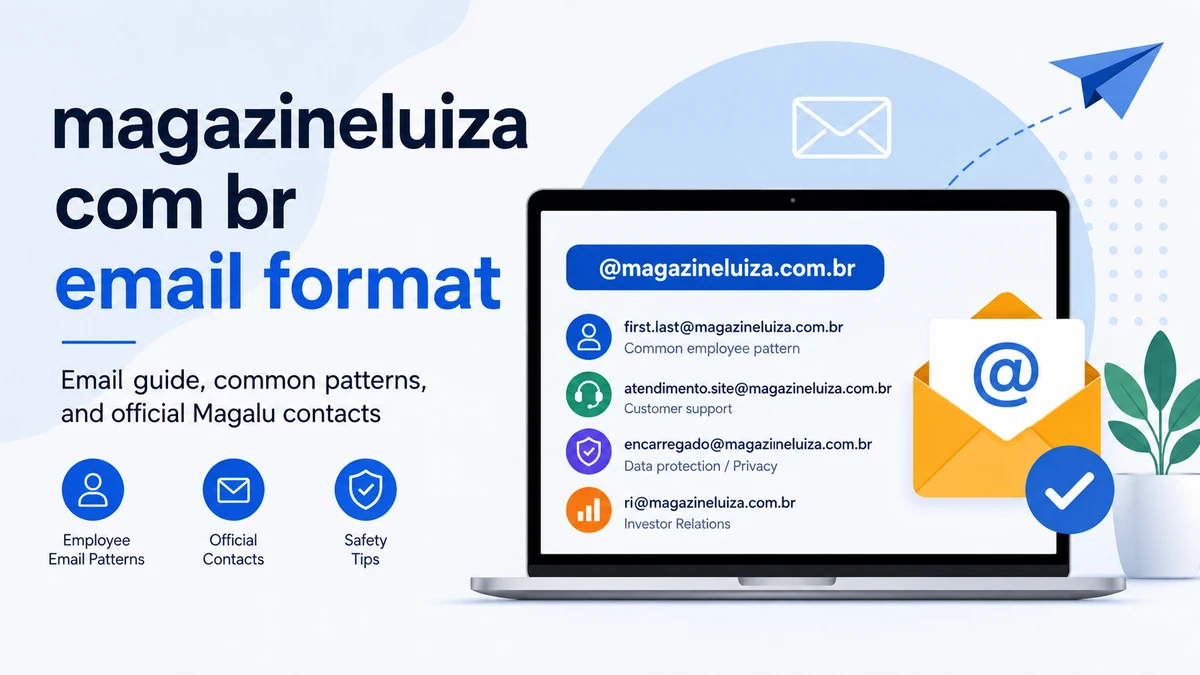
Quick answer: The most commonly reported Magazine Luiza employee email structure is first.last@magazineluiza.com.br. However, this is a third-party-observed pattern, not a guaranteed rule for every employee. Magazine Luiza also publishes functional addresses for customer service, privacy, Investor Relations, and other specific purposes.
What Does magazineluiza com br email format Mean?
The phrase magazineluiza com br email format generally refers to the way email addresses associated with Magazine Luiza are structured.
Every standard email address contains two basic components:
local-part@domain
For a corporate address, the domain identifies the organization controlling the mailbox. Magazine Luiza publicly uses:
@magazineluiza.com.br
The text before the @ may identify an employee, department, business function, or specialized contact channel.
For example, Magazine Luiza’s official resources publish addresses including:
| Purpose | Publicly documented address |
|---|---|
| Customer support | atendimento.site@magazineluiza.com.br |
| Data protection/privacy | encarregado@magazineluiza.com.br |
| Investor Relations | ri@magazineluiza.com.br |
Magazine Luiza’s support documentation currently lists both the customer-service and data-protection addresses, while its privacy policy identifies encarregado@magazineluiza.com.br as a channel for personal-data matters. Historical Investor Relations materials consistently publish ri@magazineluiza.com.br.
These examples immediately reveal something that many email-format pages overlook: not every Magazine Luiza address is constructed from an employee’s first and last name.
What Is the Most Common magazineluiza com br email format?
For individual employee mailboxes, several business-email databases identify the following as the leading pattern:
First name + period + last name + corporate domain
In generic form:
first.last@magazineluiza.com.br
Imagine a fictional employee named Ana Silva. Under this convention, the resulting example would be:
ana.silva@magazineluiza.com.br
That address is purely an illustration—it should not be interpreted as the verified email address of a real Magazine Luiza employee.
Third-party sources generally agree that first.last is a prominent or dominant pattern, but they disagree substantially on how frequently it occurs. Mailmo, for example, reports {first}.{last} as the most common structure in its dataset, while ContactOut also identifies it as the most widely used format but assigns it a considerably different percentage.
That disagreement is worth paying attention to.
Why Do Email-Format Websites Report Different Percentages?
Email-pattern databases don’t have access to a single public, authoritative directory containing every Magazine Luiza employee mailbox.
Instead, providers may build datasets from different combinations of:
- publicly indexed business information;
- historical records;
- voluntarily supplied information;
- proprietary databases;
- previously observed addresses;
- email-verification systems;
- different sample sizes.
Consequently, one database may report a very high share for first.last, while another finds the same format dominant but at a much lower percentage.
For example, Mailmo reports {first}.{last} at more than 90% of its observed Magazine Luiza addresses, whereas ContactOut reports 42.86% for the same basic pattern.
Those percentages cannot both represent an authoritative company-wide allocation.
The safer conclusion is therefore:
first.last@magazineluiza.com.bris a commonly reported employee pattern, but its exact company-wide usage percentage is not publicly established by Magazine Luiza.
That distinction prevents an estimated email convention from being mistaken for an official rule.
Other Magazine Luiza Email Patterns You May Encounter
The first.last structure isn’t the only convention reported for the domain.
Third-party datasets identify variations such as:
| Pattern | Fictional example | What it means |
first.last | ana.silva@magazineluiza.com.br | First and surname separated by a dot |
firstlast | anasilva@magazineluiza.com.br | First and surname joined |
first | ana@magazineluiza.com.br | First name only |
flast | asilva@magazineluiza.com.br | First initial followed by surname |
last | silva@magazineluiza.com.br | Surname only |
Again, these are structural illustrations—not verified addresses belonging to specific employees.
Mailmo’s dataset, for instance, reports first-name-only, first-initial-plus-surname, surname-only, and joined first-and-last-name alternatives in addition to its dominant dotted format. ContactOut similarly records several variations.
Why Would a Company Need Multiple Formats?
Magazine Luiza was founded in 1957 and has developed into a large Brazilian retail organization. Its long corporate history makes the existence of different mailbox structures unsurprising.
Large organizations can end up with variations because of:
- employees who share identical names;
- legacy accounts created under older IT policies;
- departmental rather than personal mailboxes;
- shortened usernames;
- organizational changes;
- specialized business units;
- technical account requirements.
Consider two fictional employees both named Ana Silva. A company cannot normally assign the exact same mailbox to both people, so an alternative local part may be required.
This is one reason a naming pattern should be treated as a probability, not proof that a particular mailbox exists.
Official Magazine Luiza Emails vs. Predicted Employee Emails
This is the most useful distinction to understand when researching the magazineluiza com br email format.
An officially published email appears on a Magazine Luiza-controlled resource or corporate document.
A predicted employee email is constructed from someone’s name using an observed naming convention.
They are not equivalent.
Official Email Address
Suppose Magazine Luiza publishes:
encarregado@magazineluiza.com.br
on its privacy policy.
You have direct first-party evidence that this mailbox is an official contact channel. Magazine Luiza’s current privacy materials do exactly that and identify the address as the email for its data-protection contact.
Predicted Email Address
Now suppose someone knows an employee’s name and creates:
firstname.lastname@magazineluiza.com.br
based on the dominant pattern reported by an email database.
The structure may be plausible, but the individual address remains unconfirmed.
That difference should determine how much confidence you place in an address.
Official Magazine Luiza Customer Service Email
People searching for an email format are sometimes simply trying to contact Magalu rather than locate an individual employee.
In that situation, guessing an employee mailbox is unnecessary.
Magazine Luiza’s official Security and Privacy portal publishes the customer-support email:
atendimento.site@magazineluiza.com.br
It also lists the SAC telephone number 0800 310 0002.
The company repeats the customer-service email in other first-party resources, including guidance about modifying or deleting customer registration information.
If your question concerns a purchase, account, order, or general customer issue, an official support channel is considerably more reliable than trying possible employee naming combinations.
Magazine Luiza Privacy and Personal-Data Email
Privacy inquiries have their own dedicated channel.
Magazine Luiza’s privacy policy identifies:
encarregado@magazineluiza.com.br
as the email address for its Data Protection Officer/contact responsible for personal-data matters. The policy references Brazil’s Lei Geral de Proteção de Dados (LGPD) and describes the company’s handling of personal information and data-subject requests.
Magazine Luiza’s Privacy Portal also identifies Cecilia Pinto Homsy Pacheco as its data-protection contact and displays the same mailbox.
This channel is more appropriate for matters involving personal-data rights than a general customer-service or predicted employee address.
Magazine Luiza Investor Relations Email
Magazine Luiza has also historically published a dedicated Investor Relations mailbox:
ri@magazineluiza.com.br
Corporate Investor Relations documents have repeatedly associated this address with the company’s IR function.
Notice how this structure differs completely from first.last.
ri represents a function rather than an employee’s name.
This is another reason there is no single magazineluiza com br email format that accurately describes every mailbox on the domain.
A more accurate model is:
Employee addresses → potentially name-based
Department addresses → function-based
Customer contacts → purpose-based
How to Check Whether a Magazine Luiza Email Is Genuine
Finding an address that ends in @magazineluiza.com.br is useful evidence, but the visible domain alone should never be your entire security check.
Email sender information can be manipulated, and phishing messages often imitate legitimate companies.
Magazine Luiza itself warns customers about suspicious emails and messages containing urgent language, grammatical errors, questionable links, or promotions that differ from those displayed through official channels. The company recommends navigating directly to its site or app rather than opening suspicious links.
A sensible verification process is:
- Inspect the complete sender address.
Don’t rely on the display name. A message labeled “Magazine Luiza” can still originate from an unrelated domain. - Check the domain carefully.
Look for spelling substitutions, added characters, unexpected subdomains, or visually similar letters. - Consider what the message asks you to do.
Unexpected requests involving passwords, financial details, authentication codes, or immediate payments deserve additional scrutiny. - Avoid opening questionable links or attachments.
Navigate independently to the company’s official service rather than using an unexpected email link. - Confirm unusual requests through an official channel.
Contact Magazine Luiza independently if a message involves sensitive information or an unexpected transaction.
Magazine Luiza specifically states that Grupo Magalu does not request passwords or personal and financial data through telephone calls, SMS, WhatsApp, email, or social networks.
A Familiar-Looking Domain Is Not Enough
Even when an email looks convincing, context matters.
A fraudulent message can imitate:
- branding;
- logos;
- employee signatures;
- order notifications;
- promotional layouts;
- customer-service language.
The safest question isn’t simply, “Does this look like Magalu?”
It is:
Can I independently confirm this communication through a company-controlled channel?
That approach is far more dependable.
How to Interpret an Employee Email Pattern Correctly
If your purpose is research rather than customer support, think of email patterns as templates.
Suppose an observed format is:
{first}.{last}@magazineluiza.com.br
The placeholders mean:
{first}= given name;.= separator;{last}= family name;@magazineluiza.com.br= corporate domain.
The format tells you how a hypothetical mailbox could be structured.
It does not establish that the mailbox exists.
This matters especially with Portuguese and Brazilian names, which can contain multiple surnames. A person may publicly use a shortened name while an internal corporate system uses another component of their legal or professional name.
Accents and special characters can also be normalized differently by corporate email systems.
Trying to infer those internal rules from someone’s public name creates another layer of uncertainty.
Can You Determine an Employee’s Email From Their Name?
Sometimes a likely format can be inferred, but a person’s name alone does not verify an email address.
This is where many explanations of the magazineluiza com br email format go too far.
A naming convention can suggest possibilities. It cannot establish ownership of a specific mailbox.
For informational research, keep three confidence levels separate:
Confirmed
The complete address is published by Magazine Luiza through an official page, policy, filing, corporate document, or another authoritative source.
Observed Pattern
Independent datasets contain enough examples to identify a frequently occurring structure such as first.last.
Predicted
A new address has been generated by applying that structure to someone’s name.
Only the first category provides strong direct evidence about the complete address.
What Does the @magazineluiza.com.br Domain Tell You?
The corporate domain is much better established than any universal employee naming convention.
Current first-party Magazine Luiza resources publish multiple addresses ending in @magazineluiza.com.br, including customer-support and privacy contacts. Investor Relations documents have also used the same domain.
So when analyzing an address, separate the two questions:
Question 1: Does Magazine Luiza use @magazineluiza.com.br?
Yes, first-party evidence confirms that it does.
Question 2: Does every employee use first.last@magazineluiza.com.br?
There is no comparable first-party evidence establishing that as a universal rule.
This distinction resolves much of the conflicting information found in search results.
Common Mistakes When Researching Magazine Luiza Emails
The first mistake is treating a database percentage as an official statistic.
A provider may say that 90% of addresses follow one format while another reports a dramatically different percentage. These figures describe each provider’s dataset, not necessarily Magazine Luiza’s entire email infrastructure.
The second mistake is assuming every corporate address belongs to an individual.
Addresses such as ri@..., encarregado@..., and atendimento.site@... demonstrate the importance of functional mailboxes.
The third is confusing a plausible address with a verified one.
Even when you have the correct naming convention, duplicated names, legacy accounts, alternative surnames, or internal naming policies can produce a different mailbox.
Finally, don’t use an email’s appearance as your only fraud test. Independently verify sensitive communications through official channels.
Quick Reference: magazineluiza com br email format
Here is the practical picture based on current public information:
| Question | Answer |
| Corporate domain | @magazineluiza.com.br |
| Commonly reported employee pattern | first.last@magazineluiza.com.br |
| Is that employee pattern guaranteed? | No |
| Customer-service email | atendimento.site@magazineluiza.com.br |
| Privacy/data-protection email | encarregado@magazineluiza.com.br |
| Investor Relations email | ri@magazineluiza.com.br |
| Are database percentages official? | No |
| Should a generated employee address be treated as verified? | No |
| Best source for contact information | Magazine Luiza’s first-party pages and corporate materials |
The official customer-service and privacy addresses are currently documented on Magazine Luiza-controlled pages, while the Investor Relations address appears in the company’s corporate IR materials.
Final Takeaway
The magazineluiza com br email format is best understood as a confirmed corporate domain combined with several possible mailbox structures.
Third-party business-email databases commonly identify first.last@magazineluiza.com.br as an important employee naming pattern, but their reported usage percentages vary considerably. That means the pattern is useful for understanding the company’s apparent email structure, not for proving that a particular employee address exists.
For actual communication, use the purpose-specific addresses Magazine Luiza publishes whenever one fits your needs. For customer service, privacy, and Investor Relations, first-party resources provide established contact points without requiring you to guess an individual’s mailbox.
And if you’re checking whether an unexpected Magalu email is legitimate, don’t rely on the sender name or domain appearance alone. Inspect the complete message, avoid suspicious links, and independently verify sensitive requests through Magazine Luiza’s official channels.
