

Say one wrong word in a Bangkok market and nobody blinks. Get it slightly off in a Lao village, and you might just get a smile of surprise — because so few visitors bother to learn the local greetings at all. That’s exactly why they matter so much.
Sabaidee (ສະບາຍດີ) is the essential Lao greetings, used for hello, good day, and even goodbye. It literally means “to be well,” and pairing it with the nop — hands together, slight bow — instantly signals respect. Add time-of-day variants, a thank-you, and you’re set for most everyday encounters in Laos.
What Does “Sabaidee” Actually Mean?
Sabaidee breaks down into two ideas: sabai, meaning comfortable or well, and dee, meaning good. Put together, it’s less “hi” and more “are you well, and I hope so.” That’s a small but real difference from a Western greeting, and it explains why Lao people tend to say it with genuine warmth rather than as a throwaway word.
Pronunciation is forgiving for beginners: “sa-bai-dee,” with even stress on each syllable. Lao is a tonal language — six tones, to be exact — but this particular phrase doesn’t hinge on nailing them perfectly. Locals hear the effort long before they judge the accent.
You’ll also come across sabaidee bor (ສະບາຍດີບໍ), which adds a question particle and functions as “how are you?” The expected reply is simply “sabaidee” back, or “khoy sabaidee” (“I’m well”).
Quick takeaway: Sabaidee works in nearly every situation — meeting a stranger, greeting a friend, walking into a shop. When in doubt, use it.
The Nop — Lao’s Greeting Gesture
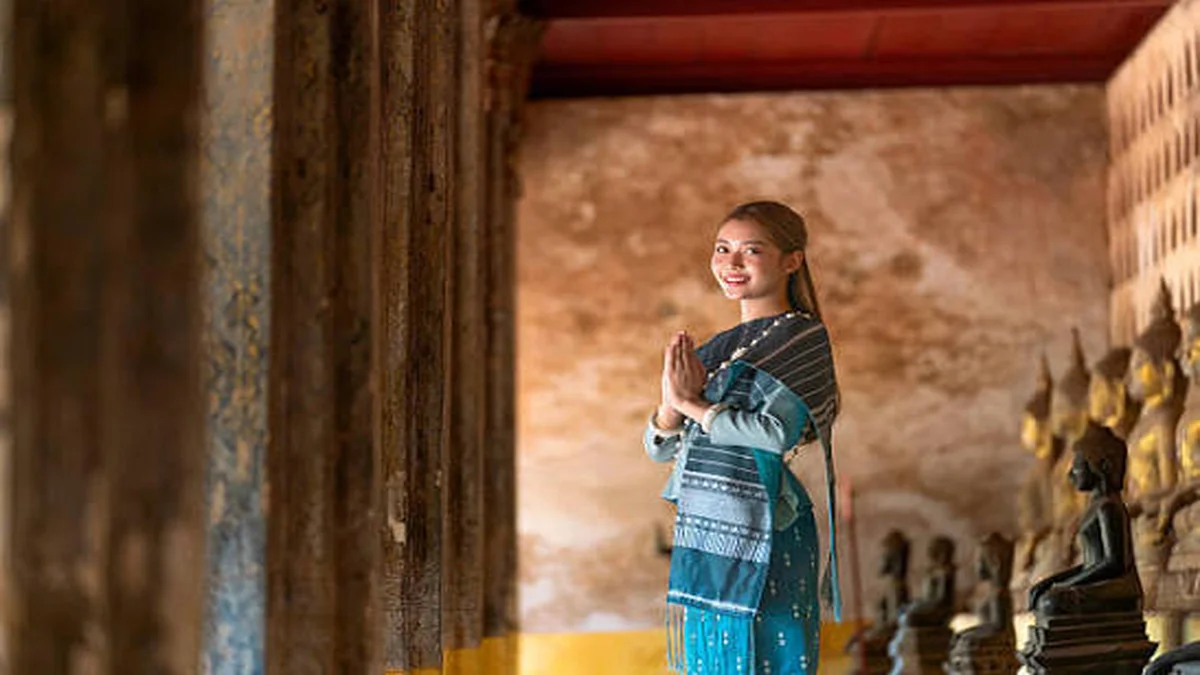
Words are only half the greeting. The nop — palms pressed together at chest height with a slight bow of the head — carries as much meaning as anything you say. It looks similar to the Thai wai, and travelers who’ve spent time in Thailand will recognize the shape immediately, even though the two customs aren’t identical in when and how they’re used.
Hand placement isn’t random. It signals the level of respect being offered:
| Hand Position | Typical Use |
|---|---|
| Under the chin | Greeting someone younger or of equal status |
| Chest level | Standard greeting between adults |
| Just below the nose | Addressing monks or people of high status |
| Touching the forehead | Rare, reserved for the most formal or reverent occasions |
You don’t need to memorize this like a script. In practice, chest level covers almost every everyday interaction, and nobody expects a foreigner to get the hierarchy exactly right on day one.
Saying “How Are You” and Greeting by Time of Day
Sabaidee alone works around the clock, so you never strictly need a time-specific version. But adding one shows a bit of extra effort, and Lao speakers notice:
- Sabaidee ton sao (ສະບາຍດີຕອນເຊົ້າ) — good morning
- Sabaidee ton suay / ton klang wan — good afternoon
- Sabaidee ton laeng (ສະບາຍດີຕອນແລງ) — good evening
To ask how someone’s doing, use jao sabaidee bor? (“are you well?”). It’s common enough to double as small talk, similar to how English speakers ask “how’s it going?” without expecting a detailed answer.
Two more casual openers are worth knowing, especially outside the capital: kin khao leo bor (“have you eaten yet?”) and pai sai maa (“where are you coming from?”). Neither is meant literally — they’re conversational icebreakers, much like “how’s your day been?” in English. If someone asks whether you’ve eaten, a simple “gin leo” (already eaten) or “baw gin” (not yet) is a perfectly normal answer.
Thank You, Goodbye, and Other Everyday Lao Phrases
Once sabaidee is second nature, a handful of follow-up phrases round out most daily interactions:
| English | Lao (romanized) |
|---|---|
| Thank you | Khop chai / Khawp jai |
| Thank you very much | Khop chai lai lai |
| Please | (add) duai |
| Excuse me / sorry | Kho thot |
| Goodbye | La kon / Sok dee |
| Good luck (also used as a farewell) | Sok dee |
“Khop chai” is one of the most-searched Lao phrases after sabaidee itself, and for good reason — it’s used constantly, from markets to guesthouses. Tacking on “lai” (very much) turns a polite thank-you into a warmer, more sincere one.
Quick takeaway: If you only learn three words for a trip to Laos, make them sabaidee, khop chai, and sok dee.
Greeting Elders, Monks, and People of Higher Status
Age and status shape Lao social interaction more than most Western visitors expect. When greeting someone clearly older, a monk, or a person in a position of authority, raise the hand position slightly and deepen the bow — this is where the nop’s hierarchy actually matters.
There’s also a real chance a much older person won’t return your greeting verbally at all. A nod or a small smile is a normal, respectful response from someone senior greeted by someone younger — it isn’t rudeness, it’s etiquette working the other direction. Titles matter too: adding “thaan” before someone’s name is a mark of respect for people of high status, similar to using “Mr.” or “Madam” formally in English.
Monks are a special case. Physical contact, including handshakes, is generally avoided, and the nop is placed higher — closer to the nose — as a mark of reverence.
Common Mistakes (and How Lao Greetings Differ from Thai)
A few things trip up first-timers:
- Overcomplicating it. Sabaidee alone genuinely covers 90% of situations. You don’t need to memorize every time-of-day variant before your first conversation.
- Skipping the gesture. Saying sabaidee without any nop can come across as a little flat, especially with older people.
- Assuming Lao and Thai greetings are interchangeable. They sound related — sabaidee and the Thai sawasdee share linguistic roots and a similar gesture — but they’re not the same word, and using Thai in Laos (or vice versa) can come across as not having bothered to learn the local version.
- Forgetting the reply. If someone greets you with sabaidee, the polite move is always to say it back, not to launch straight into a question.
None of these are serious missteps. Lao culture is famously forgiving of visitors who are clearly trying, and a warm sabaidee with a rough nop will earn far more goodwill than perfect grammar delivered coldly.
Conclusion
Lao greetings aren’t complicated, but they carry more weight than a simple “hi.” Sabaidee, the nop, and a genuine khop chai will carry you through almost any everyday interaction in Laos, and layering in the time-of-day variants or respect gestures for elders shows a level of effort that locals consistently notice and appreciate. Start with sabaidee today — say it out loud a few times, practice the gesture in a mirror if it helps, and use it on your very next interaction with a Lao speaker.
LOOKING FOR MORE LANGUAGE GUIDES? CHECK OUT LORETRANS’S TRANSLATOR FOR THE FULL LIBRARY.
FAQ Section
What does “sabaidee” mean in Lao?
Sabaidee means “to be well” or “to be comfortable,” and functions as hello, good day, or even goodbye depending on context. It’s the single most useful word in the Lao language for greetings.
How do you respond when someone says sabaidee to you?
Simply say “sabaidee” back. If they ask “sabaidee bor?” (are you well?), you can reply “khoy sabaidee” (I’m well).
What is the nop gesture?
The nop is a greeting gesture where the palms are pressed together at chest height with a slight bow, similar to the Thai wai. Hand position rises for people of higher status or age.
Is sabaidee formal or informal?
Sabaidee works in both formal and informal settings, which is part of what makes it so useful. Formality is expressed more through the nop’s hand position and tone than through word choice.
How do you say thank you in Lao?
“Khop chai” (or “khawp jai”) means thank you. Add “lai” at the end for “thank you very much.”
Do Lao people shake hands?
Handshakes happen in informal or business settings, typically between men, but the nop remains the traditional and most widely used greeting gesture.
What’s the difference between Lao and Thai greetings?
Lao’s “sabaidee” and Thai’s “sawasdee” share linguistic roots and a similar hand gesture, but they’re distinct words from distinct (if related) languages — using one in the other country can come across as not having learned the local version.
How do you say goodbye in Lao?
“La kon” or “sok dee” (literally “good luck”) are both commonly used to say goodbye.
